# Genspark Help Center
> Guides and answers for every Genspark feature, from Super Agent and AI Slides to membership plans, credits, and account help.
Every Genspark Help Center article as Markdown, in the order of the index at https://www.genspark.ai/llms.txt. Each article starts with its title, then the URL of its HTML page; that page is also served in 18 other languages at https://www.genspark.ai/{locale}/helpcenter/{slug}.
# Super Agent {#super-agent data-doc-group=ai-team}
Source: https://www.genspark.ai/helpcenter/super-agent
## What is Genspark Super Agent? {#what-is-super-agent data-section-type=overview}
Super Agent is Genspark's autonomous AI assistant that thinks, plans, and acts to complete your everyday tasks.
### More than a chatbot {#more-than-a-chatbot}
Instead of just answering questions, Super Agent breaks your request into steps, chooses the right tools, and carries the work through to a finished result — research, content, analysis, design, coding, communication, and more.
### Works with the apps and tools you already use {#works-with-your-apps-and-tools}
Super Agent connects to your everyday apps and data so it can act with real context — pulling from your files, your connected accounts, and your SecondBrain to complete tasks the way you would.
## What's New? {#whats-new data-section-type=changelog}
The new Super Agent is a major step up: stronger, faster, and sharper than ever, it now takes on the kind of work you'd normally hand to a whole team of experts.
### Turn any workflow into a skill {#turning-workflows-into-skills}
Teach Super Agent a workflow once, and it's saved as a skill. Run it anytime, and share it with your whole team.
How to save a Skill: Just tell Super Agent directly — for example, "Save this workflow as a skill" — and the agent handles the rest.
Once saved, your Skill is ready to use in any future conversation. Explore the official skills library or learn more in our Help Center.
Here are two sample projects — click to explore each one:
- [How to create a skill](https://www.genspark.ai/agents?id=7720b50b-43bc-432e-97c5-462c20012185)
- [How to use a skill](https://www.genspark.ai/agents?id=cb2d5181-4d1c-440c-af01-175e11a957ff)
### Built for Complex Work {#built-for-complex-work}
The new Super Agent handles long, multi-step tasks more reliably:
- Sharper on long-running tasks. It reasons through every step without losing the thread. Start it, close your laptop, and come back to finished work.
- Work in parallel. Run several tasks at once in a single project, and let each one build on the others' results.
- Bigger files. Up to 500 MB on the free plan and 1 GB each on paid plans — or pull them straight from Google Drive, AI Drive, and more.
## Classic Super Agent vs. the New Super Agent {#classic-vs-new data-section-type=changelog}
| | Classic Super Agent | New Super Agent |
|---|---|---|
| Environment | No dedicated cloud machine | Dedicated sandbox environment: real browser, own filesystem, and powerful execution |
| Reusability | Re-describe each task | Save any workflow as a reusable skill |
| Long tasks | Handles multi-step tasks primarily in sequence. | Sharper and more reliable, checks own output and build on earlier progress |
## How to Use Super Agent {#how-to-use data-section-type=feature}
Navigate to the Genspark homepage and enter your prompt in the central chat box, or select Super Agent from the "New" menu in the sidebar.
What to ask: Describe any task — research, content, data analysis, design, coding, communication, and more. Super Agent coordinates the right agents and tools automatically.
### Try these examples {#try-these-examples}
**Read more context**
- Give me a weekly recap from this week's meeting notes — wins, decisions, blockers, next steps.
- Use my last product launch deck as a template and create a new one for the November feature release.
**Turn workflows into skills**
- Run a comprehensive industry analysis using Porter's Five Forces framework, then save the workflow as a reusable skill.
- Score a customer's renewal risk from their recent emails, tickets, and usage — save as a skill.
**Research & Analysis**
- Explain the differences between Web3 and traditional web applications in simple terms
- Research electric vehicle market trends and create a 10-slide presentation with key insights
**Data Analysis & Visualization**
- Analyze the sales data from my uploaded file and build a category analysis with charts and an average-order-value table
**Coding & Development**
- Create a product landing page for my smart water bottle based on the uploaded product brief
**Image & Video Creation**
- Create four different style birthday posters for my friend Vivian's 30th celebration
**Communication & Coordination**
- Draft a professional email to schedule a marketing meeting about the New Year campaign (Connect Gmail or Outlook first to enable sending)
**Download to AI Drive**
- Download 10 influential 2024 research papers on solar energy and save them to my AI Drive
## Files & Sessions {#files-and-sessions data-section-type=feature}
In New Super Agent mode, files the agent creates or works with are kept in the workspace for the duration of your session, so it can build on them across multiple messages.
Anything the agent delivers (the file cards you see in chat) is saved with your project and stays downloadable.
💡 If there's something you want to keep, ask the agent to deliver it rather than leaving it in the working environment.
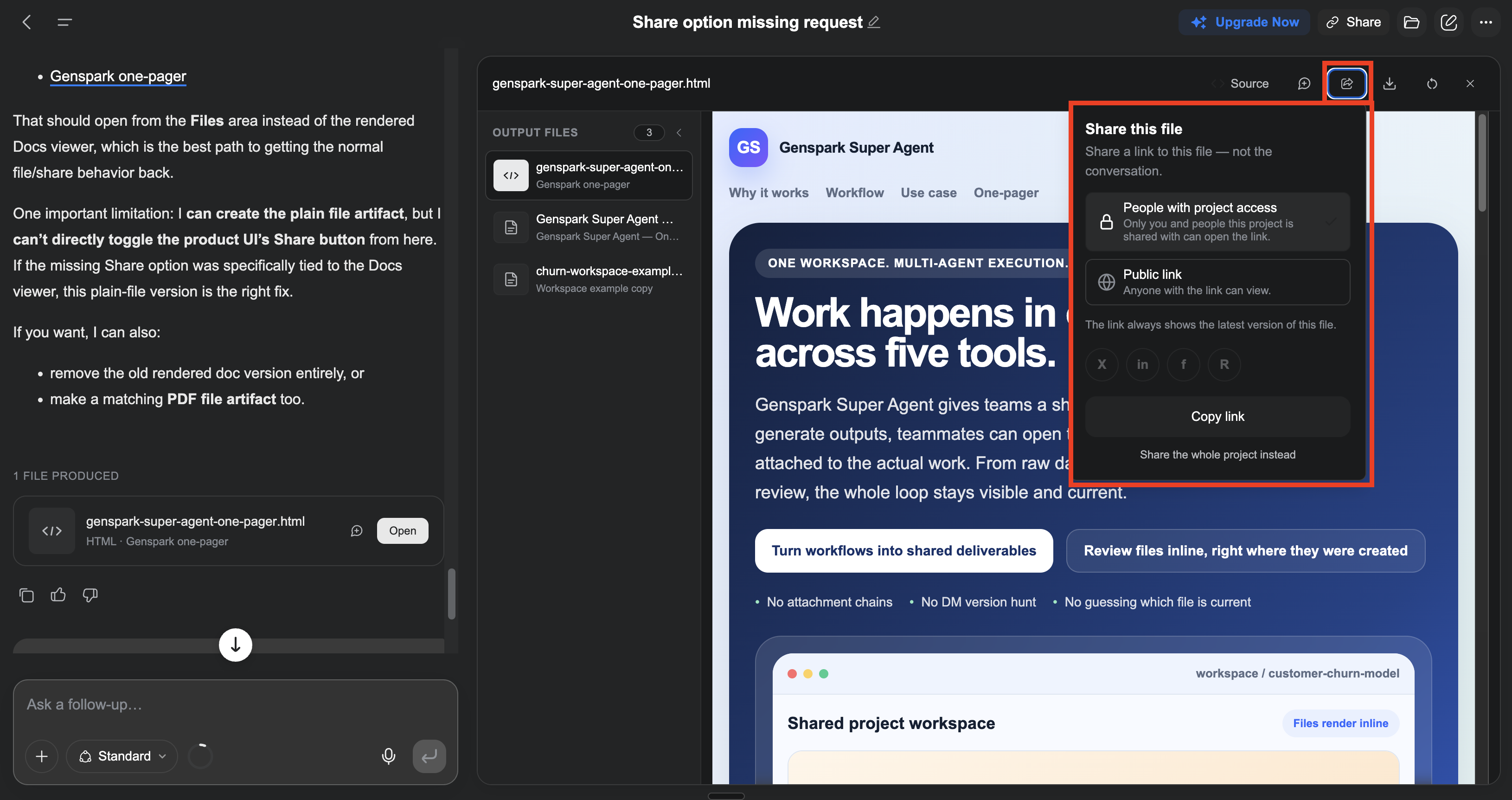
Share files individually: you can now share each delivered file on its own, separately from the conversation — so you can send a single file to anyone without sharing the whole project.
## FAQ {#faq data-section-type=faq}
### Does New Super Agent use more credits? {#new-super-agent-credit-usage}
Not because of the mode itself. A New Super Agent task can use more credits overall because it does more — multi-step work, live browsing, running code, and more tool calls.
To keep credit use low:
- Choose a lower model tier when you don't need maximum power.
- Nail the prompt in AI Chat first. Use AI Chat to shape and refine exactly what you want, then hand the finished prompt to Super Agent — so it executes cleanly instead of spending credits on back-and-forth clarifying steps.
# AI Slides {#ai-slides data-doc-group=office-suite}
Source: https://www.genspark.ai/helpcenter/ai-slides
## What is AI Slides? {#what-is-ai-slides data-section-type=overview}
**AI Slides** is Genspark's intelligent presentation agent. Instead of just generating a deck and handing it to you, it builds the deck *around you* — following your needs, your content, and your brand.
- **Built around you** — Already have a template or brand style? It follows them. Want something new? It designs from scratch.
- **Conversational by design** — It understands your goal and talks it through with you first, then structures and builds the deck.
- **A full presentation workspace** — Your deck builds live on a canvas beside the chat. Point at anything to change it, queue up batch edits, verify the facts, add speaker notes, and present with a speaker console.
- **Expert Skills, not just templates** — Apply 100+ built-in expert Skills, or save your own style as a reusable Skill.
- **A real built-in computer** — It can actually run code, so data analysis, calculations, and charts are computed accurately rather than guessed.
- **Multimedia and document conversion** — Add AI-generated or web images, and import existing files (PDF, Word, Excel, PPT) to build from.
**Learn more about AI Slides:** https://www.genspark.ai/blog/genspark-ai-slides
## Quick Start {#quick-start data-section-type=overview}
Get started in three simple steps:
1. **Go to AI Slides**
Click "AI Slides" at the bottom of the Genspark homepage, or select it from the "New" menu in the sidebar.
2. **Describe what you want to create**
Enter your topic, goal, or key message. You can also upload documents for AI to analyze and extract key insights.
Sample prompts:
```trythisprompt
Create a 10-slide presentation on renewable energy trends in 2024
```
```trythisprompt
Build a pitch deck based on my uploaded business plan
```
```trythisprompt
Make a sales presentation for our new SaaS product
```
3. **Get your presentation**
AI Slides automatically researches, structures, designs, and generates a complete, visually compelling deck, building it page by page in the Slides workspace right beside the chat. Review, refine, and export as PDF, PPTX, or Google Slides.
## Choose Your Mode {#choose-your-mode data-section-type=feature}
Before you write your prompt, take five seconds to set the modes at the top of AI Slides. There are three choices, and they make a big difference to your result.
### Professional vs Creative {#creative-mode}
This sets the overall style direction:
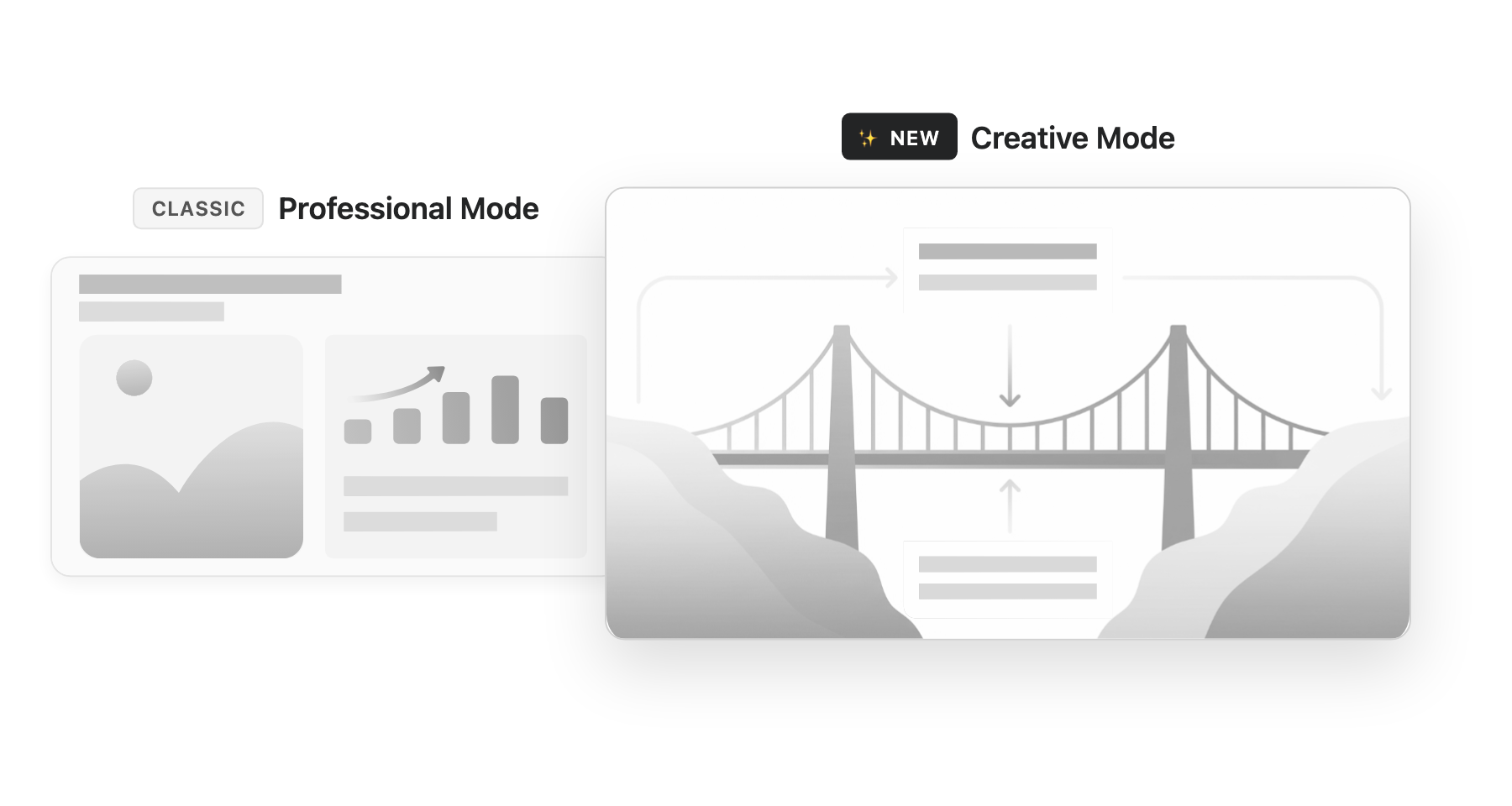
- **Professional** — Clean, structured, business-oriented. Best for sales proposals, internal reports, and consulting decks.
- **Creative** — More visual impact, with richer colors and imagery. Each slide is designed as a complete visual, like a poster. Best for brand campaigns, product launches, and marketing materials.
Quick rule: presenting to clients or executives → **Professional**; presenting to consumers → **Creative**.
A few things to know about **Creative Mode**:
- It supports multiple aspect ratios (16:9, 4:3, 1:1, 3:4, 9:16, 21:9), making it suitable for posters, social media carousels, knowledge cards, and more.
- You can choose the image generation model (e.g. GPT Image 2 or Nano Banana Pro) and paste reference images to guide the style.
- **Draw to edit** is on by default — mark anywhere on a slide with the pen, marker, or box tool, then describe your change. AI regenerates just that part while keeping the rest intact.
> **Note:** Once a project is created, its mode cannot be changed. To switch modes, start a new project.
### Guide Mode {#guide-mode}
By default, you type one prompt and get instant slides — fast and effortless. **Guide Mode** takes a different approach: AI acts as your presentation consultant, walking you through a structured consultation before building a single slide.
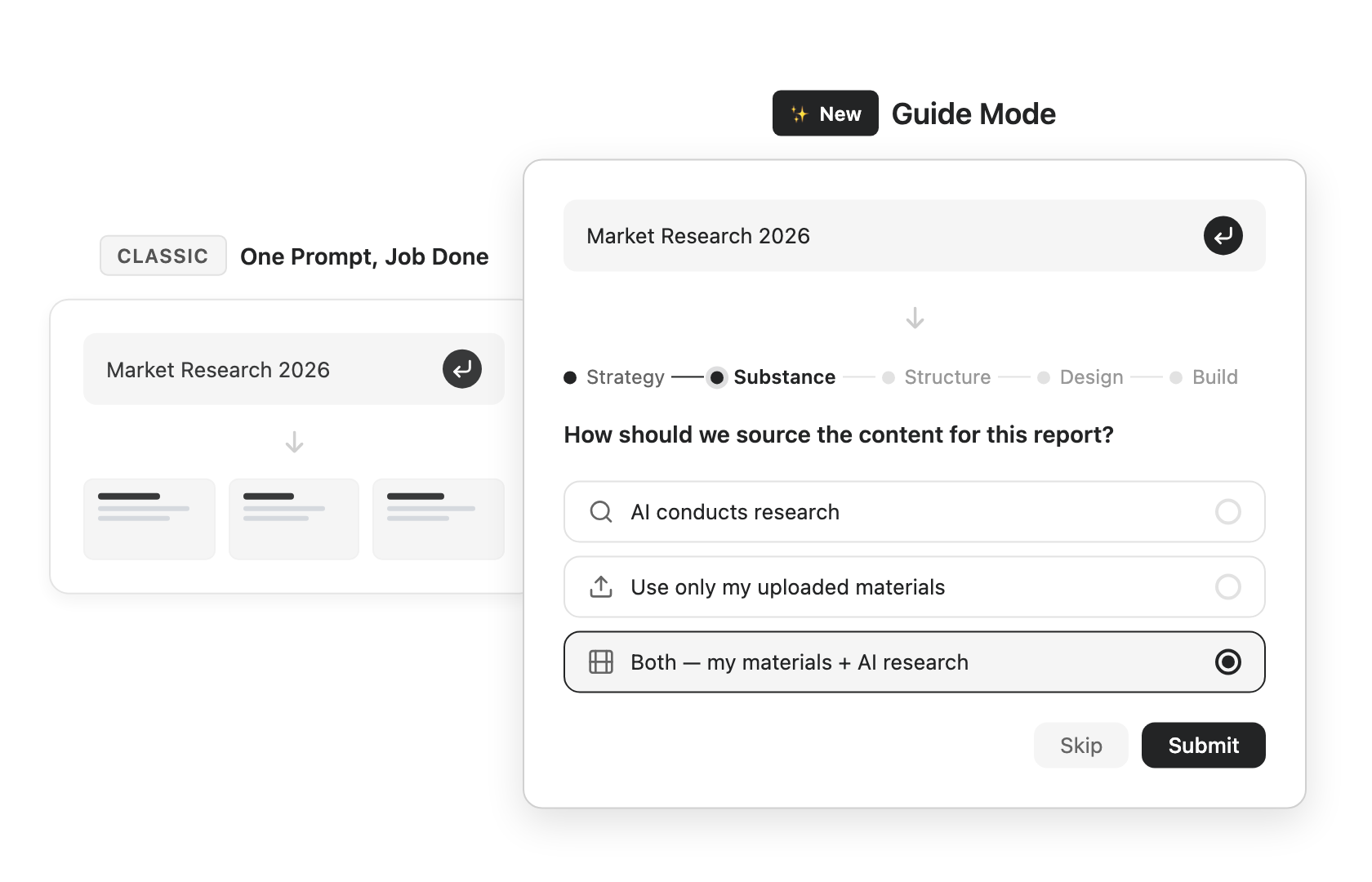
The difference is the role it plays. In the default mode, AI acts like an executor — once it understands your request, it builds the deck as fast as possible. In Guide Mode, it acts like a co-creator — a professional mentor that keeps discussing with you, sparks ideas, and confirms the outline with you before generating the final deck.
**How to choose:**
- Just want a quick result → leave Guide Mode off.
- New to AI Slides, building something complex or formal, or want control over every detail → turn Guide Mode on.
### Standard vs Ultra {#standard-vs-ultra}
This sets the model quality:
- **Standard** — Fast and economical, good for everyday decks. Uses 0.5× credits using [Genspark Gen-1 model](https://www.genspark.ai/helpcenter/gen-one-model).
- **Ultra** — The best choice for high-quality decks, with stronger reasoning and output. Uses 1.0× credits.
Quick rule: choose Standard when you want a fast deck, Ultra when you want the best quality.
> **Enterprise model policies:** if your organization restricts AI model vendors ([Team Admin → Connectors](/payment/team_admin?view=connectors) → **"Restrict AI Model Vendors"**), AI Slides automatically picks every model it uses — including the Standard and Ultra tiers — from your approved vendors. Members don't need to change anything.
## Writing Effective Prompts {#writing-prompts data-section-type=feature}
The key to a great deck is writing your prompt from the outcome. A vague prompt like "make a deck" leaves AI guessing who it is for, how long it should be, and what to cover.
### Start with three essentials {#prompt-essentials}
Open your prompt with three things:
1. **Audience** — who is it for? (Clients? Team? Executives?)
2. **Length** — roughly how many slides?
3. **Structure** — how should the content be organized?
Instead of "make a marketing deck", write something like:
```trythisprompt
Build a Gen Z marketing strategy deck, 5 slides, conclusion first, covering market analysis, target audience profile, and marketing strategy
```
The more specific you are, the sharper the output.
> **Not sure how to phrase it?** Just turn on Guide Mode and leave the rest to AI — it will walk you through and clarify what you need.
### Add more detail when it helps {#prompt-advanced}
- **Data source** — "use 2024 data", "cite authoritative sources"
- **Tone** — "professional business", "young and energetic", "minimalist"
- **Reference style** — paste a screenshot of a deck you like
- **Your own files** — drag in a PDF, Word, Excel, or PPT and build from it
### Prompt templates for common scenarios {#prompt-templates}
- **Sales proposal** — "Build a sales proposal from [your company] to [client company], [N] slides, conclusion first, emphasizing the product value for the client."
- **Internal report** — "Build a [topic] quarterly review report, [N] slides, structured as current state, achievements, issues, and next-quarter plan."
- **Training material** — "Build a [topic] training deck, [N] slides, for beginners, with a hands-on case per chapter."
## Slide Skills {#slide-skills data-section-type=feature}
Slide Skills are AI Slides' most powerful way to get expert-quality decks and keep your style consistent. Skills replace the older idea of templates — and go far beyond them.
### What is a Skill? {#what-is-a-skill}
A traditional template only reuses a visual look. A **Skill** packages **expert thinking + design** together. It tells AI not only how the deck should look, but also how to think, how to organize the content, and how to build the argument. Think of it as the way an expert works, packaged for reuse.
### Use built-in Skills {#using-skills}
Genspark ships with **100+ expert Skills**, covering a wide range of work scenarios — Corporate Strategy, B2B Sales, Professional Training, Academic Research, Marketing, Data & KPI, Fundraising, Consulting, Product Management, and more.
1. On the AI Slides home screen, browse the **Skills** library below the input box. Switch between **Featured** and category tabs to explore.
2. Click the Skill you want to apply.
3. Enter your prompt — AI generates the deck following that Skill's expert approach.
With a Skill applied, the structure, the reasoning, and the visual style all follow how an expert would actually do it: a sales proposal uses a sales director's framing, a strategy analysis uses a consultant's frameworks.
### Save your own Skill {#save-your-skill}
Beyond the built-in library, you can save your own style as a reusable Skill — especially useful for reusing a brand template across your team. Your saved Skills appear under the **My Skills** tab.
The most common case is that **you already have your own PowerPoint or PDF template.** Open the **New Skill** dialog from the Skills library and choose how to start:
- **Save my presentation as a template** — upload a PowerPoint or PDF to turn your existing deck into a reusable Skill. This is the path most people use.
- **I already have a skill package** — import a `.zip` Skill that someone shared with you.
- **I'm starting from scratch** — build a custom Skill from the ground up.
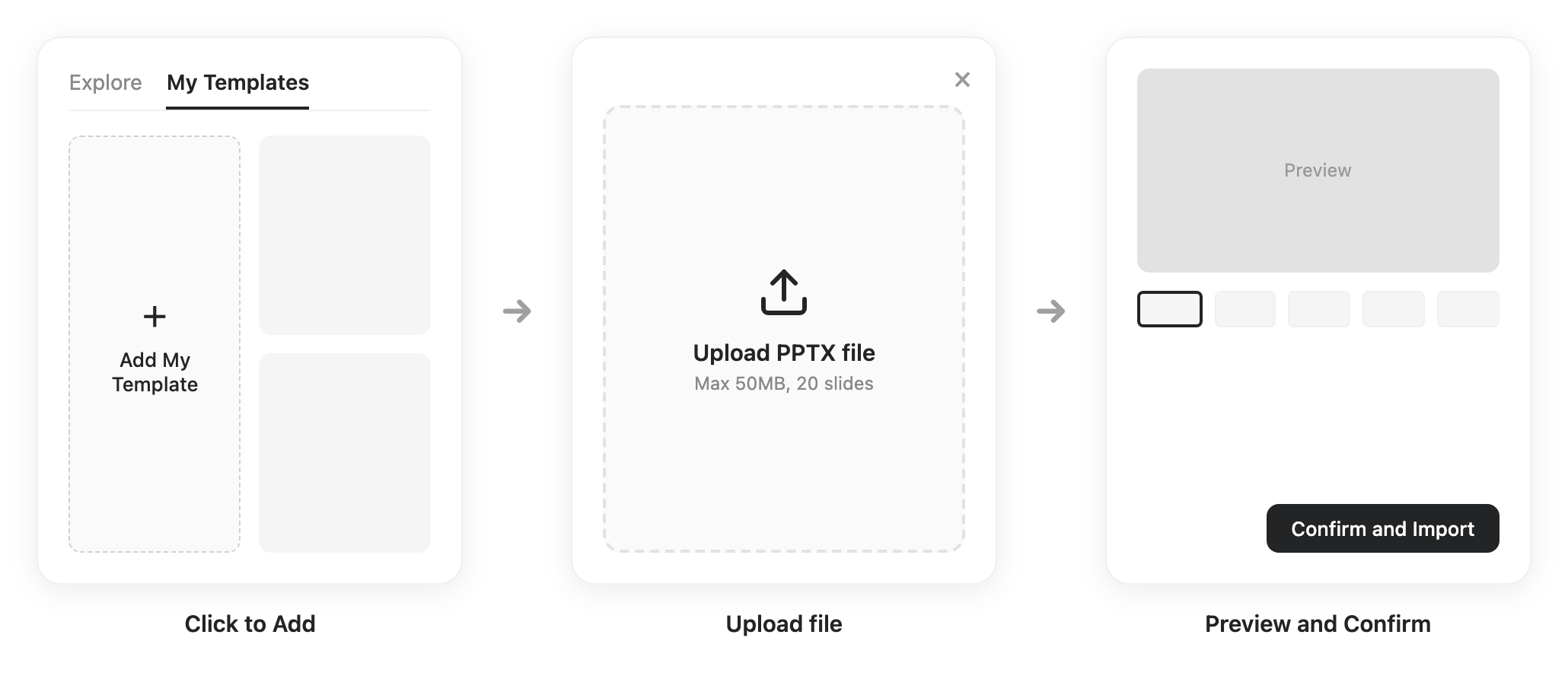
You can also save a deck you are currently working on: click the **⋮** menu at the top of the workspace → **"Save as Skill"**.
**For client work:** you can do the same with a client's brand — look up their colors and style, save it as a Skill, and apply it whenever you build a deck for them. It is a small touch that makes clients feel understood.
> **Reuse a project on the fly:** You can also start a new project, paste the link of a project whose style you like, and tell AI to use it as the basis for your new deck.
### Share a Skill {#share-skills}
Every Skill you own has a **Share** panel — share it like a doc, with one link, instead of exporting a `.zip` and sending files around:
1. Open one of your Skills and click **Share**.
2. Invite specific people by email, or set General access to **"Anyone with the link"** and copy the link.
Recipients can preview the Skill and import their own copy. You stay in control — remove a person or disable the link at any time; copies people already imported remain theirs.
### Team Skills: publish to your whole organization {#team-skills}
Person-to-person sharing spreads a Skill one colleague at a time. **Team Skills** publish it to everyone at once, so your whole team builds decks one consistent way — the company proposal framework, a department's brand style, a report format that took years to refine. A new employee can build a polished, on-brand deck on day one. Available on both the Team and Enterprise plans.
1. **Members** — open your Skill, click **Share**, and set General access to **"Organization"**. This submits the Skill for admin review.
2. **Admins** — review submissions in [Team Admin → Skills](/payment/team_admin?view=skills&skilltab=slides) and approve or reject (with a reason). Email and in-app notifications keep the loop moving on both sides.
3. Once approved, the Skill appears in the **"Team Skills"** tab of the Skills gallery for every member and activates automatically — no importing needed. When the publisher updates it, everyone gets the latest version.
## Charts & Data Visualization {#charts data-section-type=feature}
Presentations often stall on diagrams — process flows look uneven, org charts get tangled, and data charts mean a separate trip to Excel. AI Slides handles all of this internally, and because it actually runs code, the numbers behind your charts are computed accurately.
### Charts you can generate directly {#chart-types}
- **Business process flows** — order-to-delivery, user journeys
- **Org charts** — clean hierarchies
- **2x2 matrix analysis** — competitor positioning, prioritization
- **Funnel charts** — sales and conversion funnels
- **Gantt charts and timelines** — project schedules, milestone planning
- **Data charts** — bar, line, pie, radar, and more
These are just the most common types — basically any chart you can think of, AI Slides can produce.
### How to generate them {#chart-how}
Specify what you want directly in your prompt:
```trythisprompt
Build a 10-slide product launch plan. One slide needs a 2x2 competitor analysis (by price and functionality), and another needs a user growth funnel.
```
You can also hand AI a data file and ask it to visualize it:
```trythisprompt
Use this sales spreadsheet to create a monthly trend line chart, a product-line comparison bar chart, and a regional distribution heatmap
```
> **Not sure which chart fits?** Just ask — "What is the best chart for this content?" — and let AI recommend one. It often picks the most fitting type, sometimes one you would not have thought of.
## Refining Your Slides {#refining data-section-type=feature}
Your deck lives in the **Slides workspace**: an outline rail on the left shows every slide at a glance, the current slide sits center stage, and the chat stays right beside it — so you can talk to AI and watch every change land in real time. Above the slide, a toolbar switches between three ways of working: **Select**, **Draw**, and **Edit**.
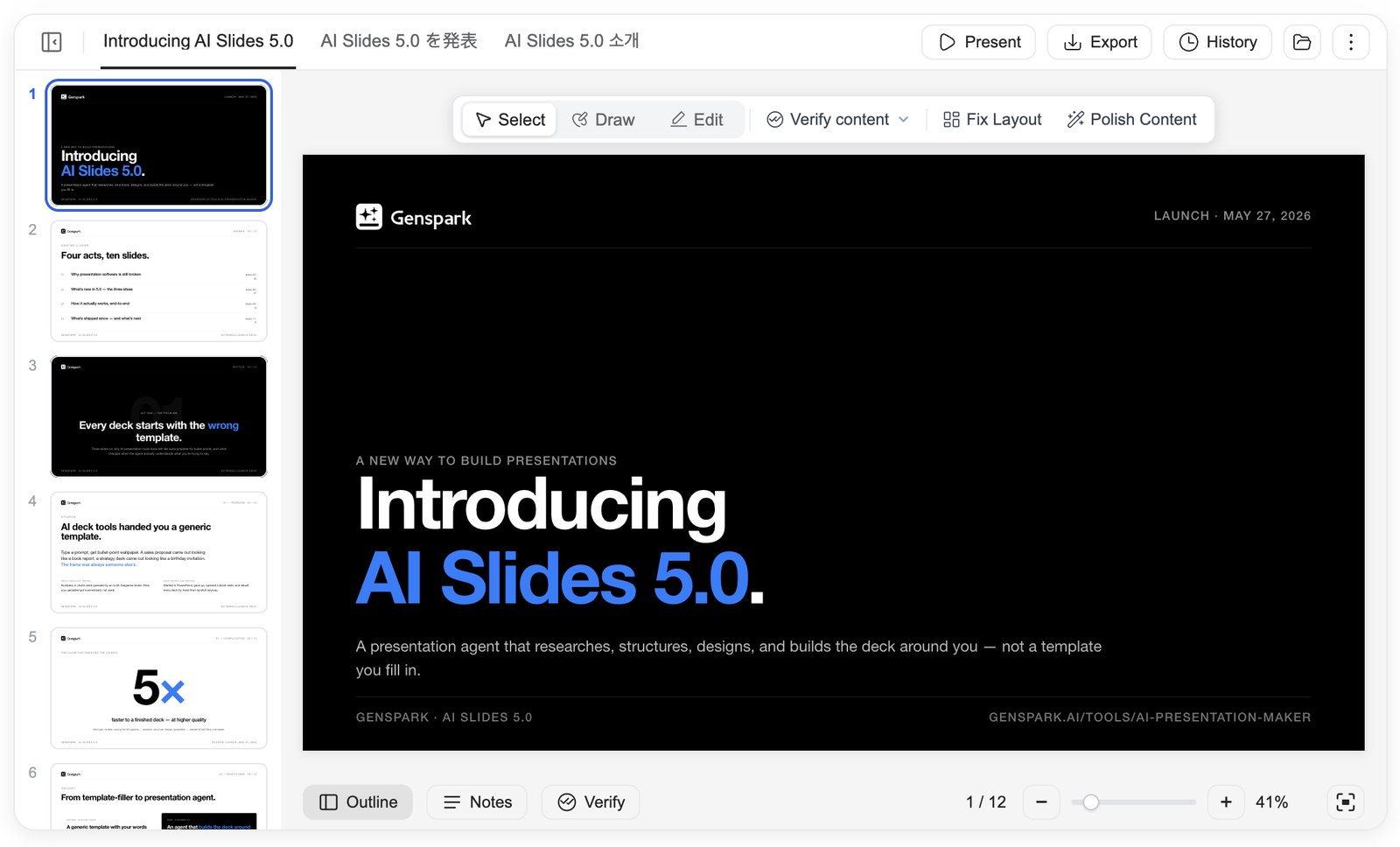
### Point at what you want changed {#select-edit}
In **Select** mode, click any element on a slide — a title, a paragraph, an image, a chart. The element attaches to the chat box, labeled by type; describe what you want, and AI changes exactly that spot while keeping the rest of the design intact.
### Mark up the whole deck, send once {#draw-edit}
Review your deck the way you would go through a printed draft. Switch to **Draw**, then circle things with the **Pen**, highlight with the **Marker**, or drag a **Box** around a region — and jot a short note on each mark. Annotations stay put as you flip through pages, collecting into the **Edit queue** at the chat box. When you have marked up everything, click **"Send N edits"** once: AI works through the whole batch while you grab a coffee or join your next meeting, and you come back to review the results in one pass.
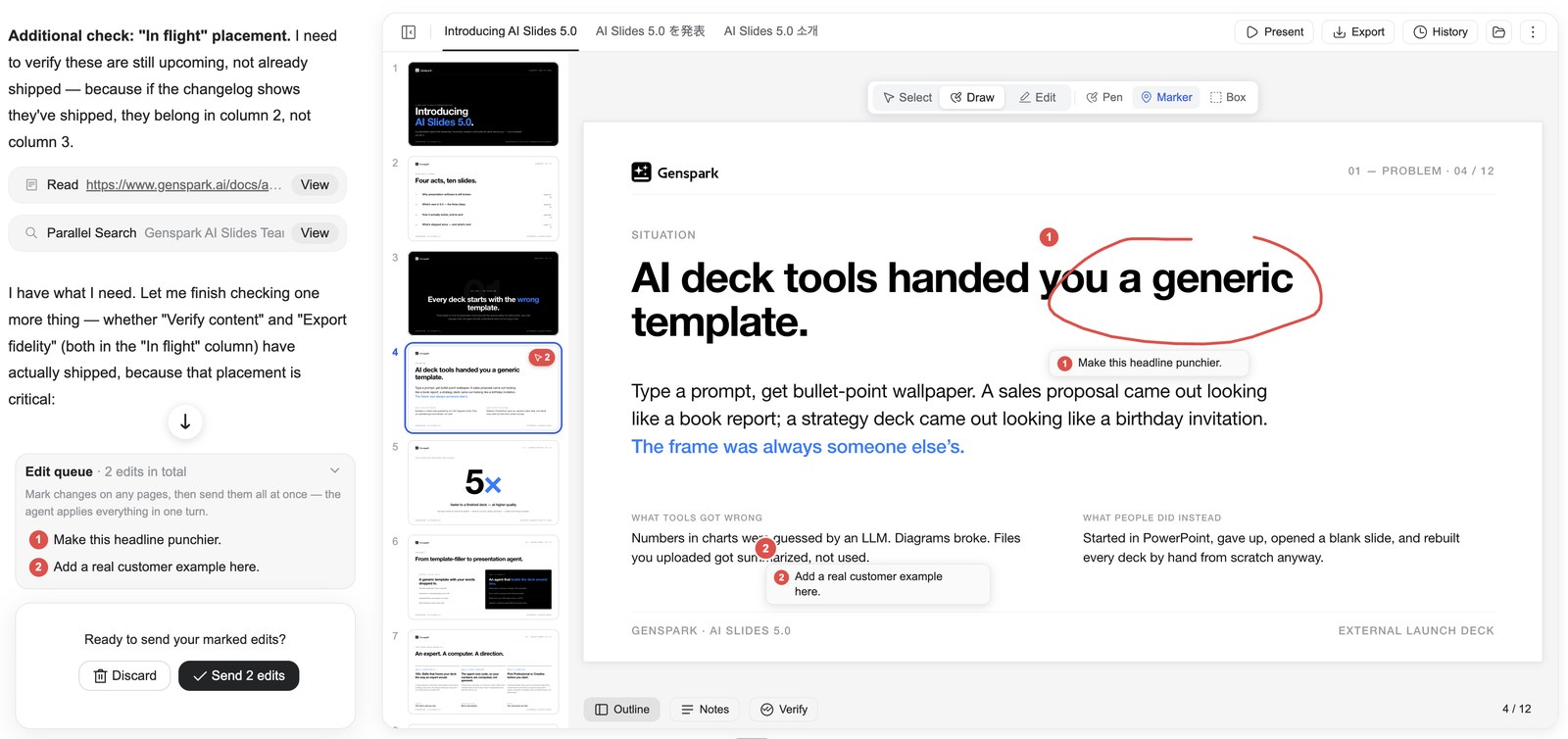
Changed your mind about a mark? Remove it from the queue before sending, or click **"Discard"** to clear the current page or all pages.
### AI Edit {#ai-edit}
The toolbar also offers one-click AI refinements. The available options depend on your mode:
- **Professional Mode** — **Fix Layout** (detect and fix overlap, overflow, and misalignment) and **Polish Content** (improve logic and layout while matching the current style).
- **Creative Mode** — **Enrich Content**, **Simplify Content**, and **Redesign Layout**.
### The built-in editor — full manual control {#advanced-edit}
Sometimes you don't want to ask AI — you just want to grab that title and move it yourself. Switch to **Edit** in the toolbar and the slide becomes directly editable, right on the canvas: no page change, the chat and AI stay by your side, and manual edits do not consume credits.
- **Work with elements like a design tool** — click to select, drag to move, use the handles to resize and rotate. Marquee-drag to select several elements, then align, distribute, or group them, and reorder layers (bring forward / send back). Right-click any element for cut, copy, paste, and duplicate.
- **Format text in place** — double-click into any text and type. The floating toolbar covers font, size, color, bold/italic/underline/strikethrough, alignment, line height, and letter spacing.
- **Fine-tune images** — replace an image, crop it freely or to a shape or ratio, round its corners — or open **Change Focus** and drag a dot on a miniature of the original photo to choose exactly which part stays in frame.
- **Manage pages from the rail** — drag thumbnails to reorder; right-click a page to add, duplicate, copy, paste, or delete slides.
- **Edit speaker notes** — type directly in the **Notes** panel while you edit.
- **Undo anything** — undo any action in a single step (and redo just as easily), and the **History** panel keeps full version snapshots; manual edits and AI edits share the same history. Changes save automatically, and if the deck changes while you are editing — say, AI finishes an edit — you will be shown the newer version and choose how to proceed, with no silent overwrites.
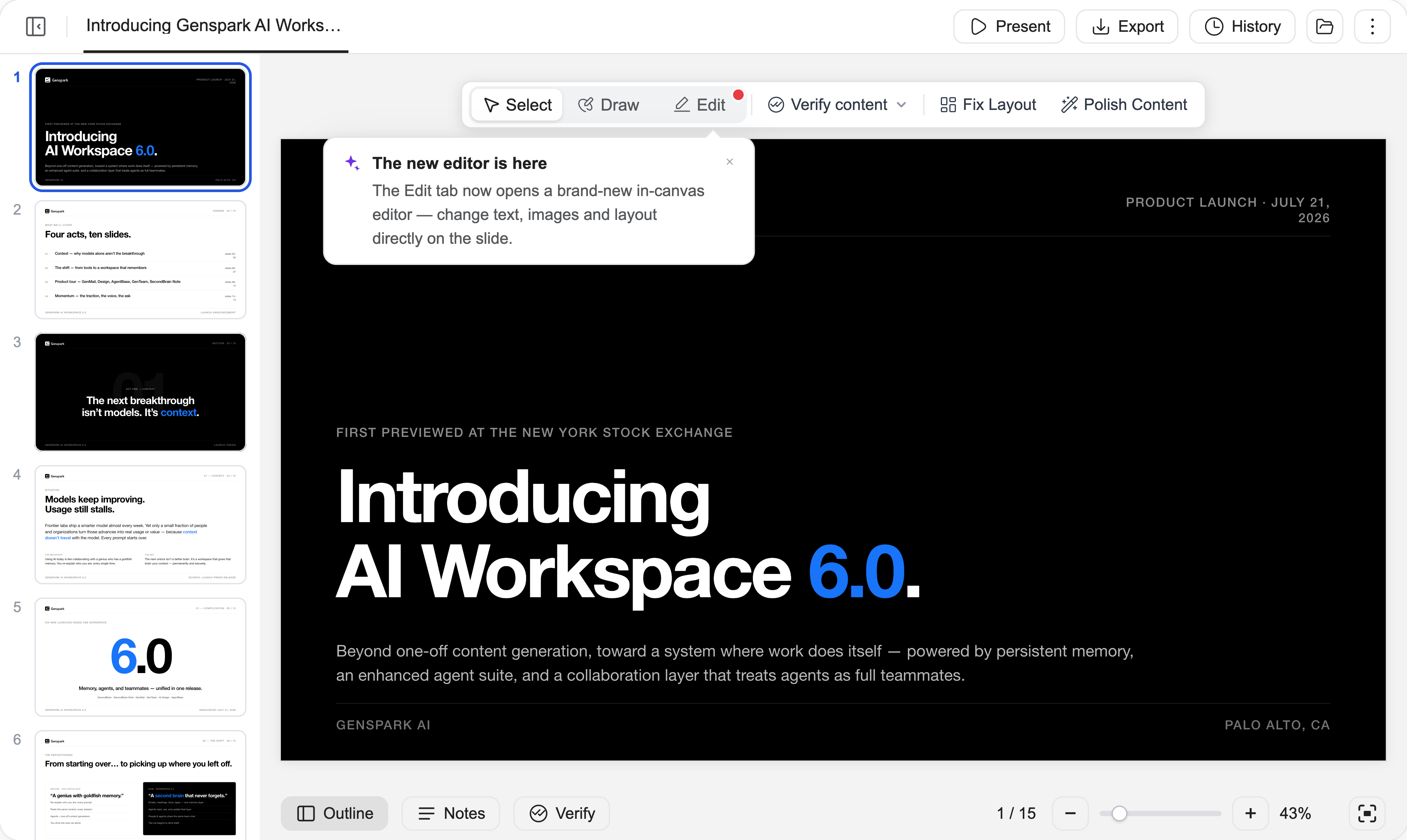
*(The built-in editor is only available in Professional Mode)*
### Verify Content {#fact-check}
Before an important deck goes out, have AI verify every figure and claim in it — checked against the web or against the files you uploaded:
1. Click **"Verify content"** in the toolbar and choose **"Verify this page"** or **"Verify entire deck"**.
2. AI cross-checks facts, figures, sources, and calculations, corrects what is wrong, and leaves a verification mark on each checked slide with reference links.
3. Review the marks to see what was checked and how. When you export to PPTX, the verification trail is written into the slide notes, so whoever receives the file sees the evidence behind every number.
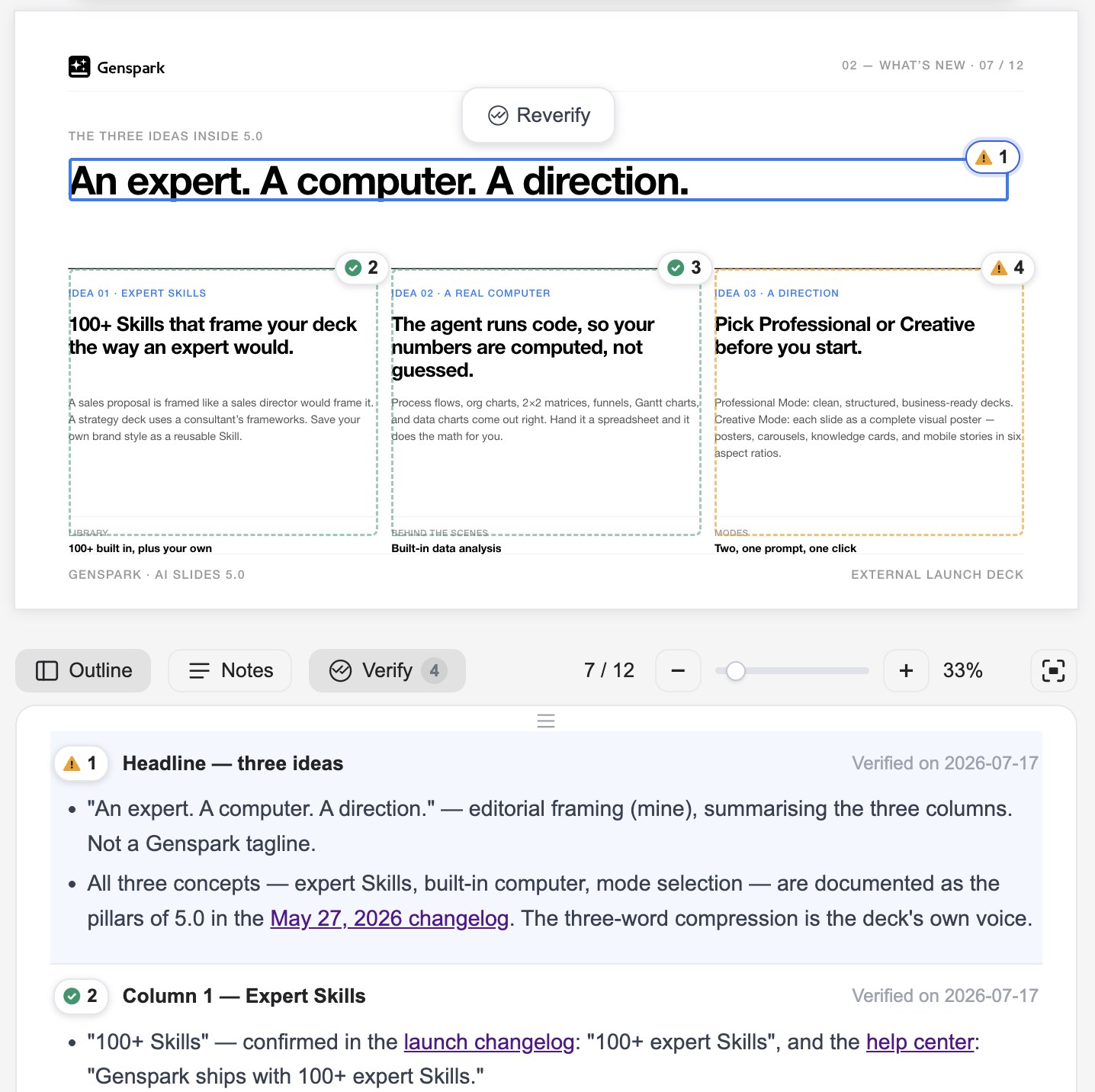
This step is especially valuable for sales proposals and reports, where solid data matters most. A reliable flow is: **simple prompt → fast generation → verify → sharp result**.
## Present, Export & Share {#present-export-share data-section-type=feature}
### Speaker notes {#speaker-notes}
Once the deck is ready, shape your delivery. Open the **Notes** panel from the bottom toolbar to read and edit per-slide speaker notes — or have AI write them: click **"Add notes"** (for this slide, or for all slides), and AI first asks a few questions about the occasion, the audience, and the tone, then writes notes tailored to your answers.
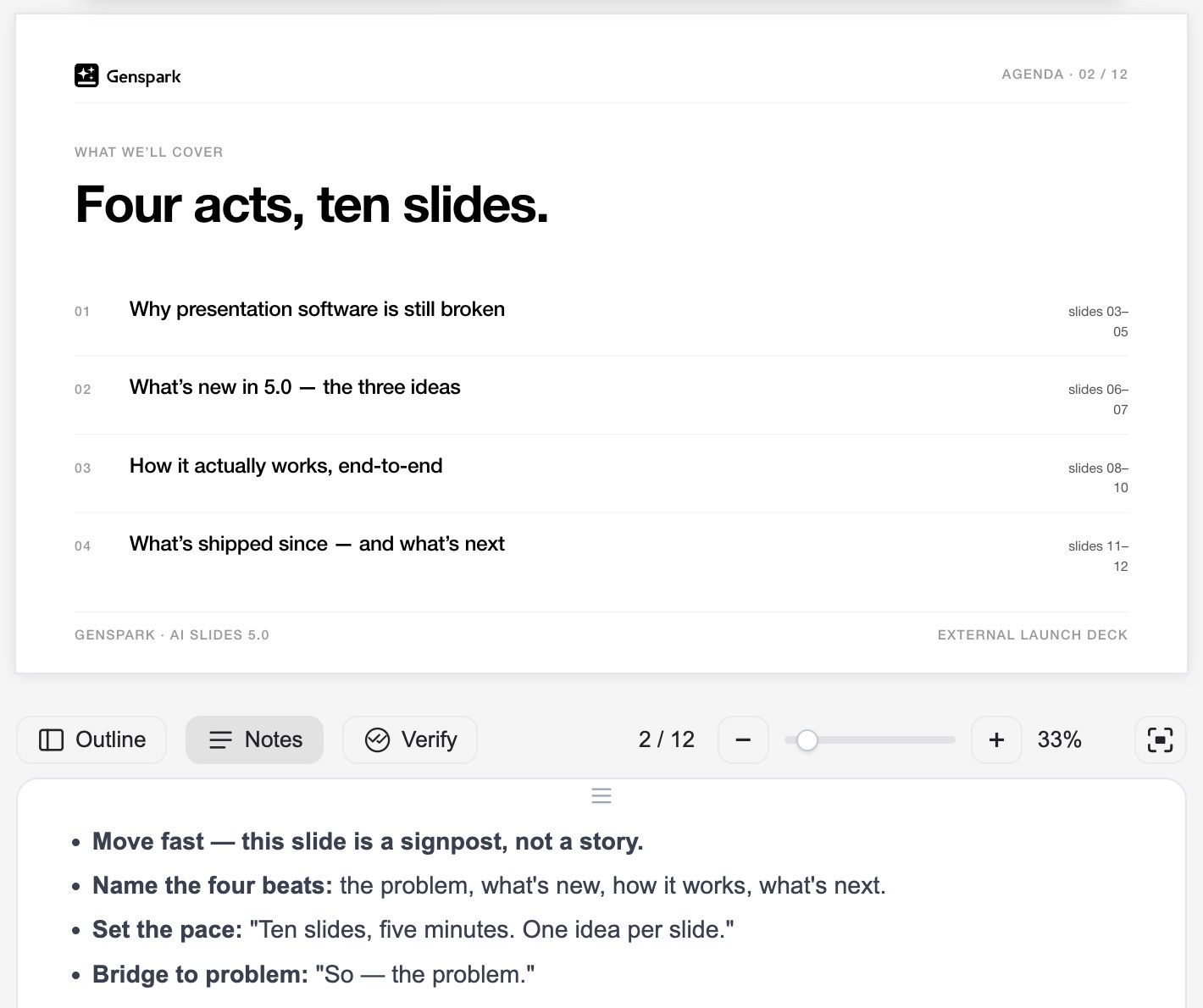
Notes are included when you export to PPTX, so anyone you hand the file to can present it smoothly too.
### Present online {#view-online}
Present your slides directly in the browser, with no download required:
1. Click **"Present"** at the top of the workspace.
2. Choose **"From beginning"** or **"From current slide"**.
3. While presenting, use **"Draw on page"** to circle and underline things live for your audience.
### Presenter view {#presenter-view}
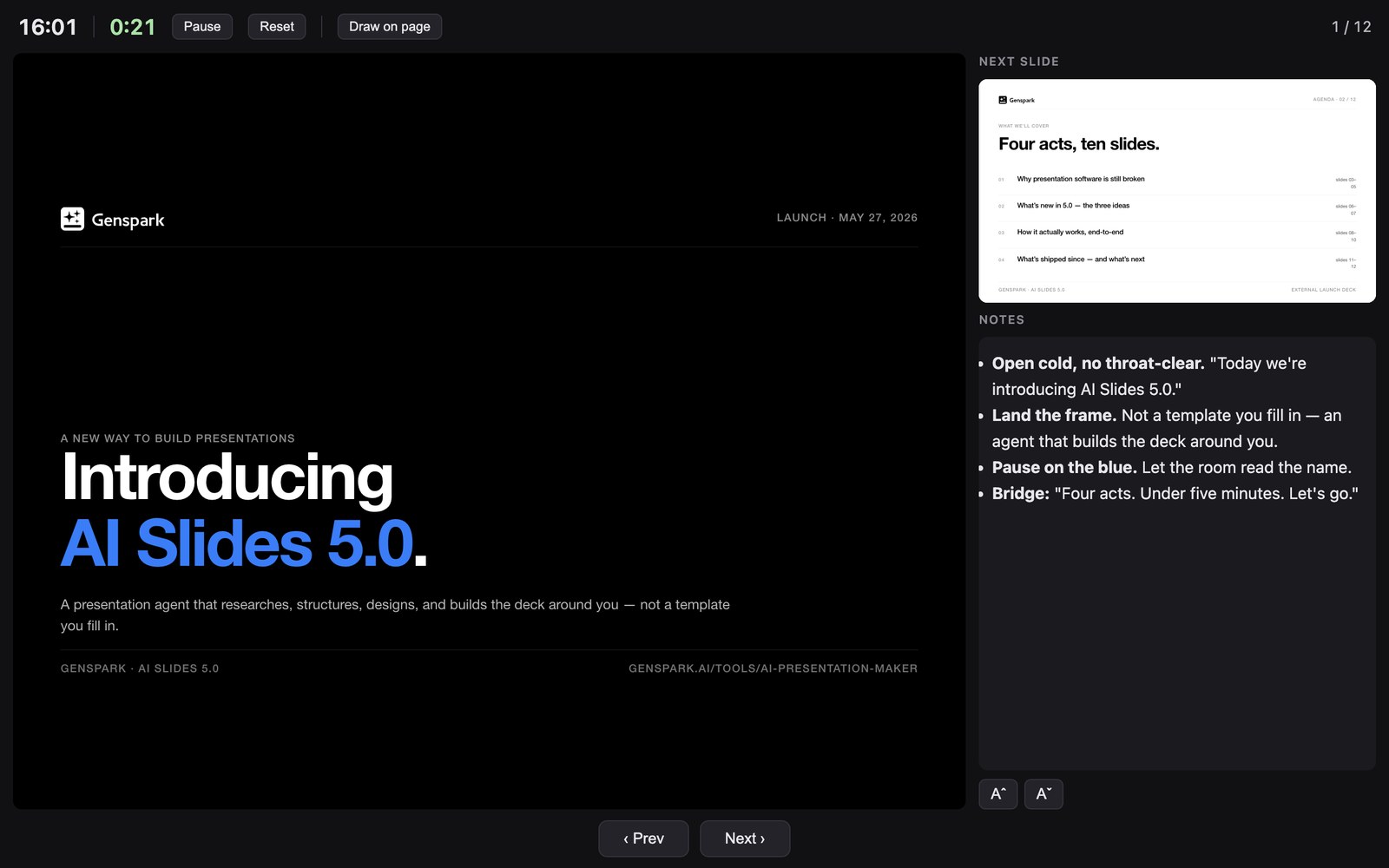
For the full on-stage setup, click **"Present"** → **"Presenter view"**. A speaker console opens in its own window with the current slide, the next slide, your notes, and a timer — while the audience window shows nothing but clean slides. Move the audience window to the projector or the shared screen, make it fullscreen, and drive the whole show from your console; your cursor stays synced across both displays.
### Export {#export}
Download your presentation as PDF, PPTX, or Google Slides *(available for Plus, Pro, Team, and Enterprise users)*:
1. Open your presentation, then click **"Export"** in the deck header's right-hand action row. Export appears only when a deck is open and editable — an embedded preview or an anonymous share viewer has no Export button.
2. In the **"Export Slides"** dialog, choose a **Format** - PDF, PPTX, or Google Slides - and set a **page range**: All pages, or Custom range with From/To. Export stays disabled on an invalid range.
A quick decision rule:
- Still need to edit it → export **PPTX** to PowerPoint
- Sending it straight to someone → export **PDF**
- Collaborating with a team → export **Google Slides**
### Make a Copy {#make-a-copy}
Create a full, independent copy of your presentation as a new project — useful when adapting slides for a different client, translating into another language, or creating a variation without affecting the original. Click the **⋮** menu at the top of the workspace → **"Make a Copy"**, or simply tell AI **"make a copy"** in the conversation.
### Share {#share}
Share your presentation through Genspark's project sharing:
1. Open the project share options.
2. Invite collaborators by email, or change General Access to **"Anyone with the link"**.
3. If you choose "Anyone with the link", pick your sharing mode:
- **Presentation share** — final slides only; the creation process is not included.
- **Project share** — includes the full project and creation process.
### Editing in Canva or Figma {#canva-figma}
Want more design control? Export your slides and continue editing in Canva or Figma for advanced customization.
**Learn more:** [External Editing Guide](https://www.genspark.ai/blog/genspark-ai-slides-edit)
## Tips & Saving Credits {#tips data-section-type=feature}
### Plan for clean, balanced layouts {#clean-layouts}
Want professional-looking slides? Plan your content structure before generating. Start with an outline and keep the information volume consistent per slide. If a slide looks crowded, split it across multiple slides — you can always pause generation and adjust as you go. Try:
```trythisprompt
Create a comprehensive outline first, determine the content for each slide, and keep the information volume consistent per slide. Wait for my confirmation before starting production.
```
### Keep your style consistent {#style-consistent}
Two approaches that work well:
**1. Sequential creation** — tell AI to generate slides one at a time:
```trythisprompt
Please create slides one by one, do not process in parallel
```
**2. Style approval workflow** — approve the first slide, then have AI match it:
```trythisprompt
Please create the first slide and wait for my approval of the style. Then create all remaining slides to match that exact style — same fonts, colors, spacing, and layout structure.
```
For long-term consistency, save your approved style as a [Skill](#slide-skills).
### Save credits {#saving-credits}
AI generation is what consumes credits — manual edits in **Advanced Edit** are free. A few ways to make the most of your credits:
1. **Think first in a free AI chat.** Building a deck spends credits on two things: thinking through the content, and producing the slides. You can do the "thinking" part for free — talk through your content and per-slide plan in a free AI chat (like Genspark's AI Chat), then hand the draft to AI Slides to produce. You only pay for production.
2. **Create with Ultra, reuse with Standard.** Building a high-quality deck from scratch is worth the stronger model, so use **Ultra** when creating a reusable Skill. Reusing a finished Skill is far easier, so switch to the cheaper **Standard** for everyday decks built from it.
3. **Stop early.** If the output isn't what you want, stop generation immediately instead of letting unused slides finish.
4. **Use Advanced Edit for small changes.** Reserve AI generation for major revisions; use the free Advanced Edit for text, formatting, color, and layout tweaks.
## FAQ {#faq data-section-type=faq}
### Why won't my presentation export, download, or preview? {#export-troubleshooting}
Try these steps in order:
- **Refresh and retry.** Reload the page and reopen the presentation, then attempt the export again.
- **Check your browser.** Disable pop-up blockers for genspark.ai and make sure downloads aren't being blocked. Try Chrome or Edge if the issue persists.
- **Try a different format.** If PPTX won't export, try PDF (or vice versa) to narrow down where the issue is.
If it still won't export, contact support and share your project with **support@genspark.ai** so we can look at it directly (see below).
### Do exports cost credits? {#export-credits}
No — exporting does **not** cost credits. Neither does manual editing (Advanced Edit) or saving a presentation. Credits are only consumed by AI generation.
### I made a deck on a Free plan, how do I get the file {#free-plan}
Exporting any format, requires a paid plan.
### How do I share my project link with support? {#share-project-link}
On Free you can present in the browser and share a live link, but downloading needs an upgrade. Your deck is saved — nothing is lost — and it becomes exportable the moment you upgrade.
Support can only investigate a presentation if the project link is set to public.
- Open the agent or task containing your presentation.
- Click **Share** (top right of the project).
- Invite **support@genspark.ai** as a Viewer
- Copy the link and paste it into your support email.
> ⚠️ Without public access, we can't open the project — this is the most common reason investigations get delayed.
# AI Sheets {#ai-sheets data-doc-group=office-suite}
Source: https://www.genspark.ai/helpcenter/ai-sheets
## What is AI Sheets? {#what-is-ai-sheets data-section-type=overview}
AI Sheets is Genspark's autonomous AI spreadsheet agent that turns data analysis into natural conversation. Simply describe what you need — AI handles data collection, analysis, and visualization automatically.
- **Multi-Source Data** — Web scraping, file uploads, or database connections in one prompt
- **Autonomous Analysis** — Clean messy records, compare performance, forecast trends, discover patterns, calculate metrics, etc.
- **Native Excel Compatible** — Full support for .xlsx format with seamless import/export and generation of standard Excel formulas
- **Smart Visualization & Styling** — Transform raw spreadsheets into polished, presentation-ready tables with formatting and design, generate professional charts based on your needs
- **Actionable Insights** — Extract key findings and strategic recommendations for decision-making

## Quick Start {#quick-start data-section-type=overview}
Get started in three simple steps:
1. **Go to AI Sheets:**
Click "AI Sheets" at the bottom of the Genspark homepage, or select it from the "+" (New) button in the sidebar.
2. **Describe your needs:**
Tell AI what you want to analyze. Sample prompts:
```trythisprompt
Compile NVIDIA's financial statements from FY2021 to FY2025.
```
```trythisprompt
Analyze sales trends from the uploaded Excel and visualize performance by region.
```
3. **Get results:**
Based on your needs, AI automatically selects and executes the right analysis steps — cleaning messy data, writing SQL queries for databases, running Python for statistical analysis, generating Excel formulas, or creating visualizations. All code and logic are transparent. Edit directly in the sheet, refine with follow-up prompts, or export as .xlsx for further use.
## Feature & How-To Guides {#feature-guide data-section-type=feature}
### Data Collection {#data-collection}
AI Sheets automatically collects structured data from authoritative sources:
* **Professional Databases:** Genspark integrates specialized databases across different domains:
* **Financial Data** — SEC (public company filings, 10-K/10-Q, etc.), Yahoo Finance (stock prices, etc.)
* **Academic Data** — Google Scholar (papers, citations, research trends, etc.)
* **Product Data** — Amazon (product information, pricing, reviews, etc.)
* **General Web Data:** For non-database data, AI retrieves high-quality information from public web sources based on your needs, and cross-checks critical data against multiple sources. Verification still matters — always check critical values against the source cells and citations before you rely on them.
AI Sheets supports data extraction and analysis from multiple sources:
* **Upload Files via Chat:** Upload local files directly (Excel, PDF, Word, images, etc.), and AI will automatically extract and analyze the data.
* **Connect Data Sources via MCP:** On the Genspark homepage or within AI Sheets, click the "Tools" button in the chat box, open the MCP page, select the tool you want to connect, and follow the instructions to complete the setup. Once connected, you can use prompts to have AI directly query the data source and perform analysis. Currently supported:
* **Google Drive** — Access cloud files, extract documents and spreadsheet data
* **Supabase** — Connect to your database, execute SQL queries and data analysis
* **Custom MCP** — Other MCP tools that meet AI Sheets query requirements, which can connect to enterprise databases
For the full connector list and how connections work, see [Connectors and integrations](https://www.genspark.ai/helpcenter/connectors-and-integrations).
### Sheet Operations {#sheet-operations}
AI Sheets features a built-in web-based spreadsheet editor that supports both manual editing and AI-assisted editing:
* **Manual Editing:** You can operate the spreadsheet just like Excel:
* Copy, paste, cut, delete data
* Use common Excel formulas for data processing and analysis
* Create and adjust charts, including: Area charts, Bar charts, Column charts, Line charts, Pie charts, Doughnut charts, Scatter charts, Funnel charts, Radar charts, Treemap charts, Waterfall charts
* Format settings and style adjustments
* Add and delete worksheets
* Click **Fullscreen** in the upper right corner to enter full-screen editing mode for more workspace.
* **AI Editing:** You can also direct AI to perform spreadsheet operations using natural language:
* **Generate Formulas** — Describe calculation logic in natural language, and AI automatically generates the corresponding Excel formula:
```trythisprompt
Show what percentage each product contributes to overall revenue
```
```trythisprompt
Calculate the compound annual growth rate (CAGR) from 2020 to 2024
```
```trythisprompt
Add a column that shows "High" if sales > 10000, "Medium" if between 5000–10000, otherwise "Low"
```
* **Generate Charts** — Describe visualization needs, and AI auto-selects the appropriate chart type and generates it:
```trythisprompt
Visualize the market share comparison between competitors using a pie chart
```
```trythisprompt
Generate a bar chart comparing sales performance across different regions
```
```trythisprompt
Show customer satisfaction performance by department using a radar chart
```
* **Focused Area Editing (Send to Chat)** — After selecting a cell range, click the "Send to Chat" button to send the selected area to the chat box. You can direct AI to perform content corrections, in-depth analysis, or chart generation for that specific area:
```trythisprompt
Analyze the selected data and identify the top 3 anomalies or outliers
```
```trythisprompt
Highlight duplicate values in the selected customer ID column
```
```trythisprompt
Standardize all phone numbers in the selected range to (XXX) XXX-XXXX format
```
### Analysis & Insight {#analysis-insight}
You can ask questions about spreadsheet content, and AI will provide answers with cell references. You can also have AI deeply explore the data and generate insights, with the agent creating beautiful visualization dashboards using HTML tools.
* **Share:** Click "Share" in the top right corner, adjust permission settings, and share your project link for viewing or collaborative editing.
* **Export:** Click **Export** in the upper left corner of the editor, then choose **Export as XLSX**. Your formatting, formulas, and calculations are preserved, and the file opens in Microsoft Excel and other spreadsheet apps.
## Credits and Free Quota {#credits-and-free-quota data-section-type=feature}
AI Sheets works through agent tasks. A few things are worth knowing before you spend:
* **A run that partly succeeds still costs credits.** Attach the files the task needs and give clear, well-scoped instructions before you start. If a task keeps failing on the same step, stop it and fix the input rather than retrying.
* **Free Quota covers some runs.** If your plan includes Free Quota — the weekly allowance that covers eligible tasks at no credit cost — a covered AI Sheets task is paid from the Free Quota pool instead of your credits. See How Free Quota Works for what's covered.
* **Billing questions.** For a technical billing issue, contact support with a link to the task, what went wrong, and your approximate balance before and after. For how credits are counted and charged, see the [Credits Guide](https://www.genspark.ai/helpcenter/credits-guide).
## Pro Tips {#pro-tips data-section-type=feature}
### Break Down Complex Tasks into Steps {#break-down-tasks}
* For multi-step analysis tasks, have AI complete data collection and cleaning first, then proceed to in-depth analysis
* Split complex tasks into multiple instructions, verify results after each step before telling AI to proceed to the next step to avoid errors that could impact the final results
**Sample: Financial Analysis on NVIDIA**
* Collect NVIDIA's revenue, net income, and operating margin data from FY2020 to FY2024.
* Calculate year-over-year growth rates for revenue and net income, and visualize the trends.
* Analyze what drove the revenue growth in FY2024, compare with industry benchmarks, and provide strategic insights.
**Sample: ROI Analysis of Marketing Campaign**
* Use my marketing campaign data and calculate total spend, conversions, and revenue generated by each campaign.
* Based on the results, calculate ROI and cost per conversion for each campaign, then rank them by performance.
* For the top 3 campaigns, analyze which channels and audience segments performed best, and recommend budget allocation for next quarter.
### Multi-Sheet Collaborative Analysis {#multi-sheet-analysis}
When working with complex data that spans multiple dimensions, leverage AI Sheets' multi-tab capabilities to understand existing workbook structures and perform cross-sheet relational analysis automatically.
* Upload existing multi-tab spreadsheets and ask AI to explain complex formulas and model structures
* Create multiple sheets within a single project for organized data management
* Use natural language to direct cross-sheet analysis:
* Link sales data from Sheet1 with inventory data from Sheet2 to generate a restocking recommendation table
### Reduce Conversation Rounds per Project {#reduce-conversation-rounds}
* When there are too many conversation rounds, AI may lose performance due to context compression
* Whenever the context becomes too long, create a new Sheets agent project
## AI Sheets vs GenOffice vs Genspark for Microsoft Office {#ai-sheets-vs-genoffice-vs-genspark-for-microsoft-office data-section-type=feature}
Three different products share the spreadsheet name:
* **AI Sheets** (this page) — Genspark's autonomous AI spreadsheet agent
* **GenOffice** — a separate, standalone open-source office suite (Docs, Sheets, Slides, PDF) with AI built in
* **Genspark for Microsoft Office** — a set of three add-ins for Word, Excel, and PowerPoint that open an AI task pane inside the app
If you're working inside Microsoft Excel and want AI in the task pane, see [Genspark for Microsoft Office](https://www.genspark.ai/helpcenter/microsoft-office-plugin).
## Troubleshooting {#troubleshooting data-section-type=troubleshooting}
### 1. It said the task was done, but the sheet didn't change {#it-said-the-task-was-done-but-the-sheet-didnt-change}
* Check you're looking at the right place. If the project has more than one sheet (tab), confirm the change landed on the one you're viewing.
* Name the exact cell instead of describing the problem. "Cell B12 shows 0; it should be 1,240" works better than "fix the totals".
* Give one instruction at a time, and check the result before sending the next one.
* If an earlier step went wrong, restore the earlier version — see [3. A sheet went blank, or I lost a step](#a-sheet-went-blank-or-i-lost-a-step).
### 2. The export didn't download {#the-export-didnt-download}
* On desktop, use **Export** in the upper left corner of the editor, then choose **Export as XLSX**. There is no separate "Download" item.
* "Completed" means the task finished — it doesn't guarantee your browser saved the file. Check your Downloads folder, and if nothing appears, allow downloads for genspark.ai in your browser.
* If the file still doesn't download, open the project on a desktop browser and try **Export as XLSX** again.
### 3. A sheet went blank, or I lost a step {#a-sheet-went-blank-or-i-lost-a-step}
* On the result card in the chat, click **Restore** (the tooltip reads "Restore to this version"). It reloads that earlier version into the live workbook and saves it again.
* **Restore** takes the workbook back to the state before that step. It isn't a browsable version history, and you can't name or keep separate snapshots of a workbook.
* The button is greyed out with "Cannot restore while AI is responding" — wait for the current task to finish, then restore.
* To protect a good state, use **Export as XLSX** on desktop before you try something risky.
### 4. A chart or format didn't update {#a-chart-or-format-didnt-update}
* Name the object and the sheet: "change the pie chart on the Summary sheet to show Q3".
* If it still looks unchanged, restore the earlier version and send the instruction once more.
* Charts are supported — including area, bar, column, line, pie, doughnut, scatter, funnel, radar, treemap, and waterfall. An unchanged chart usually means the instruction didn't reach the right chart.
### 5. The output language changed {#the-output-language-changed}
* AI Sheets has no output-language setting, and changing your Display Language doesn't change its output — the agent replies in the language of your last message.
* To change it, write your next message in the language you want, or simply ask it to switch.
### 6. A deleted project can't be recovered {#a-deleted-project-cant-be-recovered}
Deleting an AI Sheets project is permanent. There is no undo, and no way to restore a deleted project from the project list. Before you delete, use **Export as XLSX** to save anything you might need.
## FAQ {#faq data-section-type=faq}
### Can AI Sheets be used on mobile devices? What features are supported on mobile? {#mobile-support}
AI Sheets currently only supports viewing results on mobile devices. We recommend using a desktop computer for full functionality.
### Can AI Sheets use specific statistical methods (such as regression analysis, hypothesis testing) for analysis? {#statistical-methods}
AI Sheets supports most data analysis that can be accomplished through Excel formulas, including statistical analysis.
### What is the data limit that AI Sheets can support? {#data-limit}
AI Sheets doesn't enforce a fixed cell limit — there's no set maximum number of cells. Practical performance depends on your computer's hardware and available memory: on desktop, AI Sheets performs spreadsheet operations in your browser, so keep enough machine resources free to avoid lag and memory overload. If a large workbook starts to slow down or use too much memory, split it into smaller sheets or start a new project. When the agent reads a very large range, it may process it in pieces — a single range read is capped at 3,000 cells.
### How accurate is the data AI Sheets collects? {#how-accurate-is-the-data-ai-sheets-collects}
AI Sheets cross-checks critical data against multiple sources, but automated collection isn't perfect. Before you rely on a value, verify it against the source cells and citations in the sheet — especially for high-stakes decisions.
### What should I do if AI Sheets makes an error? {#ai-sheets-error}
Tell AI the exact error and how it should be corrected, export and back up your results as you go, and break complex tasks into a series of simpler tasks. For tasks that need high accuracy, review all changes before you finalize the output.
If you can't resolve the issue, or you have a specific feature request, contact support. When support asks to see the project, share it with support@genspark.ai (in the Share dialog, invite support@genspark.ai by email as a Viewer) rather than making it public.
### What security considerations should I be aware of when using AI Sheets? {#security-considerations}
We prioritize data security. Your data is private and is never used for other purposes.
User Best Practices:
* **Source Validation:** Be cautious with files from untrusted sources, as hidden content could mislead the AI.
* **Access Control:** Please ensure project sharing permissions are set correctly to prevent unauthorized access.
### What Excel features are incompatible with AI Sheets? {#excel-incompatible}
The following are currently not supported:
* Pivot tables of any kind, including Power Pivot, aren't supported.
* **Macros & VBA execution:** You cannot execute VBA scripts natively within AI Sheets. However, AI can generate VBA code for you to copy and run in desktop Excel.
* **Excel native data connections:** Legacy connections (ODBC, OLEDB, external links) are not supported.
* **Complex or legacy charts:** Such as 3D charts or specific specialized diagrams. Standard charts are supported.
* User-defined functions (UDFs).
* Power Query.
# AI Docs {#ai-docs data-doc-group=office-suite}
Source: https://www.genspark.ai/helpcenter/ai-docs
## What is AI Docs? {#what-is-ai-docs data-section-type=overview}
**AI Docs** is Genspark's intelligent document creation agent that transforms how you create, edit, and optimize documents.
* **Smart AI assistance** Latest LLMs support document generation and modification through interactive prompts
* **Four output formats** Rich Text, Markdown, Web Doc, and Word meet different professional needs
* **Automated design intelligence** Automatically applies professional design principles, typography hierarchies, and logical structure
* **Visual integration** Upload images for AI to analyze aesthetic elements and create visually cohesive documents
* **Flexible export** Export as Word or PDF, open in a separate browser, or export as Markdown from Markdown-format documents
**Learn more about AI Docs:** [https://www.genspark.ai/blog/genspark-ai-docs](https://www.genspark.ai/blog/genspark-ai-docs)
## Quick Start {#quick-start data-section-type=overview}
Get started in four simple steps:
1. **Go to AI Docs**
From the Genspark homepage, click "AI Docs" at the bottom, or select "AI Docs" from the "New" menu in the sidebar.
2. **Choose your format**
Pick the format that fits the document — **Rich Text**, **Markdown**, **Web Doc**, or **Word**. The choice is permanent: the format is locked once the document has content. Want manual editing later? Rich Text and Markdown are the editable formats — Web Doc and Word are preview-only.
3. **Describe your needs**
Tell AI what you want to create a resume, report, contract, or any document type. Here are some sample prompts:
```trythisprompt
Create a professional resume for a software engineer position based on my LinkedIn profile
```
```trythisprompt
Design a menu for a boutique coffee shop with coffee, tea, and dessert categories
```
```trythisprompt
Convert this handwritten class schedule to a formatted electronic document
```
4. **Get results**
AI Docs automatically generates your document with proper structure and formatting. You can then refine through conversation, make manual edits, and export your document. The system automatically creates "Save Points" for version tracking.
## Feature & How-To Guides {#feature-guide data-section-type=feature}
### AI Edit {#AI-Edit}
Select any text for precise AI editing without regenerating the entire document.
1. Select text with your mouse — the selected content appears above the chat box
2. Enter your instruction, such as:
* "Rewrite this in a more professional tone"
* "Expand this section with specific examples"
* "Translate this paragraph to Spanish"
* "Make this more concise"
3. Apply to let AI rewrite the selected content
In **Rich Text**, you can also select text and use the in-place **AI Rewrite** control, or right-click and choose **AI Tools** → **AI Write**. **Markdown** has no in-place AI tools — selecting text there sends it to the chat bar as context instead.
**AI Rewrite** and **AI Write** send your entire document as context — a one-line edit bills input tokens for the whole doc. Manual editing bills nothing.
### Manual Edit {#Manual-Edit}
You can make direct edits in the **Rich Text** or **Markdown** editor to adjust text formatting, layout, and insert elements like links, images, and tables.
Which formats are editable:
| Format | Manual editing |
| --- | --- |
| **Rich Text** | Yes — full visual editor |
| **Markdown** | Yes — plain-text editor |
| **Web Doc** | No — preview only |
| **Word** | No — preview only |
The output format is chosen up front and is **locked once the document has content**. The format selector works before the document exists; after that it greys out — if you try to switch, it reads: "To use a different format, please start a new project."
There's no Save button — your edits save automatically (about a second after you stop typing), and they're included when you export, even if you export right after editing.
### Edit any document {#edit-any-document}
Web Doc and Word documents can't be hand-edited, but you can still change them:
1. **Open the document.**
2. **Highlight the text** you want to change — this works in every format. In **Rich Text** and **Word**, you can also **click a generated element** (a table, for example) to target it; **Web Doc** is text-selection only.
3. **Prompt the change in the chat bar** on the left.
Selection-targeted editing works this way for every format — including preview-only Web Doc and Word documents.
### Export {#export}
Click **View & Export** in the top right corner of the document. The button appears once your document has content and is disabled while the agent is still working. The menu depends on your format:
* **Rich Text / Web Doc** — Export as Word Document · Export as PDF · Open in separate browser · Make a Copy
* **Markdown** — the same, plus Export as Markdown
* **Word** — Download Word Document · Export as PDF · Make a Copy
**Open in separate browser** opens your document as a web page in a new tab — that's the HTML view, not a file download. **Make a Copy** duplicates the document into a new project for independent editing.
Certain export formats (Word, PDF, Markdown) are included with **Plus, Pro, and Team** plans.
### Version Management {#Version-Management}
AI Docs uses a Save Point system to track every modification:
* **AI edits:** Each AI prompt creates a new Save Point (none is created if the content didn't change)
* **Manual edits:** A manual edit creates a Save Point named **"[Manual Edit]"**; consecutive manual changes by the same person are merged into that same version — a second editor or a version conflict starts a new Save Point
* **Complete tracking:** Every Save Point captures the full document state and modification information
**Here's how to use Save Points:**
1. Click version dropdown in upper left corner of editor
2. View all historical versions (reverse chronological order)
3. Select any version to preview its content
4. Click "Rollback to" to restore your document to that version
The Save Point dropdown appears only once there's more than one Save Point, and it's hidden on mobile and in read-only documents.
**Export follows the version you're previewing.** If you're viewing an older Save Point, that older version is what exports — not your latest edits. Make sure you're on the version you want before you export.
**Here are some common scenarios:**
* **Recover deleted content** Find the Save Point before deletion, preview to confirm, then rollback
* **Compare different approaches** Try version B with AI, compare it with version A, rollback if needed, or try version C
* **Track document evolution** Review how your document was refined step by step through each Save Point
### Format Conversion {#Format-Conversion}
The format is chosen when you create the document and is **locked once the document has content** — the format selector greys out, and if you try to switch you'll see: "To use a different format, please start a new project." There's no format conversion after the document is generated; to use another format, start a new project and choose it at creation.
### Template Library {#template-library}
We provide hundreds of professional templates covering job applications, business communications, reports and analysis, legal and finance, creative and marketing, event planning, and more.
You can select a template on the AI Docs homepage, enter your prompt to customize content, or use "Manual Edit" or "AI Edit" to refine your document.
* **Share:** Click "Share" in the top right corner, adjust permission settings, and share your project link
* **Export:** Click **View & Export** in the top right corner and choose your format — the options depend on the document's format (Markdown documents also offer Export as Markdown)
## FAQ {#faq data-section-type=faq}
### Should I choose Rich Text or Markdown? {#rich-text-vs-markdown}
Choose "Rich Text" if you need beautiful layout and visual editing; choose "Markdown" if you focus on content, need version control, or write technical documentation.
### Is AI-generated content accurate? {#content-accuracy}
AI uses the latest large model technology with high accuracy, but we recommend human review of key information.
### How long can a document be generated at once? {#document-length-limit}
There's no strict limit, but we recommend generating complex documents in segments for better quality control.
### Can I recover my current work after rolling back to a previous version? {#recover-after-rollback}
No, when you rollback to a previous version, all changes made after that version will be lost and cannot be recovered — and the conversation history after that point is cleared too. Make sure to review the version carefully before confirming the rollback.
### How to delete unwanted Save Points? {#delete-save-points}
Currently the system automatically manages all historical records to ensure complete version tracking.
# Genspark Code {#genspark-code data-doc-group=build-suite}
Source: https://www.genspark.ai/helpcenter/ai-developer
## What is Genspark Code? {#what-is-ai-developer data-section-type=overview}
**Genspark Code** (formerly AI Developer) is a L4 autonomous AI coding agent that enables everyone to build complete applications without coding skills. Evolving from traditional AI copilots (L3 tools like Cursor or Lovable), it marks the leap to L4 full autonomy, where AI independently plans, codes, tests, and deploys. This is the future of vibe working — AI handles technical execution so humans can focus on creativity, strategy, and innovation.
**Learn more about Genspark Code:** https://www.genspark.ai/blog/genspark-ai-developer
### Projects tab {#projects-tab}
The Genspark Code home page has a **Projects** tab in the category row. It shows the projects you've built with Genspark Code so you can pick work back up where you left off.
* **Reopen in one click** — each project card is a direct link into the project; no intermediate step.
* **Pinned projects first** — pinned projects stay at the top of the list across pages; each card shows a cover thumbnail and when it was last edited.
* **A paginated list** — there's no search box or filter; longer lists load in pages with a **Load more** button.
* **Genspark Code projects only** — the tab lists code projects (deleted ones excluded). It's not a general history, so it won't show AI Slides, AI Docs, or Super Agent work.
The projects tab isn't the page's default view — the Genspark Code home page still opens with **Web** selected. Switch to **Projects** when you want to get back to your work.
When there are no projects yet, the tab shows **"No projects yet"** with a **Start building** button. A project that has no name appears as **Untitled project**; if a list fails to load, you'll see a **Retry** option.
**Don't confuse this tab with the recent-projects drawer:** the Genspark Code page also has a pre-existing recent-projects drawer — a slide-out from the top-left that opens your project list. That drawer is a separate, older feature; it isn't the Projects tab and still works alongside it.
## Tutorials {#tutorials data-section-type=feature}
Genspark Code builds in the five categories **Web**, **Mobile Apps**, **Game**, **E-commerce**, and **Existing code**. Pick one on the home page to start a project, then open the **Tutorial** tab in the panel on the right for a step-by-step guide.
For the complete tutorials, visit https://www.genspark.ai/code/.
## FAQ {#faq data-section-type=faq}
### What is the Projects tab in Genspark Code? {#what-is-projects-tab}
The Projects tab lists the projects you've built with Genspark Code so you can reopen them — each card links straight into the project. It lists code projects only, and it isn't the page's default view: the home page opens on **Web**; switch to **Projects** to see your work.
### Why does the Genspark Code home page open on Web instead of Projects? {#why-home-page-opens-on-web}
The Projects tab is an entry point, not the default — **Web** is selected when the page loads. Click **Projects** in the category row to see your projects.
# AI Meeting Notes {#ai-meeting-notes data-doc-group=tools}
Source: https://www.genspark.ai/helpcenter/ai-meeting-notes
## What is AI Meeting Notes? {#what-is-ai-meeting-notes data-section-type=overview}
Genspark AI Meeting Notes is the world's first AI meeting notes tool for Apple Watch, also available on iOS, Android, and Web. Just double-tap on your Apple Watch or tap once on your phone to instantly turn any meeting into comprehensive, professional meeting notes.
Learn more in the [AI Meeting Notes blog post](https://www.genspark.ai/blog/genspark-ai-meeting-notes).
## Quick Start {#quick-start data-section-type=overview}
1. Open the Genspark app and go to AI Meeting Notes.
2. Tap Connect Calendar to link your Google Calendar or Outlook — this lets the app show your upcoming meetings and enables Meeting Bot to join them automatically.
3. Tap **+ New** to start recording. When the meeting ends, tap End to generate your notes.
4. The system automatically analyzes the recording and produces meeting notes with a full transcript. You can then ask AI questions about the meeting content.
AI Meeting Notes is available on web, mobile app, and Apple Watch.
## Feature & How-To Guides {#feature-guide data-section-type=feature}
### Meeting Recording {#meeting-recording}
- **Language support:** All major languages are supported.
- **Recording length:** No time limit.
- **Audio source:** Records via your device's microphone only (system audio is not supported).
- **Recording interruptions:** Recording auto-resumes if interrupted. If the app closes, reopen it or tap Resume to pick up where you left off.
- **Generating notes:** Tap End to upload. Keep the app open until progress passes 50% to avoid upload failures.
- **If generation fails:** On web, click the Resume button on the recording entry to re-upload. On mobile, reopen the app to automatically retry. On Apple Watch, swipe left on the entry and tap the phone icon to regenerate.
- **Import audio:** Available on the mobile app and web.
- **Live notes:** During recording, you can jot down notes in the notes input box at any time — they'll be used as additional context when generating your meeting summary.
### Meeting Notes Management {#meeting-notes-management}
- **Edit notes:** Click anywhere in the meeting notes area to edit (undo and version history are not supported in the current version).
- **Copy transcript:** Transcripts can't be edited directly, but you can copy the full content with one click.
- **Delete a recording:** On mobile, swipe left on the entry and select Delete. On desktop, click the three-dot menu (⋯) to the right of the entry and select Delete.
- **Chat:** Ask AI questions about your meeting content. Responses appear in the chat stream and won't overwrite your original meeting notes.
- **Search:** The search bar on the main page searches across all meeting titles and summaries. Inside a transcript, you can search for specific keywords and jump to where they appear.
### Sharing & Export {#sharing-export}
- **Share with participants:** After the meeting ends, expand the Participants section on the meeting notes detail page and click Share with X participants — the system will automatically email the notes to all attendees.
- **Export to Google Docs:** Send notes or full transcript to a new Google Doc; ready-to-open link; one-time auth scoped only to files it creates.
- **Email sharing:** You can also type "send email to XX@example.com" in the chat box, and the system will send the notes via the Genspark team email (team@genspark.ai).
- **Share link:** Generate a shareable link — set General Access to "Anyone with the link," or invite specific team members by email, then copy and share the link.
- **Save as PDF:** Export your notes as a PDF, great for printing or archiving.
- **Save to Notion:** If you have Notion installed, you can save your meeting notes to Notion with one click.
### Apple Watch {#apple-watch-usage}
- **System requirements:** watchOS 10.0 or later.
- **Installation:** After installing the Genspark app on your iPhone, the Watch app will automatically install on your Apple Watch. If it doesn't, manually install it from the Available Apps section in the Watch app on your iPhone.
- **Recording a meeting:** Open the Genspark app on your Apple Watch and tap to start recording. You can switch apps or turn off the screen during recording — it keeps going in the background. When you're done, tap to stop, and the recording will automatically sync to your iPhone and the web.
### Meeting Bot & Calendar Integration {#meeting-bot}
Meeting Bot is an AI assistant that automatically joins your online meetings, records them, and generates meeting notes when they're done — no manual steps required.
**Step 1 — Connect your calendar.** Tap Connect Calendar on the AI Meeting Notes home screen to link your Google Calendar or Outlook (if you haven't done this already). Once connected, the Coming up section will show your public meetings for the next three days (private events are excluded).
**Step 2 — Enable Auto-join.**
- Click the settings button in the top-right corner, go to Settings → AI Meeting Notes.
- Under Meeting Bot, turn on Auto-join.
With Auto-join on, Meeting Bot will automatically join and record all calendar meetings where a meeting link is detected. You can also start it manually for any specific meeting — just tap it in the Coming up section and hit Join Meeting.
**Additional settings:**
- **Bot name:** Customize the name shown in the meeting room — defaults to "Genspark Meeting Bot".
- **About the Bot name:** the name can be up to 50 characters. It is applied when Meeting Bot is set up for a meeting, so a change takes effect for meetings it hasn't joined yet.
- **Supported platforms:** Zoom, Google Meet, Microsoft Teams, Webex, GoToMeeting.
- **Credits:** Recording with Meeting Bot uses Credits, billed by actual recording time.
*Note: Meeting Bot can only join meetings where a meeting link is included in the calendar invite. If there's no link in the invite, the Bot won't be able to join automatically.*
### Auto-share {#auto-share}
When enabled, Auto-share automatically emails the meeting notes to all participants as soon as the meeting ends — no manual steps needed.
To turn it on: go to Settings → AI Meeting Notes and enable Auto-share.
### Language Settings {#language-settings}
There are two separate language settings in AI Meeting Notes, and they work independently:
**1. Transcript language.** The transcript is always auto-detected based on what was actually spoken. It accurately reflects the real speech — even in multilingual meetings where participants switch between languages, the transcript will capture each language as heard.
**2. Meeting notes language.** The language your final notes are generated in is controlled separately, via Settings → AI Meeting Notes → Notes Language:
- **Auto detect (default):** The AI reads the transcript and generates notes in the transcript's dominant language. You don't need to configure anything — it works automatically.
- **Manual selection:** If you choose a specific language, notes will always be generated in that language regardless of what language the meeting was held in.
## Troubleshooting {#troubleshooting data-section-type=troubleshooting}
### Why is my recording taking a long time to process? {#recording-processing-time}
Possible causes:
- Unstable network connection during upload
- The app was closed before the upload completed
- The server is handling a high volume of requests
What to do:
- **To prevent this:** Make sure you have a stable connection before uploading, and keep the app open until progress passes 50%.
- **If it already failed:** Check your connection and reopen Meeting Notes to trigger a re-upload.
### What should I do if there's no sound after recording on web? {#no-sound-web}
Cause: the wrong microphone device was selected.
- Make sure you've selected the correct microphone before you start recording.
- Check the audio waveform right after starting — it should show activity.
- If there's no waveform, stop the recording, switch your microphone in the browser settings, and try again.
### Why didn't Meeting Bot join my meeting? {#meeting-bot-not-joining}
Check the following:
- Is your calendar connected (Google Calendar or Outlook)?
- Is Auto-join turned on in Settings?
- Does the calendar invite include a meeting link (Zoom, Google Meet, Teams, etc.)?
- Do you have enough Credits in your account?
If everything looks good, try disconnecting and reconnecting your calendar.
### My "Coming up" meetings disappeared and Meeting Bot stopped joining automatically. What happened? {#coming-up-missing}
Your calendar connection has likely expired. Calendar integrations, especially Outlook, use time-limited access tokens. Once a token expires, Genspark can no longer read your calendar, so the Coming up section goes blank and Meeting Bot stops joining automatically.
To fix it, go to AI Meeting Notes → Connect Calendar, disconnect your current calendar, and reconnect it. After reconnecting, your upcoming meetings should reappear in the Coming up section and Meeting Bot will resume auto-joining.
### Why did I get a "Meeting recording failed" email? {#meeting-recording-failed-email}
Genspark sends this email when a meeting could not be recorded. The main causes are:
- Meeting Bot hit an error while recording.
- Meeting Bot waited in the waiting room until it timed out, or no recording was produced.
- Your account did not have enough credits.
You receive the email once per meeting and cause within 30 minutes, so repeated retries do not fill your inbox.
## FAQ {#faq data-section-type=faq}
### Can I download the original audio file? {#download-audio}
To protect user privacy, Genspark does not save or provide access to original audio files. Only the transcript text and meeting notes are available.
### Can I use more than one Meeting Bot? {#more-than-one-bot}
Each person gets one Meeting Bot per meeting link. Different meetings can run at the same time, and there is no per-account limit on how many meetings Meeting Bot can join. Each meeting produces its own notes. There is no combined summary across meetings.
### When does Meeting Bot leave a meeting? {#when-does-bot-leave}
Meeting Bot leaves on its own in these cases:
- 60 seconds after everyone else has left.
- 15 minutes after joining if nobody else joins.
- 18 minutes in the waiting room if it is never admitted.
- About 30 minutes after joining if only bots remain. Other note-taking bots count as participants, so Meeting Bot may stay in the call after the last person leaves, until this timeout. This is why the first case does not always apply.
To remove Meeting Bot sooner, remove it from the call in your meeting app.
### How are meetings charged in AI Meeting Notes? {#meeting-charges}
Live recordings, Meeting Bot recordings, and uploaded recordings are billed by actual recording time, per minute of audio. On paid plans, usage is free up to a daily limit of 24 hours of audio per day (UTC) and charged above it.
# AI Pods {#ai-pods data-doc-group=content-creation}
Source: https://www.genspark.ai/helpcenter/ai-pods
## What is AI Pods? {#what-is-ai-pods data-section-type=overview}
**AI Pods** is Genspark's AI podcast generator. Describe what you want in a single prompt, and it turns a topic, document, or link into a podcast episode — researching the content, writing the script, creating the hosts' dialogue, and producing the audio for you.
**Learn more about AI Pods:** [https://www.genspark.ai/blog/genspark-ai-pods](https://www.genspark.ai/blog/genspark-ai-pods)

## Quick Start {#quick-start data-section-type=overview}
Get started in three steps:
1. **Go to AI Pods:**
Select "AI Pods" from the "New" menu in the sidebar, or click "All Agents" on the Genspark homepage and find "AI Pods".
2. **Tell AI Pods what you want to create:**
Sample prompts:
```trythisprompt
Give me a daily news briefing podcast on today's tech headlines
```
```trythisprompt
Create a podcast explaining the research paper I uploaded
```
```trythisprompt
Make a workout motivation podcast with upbeat music and commentary
```
3. **Get your podcast:**
AI Pods usually generates your episode in 5–15 minutes. Listen to it directly, share the project link, or use **Export Audio** to save it to AI Drive and download it from there.
## Feature & How-To Guides {#feature-guide data-section-type=feature}
### Podcast Creation {#podcast-creation}
Enter a prompt to create your podcast. AI Pods writes the script and produces the audio automatically — the language, the number of hosts, the length, the style, and whether you want audio or a video podcast are all set in the prompt.
* **Style:** Describe the tone you want — conversational, educational, entertaining, or professional.
* **Editing:** After creation, you can regenerate the cover image. To change anything else, create a new podcast with an updated prompt.
### What You Can Give It {#sources-and-inputs}
AI Pods works from what you put in your prompt:
* **Upload a document** — PDF, DOCX, TXT, and similar document files. AI Pods reads the document and builds the episode around it.
* **Paste your text** — drop in notes, an article, or any block of text.
* **Describe a topic** — give it a subject and AI Pods researches it and writes the episode.
* **Give it a link** — point it at a URL and AI Pods reads the page and turns it into an episode.
### Episode Length {#episode-length}
You can ask for a duration in your prompt — for example, "make it about 10 minutes".
* The duration is a **target**, not a fixed setting. AI Pods aims the script at the length you ask for, so the finished episode may be a little longer or shorter.
* Generating an episode usually takes 5–15 minutes.
### Speakers {#speakers}
* Episodes use **2 hosts** by default, and you can ask for a single host in your prompt. Auto-generated audio supports up to 2 speakers.
* If you ask for **3 or more speakers**, AI Pods produces a **script without audio**, so you can record the dialogue yourself.
### Language {#language}
The spoken language comes from your prompt — write the language you want the episode in, for example "in Japanese" or "en español". There is no separate language setting.
* **Supported languages:** 24 languages, including English, Chinese, Arabic, German, Spanish, French, Hindi, Indonesian, Italian, Japanese, Korean, Portuguese, Russian, Dutch, Polish, Thai, Turkish, Vietnamese, Romanian, Ukrainian, Bengali, Marathi, Tamil, and Telugu.
* Name the language explicitly, especially when the topic doesn't make it obvious.
### Video Podcast {#video-podcast}
AI Pods can also produce a **video podcast**: the same host dialogue paired with visual slides and reference images, plus an automatically generated cover image. Use it when you want something to watch, post, or present rather than only listen to.
* Ask for a video podcast in your prompt.
* Export the video with the same export button — it reads **Export Video** when your episode has video.
### Publish, Share & Export {#publish-share-export}
Once your podcast is ready, you can publish it, share it, or export it.
**Publish your podcast:**
* Click **Publish** to share your episode with the Genspark community. You need to be signed in, and publishing is available once the episode has audio. Published episodes can appear on the AI Pods page.
* Publishing takes effect right away — there is no review step.
* To take your episode down, click the **Published** button to unpublish. It is removed from the published listing; the project stays in your account.
**Share your podcast:**
* For private sharing, click the **Share** button in the upper right corner, adjust the permission settings, and share the project link with others.
**Export your podcast:**
* **Export** — with an audio episode the button reads **Export Audio**; it saves your episode to AI Drive, where you download the audio file. If your episode has video, the same button reads **Export Video** and saves both the audio and the video.
## Credits & Cost {#credits-cost data-section-type=feature}
AI Pods episodes are billed in credits.
* **Credits, not Free Quota.** Audio generation is always billed in credits, even on plans that include Free Quota. See [Membership Plans](https://www.genspark.ai/helpcenter/membership-plans) for what Free Quota covers.
* **Cost tracks the script.** The longer the episode's script, the more credits it uses, so shorter episodes cost less.
* **Failed audio runs aren't billed.** If the audio generation fails, you aren't charged for it. You can ask again in the same project, or start a new episode with a shorter or clearer prompt.
For how credits are counted and charged, see the [Credits Guide](https://www.genspark.ai/helpcenter/credits-guide).
## Troubleshooting {#troubleshooting data-section-type=troubleshooting}
### My episode has no audio at all. {#no-audio}
A few things to check:
* Open the project and check whether generation has finished. If it is still working, give it up to 15 minutes.
* Did audio generation fail? If so, you aren't charged for it — ask again in the same project, or start a new episode with a shorter or clearer prompt.
* Did you ask for 3 or more speakers? See [I asked for 3 or more speakers and got a script instead of audio](#three-speakers).
### I asked for 3 or more speakers and got a script instead of audio. {#faq-three-speakers}
Auto-generated audio supports up to 2 speakers, so a request for 3 or more returns a script without audio for you to record yourself. Ask for 1 or 2 speakers in the prompt to get an audio episode.
### A run failed. What happens to my credits? {#failed-run}
If the audio generation failed, you aren't charged for it. Ask again in the same project, or start a new episode with a clearer prompt. For how credits are counted and charged, see the [Credits Guide](https://www.genspark.ai/helpcenter/credits-guide).
### The episode came out in the wrong language. {#wrong-language}
The spoken language follows your prompt, and there is no language setting to check. Create a new episode and state the language explicitly in your prompt — for example, "Create a 5-minute podcast in Japanese about…". See [Language](#language).
## FAQ {#faq data-section-type=faq}
### How do I report a problem? {#report}
Share the project with our support team, then contact support with the details:
1. Open the project and click **Share**.
2. Invite **support@genspark.ai** by email as a **Viewer**.
3. Email **support@genspark.ai** with the project link, what went wrong, and your approximate credit balance before and after.
# Call for me {#call-for-me data-doc-group=tools}
Source: https://www.genspark.ai/helpcenter/call-for-me
## What is Call for Me? {#what-is-call-for-me data-section-type=overview}
Call for Me is Genspark's AI calling agent. From a single prompt, it places a real phone call on your behalf, handles the full conversation in a natural voice, navigates automated menus, and reports back with a transcript and summary. Use it to book reservations, confirm appointments, check hours, break language barriers, and more.
**Learn more about Call for Me**: https://www.genspark.ai/blog/genspark-ai-calls-personal-phones
## Quick Start {#quick-start data-section-type=overview}
**Verify your phone number**
- Select your country code, enter your phone number, and verify it with the code sent to you by text message. Voice-call verification is a separate, optional step that enables your number to appear as the caller ID.
**Choose who to call**
- Pick **Place** to search for a business by name or type (the number and address come from Google Maps automatically), or **Contact** to enter a name and number directly.
**Describe the call purpose**
- Tell the AI what to accomplish, including any key details and fallbacks.
**Place or schedule the call**
- Choose **Call Now** or **Schedule Call**, then confirm. The AI makes the call, and you can review it afterward.
**Example Prompt**
> "Call Rosa's Trattoria and book a table for 4 tonight at 7 pm. Ask if they have outdoor seating. If 7 isn't available, try 7:30."
**What this produces:** The AI calls the restaurant, requests the booking with your preferences, handles the back-and-forth, and returns a summary of what was confirmed.
---
## Feature & How-To Guides {#features-and-how-to-guides data-section-type=feature}
### Choosing a Voice {#choosing-a-voice}
Call for Me offers 10 AI voices — 5 female (Mira, Alina, Sophia, Ruby, Willow) and 5 male (Cedric, Finn, Ryan, Mason, Leo). The default is Mira.
**Open Call for Me settings**
- Find Call for Me in your agent list and click its gear icon.
**Pick a voice**
- Choose any voice from the list, and click the play button next to a voice to hear a preview.
**Save**
- Your selection is saved and used for future calls until you change it.
### Scheduling a Call {#scheduling-a-call}
When you set up a call, choose **Schedule Call** instead of **Call Now** and pick the date and time. Call for Me places the call then and posts the transcript and summary to your history, just like an immediate call.
**Tips:**
- To cancel a scheduled call, cancel it where you created it: calls scheduled with the Schedule Call button appear in **Task List** and **History** — open the call there and cancel it before its scheduled time. If you scheduled the call by asking in a conversation, just ask in that conversation to cancel it.
### Viewing Call Results and Transcripts {#viewing-call-results-and-transcripts}
After a call finishes, open **Task List** or **History** to see a full text transcript and a short summary; a recording of the call may also be available for playback. You will also receive a task-finish email with the call summary at your account email address.
**Tips:**
- Use the **Docs** tool in Super Agent to turn a transcript into a clean, structured document for records or sharing.
- If the recipient doesn't answer, the call is marked unsuccessful — you can redial or try another contact.
- To cancel a call in progress, cancel it before it connects; once connected, it's best to let the AI finish naturally.
### Advanced: Batch Calls, Hub, and Custom Assistants {#advanced-batch-calls-hub-and-custom-assistants}
- **Batch calls** — use Super Agent to run several calls together (for example, ring three restaurants to compare availability, or notify a list of people) instead of one at a time.
- **Hub project management** — keep related calls in one Hub: group call tasks, maintain a contact library, and run follow-ups — useful for repeat outreach.
- **Custom Call for Me Assistant** — build a Custom Super Agent for scenarios you handle often, with the situation, style, and details it should remember (for example, a Restaurant Reservation Assistant that knows your usual party size, seating, and dietary needs).
---
## Pricing and Credits {#pricing-and-credits data-section-type=feature}
> **Paid plan required:** Phone number registration requires Plus or higher. For Call for Me, any paid plan can verify up to 3 phone numbers.
Call for Me runs on credits, and your phone bill is never charged — calls go out over Genspark's lines, not yours.
- Each call costs a flat **500 credits** for the real-time voice model.
- A few additional credits cover analyzing the call and writing the summary, at standard text-model rates.
---
## FAQ {#faq data-section-type=faq}
### Whose number shows on caller ID? {#caller-id}
- It depends on how you verified. You can verify up to 3 phone numbers, set a default, and choose which verified number to show for each call. If you verified your number by voice call and the recipient's network supports it, your registered number is shown; otherwise the call falls back to a virtual number.
### What languages does it support? {#languages-supported}
- Call for Me can handle calls in multiple languages and translate in real time during a call — useful when you and the business speak different languages. Translation isn't flawless, so keep that in mind for high-stakes calls.
### Can it get through automated phone menus? {#automated-menus}
- Yes. The AI can press the right number keys to navigate "press 1 for…" style menus and reach the right option or a person.
### Do failed calls still cost credits? {#failed-calls-credits}
- You're charged only when a call connects. If nobody picks up, the line is busy, or the call can't connect, the 500 credits are refunded automatically. A call answered by voicemail counts as connected and is charged, as is a call that connects and then drops mid-conversation.
### What happens if no one answers? {#no-answer}
- The call is marked unsuccessful and nothing further happens automatically — you can redial or use another contact. If the call fails to connect at dial time because of certain connection issues, Call for Me may automatically retry using a system number. It does not automatically redial after a no-answer or a mid-call drop.
### How long can a call last? {#call-duration}
- Most calls finish within a few minutes; a call can run up to about an hour, subject to carrier network limits.
### How can I remove my phone number? {#remove-phone-number}
- To remove your phone number, open Call for Me, go to **Settings**, and delete the phone number.
# Custom Agent {#custom-agent data-doc-group=custom-agents}
Source: https://www.genspark.ai/helpcenter/custom-super-agent
## What is Custom Agent? {#what-is-custom-agent data-section-type=overview}
**Genspark Custom Agent** is the world's first one-prompt AI agent creation platform. Simply describe what you need — industry reports, stock analysis, or personalized content — and your agent is ready instantly. Build in minutes without coding, reuse effortlessly by chatting or @mentioning, share globally through the Custom Agent Store, and discover amazing agents built by the community.
**Learn more about Custom Agent**: https://www.genspark.ai/blog/genspark-custom-agent
## Creation {#creation data-section-type=feature}
### Entry Points {#entry-points}
- **Homepage Entry**: Click "Custom Agent" on the Genspark homepage
- **Sidebar Quick Access**: Click the "+ New" button in the left sidebar—Custom Agent Store appears at the top of the list
- **In-Conversation Invocation**: Type @ in the Super Agent chat window to invoke
### Creation Process {#creation-process}
1. Click the "Create New" button in the upper right corner of the Custom Agent Store page
2. Create using a structured template: [Role Definition] + [Core Functions] + [Output Standards]
**Example Prompt:**
```prompt
Create an AI industry analyst that generates weekly reports on funding trends, technology developments, and policy interpretations for investment decision-making
```
3. Test the agent in the Preview window, adjust instructions based on test results, and click "Update" to save changes
## Usage {#usage data-section-type=feature}
### Managing Custom Agents {#managing-custom-agents}
- **Edit**: Click the three-dot menu on the agent card, select Configure, modify settings through conversational interaction or manual edits, then click Update to save
- **Delete**: Click the three-dot menu, select Delete and confirm (deletion is permanent and irreversible)
- **Share**: Click the three-dot menu, select Configure, then click the Share button to choose sharing scope:
- Only me
- Anyone with the link
- Custom Agent Store
### Custom Agent Store {#custom-agent-store}
- **My Super Agents**: Agents you've created and favorited
- **Trending**: Sorted by number of favorites
- **By Genspark**: Officially published agents
- **Category Filters**: Writing / Productivity / Research & Analysis / Education / Lifestyle / Others
**How to Use:**
- Click an agent card to view details and start a conversation
- Mark as favorite to add to "My Super Agents"—invoke via @ in Super Agent
- Publish an agent: Click Share on the Configure page and select "Custom Agent Store"
## Pro Tips {#pro-tips data-section-type=feature}
### Invoking Custom Agents Within Super Agent {#invoking-agents}
Type @ in a conversation to invoke Custom Agents. You can combine multiple agents to collaboratively complete complex tasks.
For example, when drafting an investment report, you can sequentially invoke a Financial Analysis Custom Agent and an Industry Research Custom Agent, then have Super Agent synthesize a complete report.
### Optimizing Instructions Through Conversation {#optimizing-instructions}
Describe your requirements in natural language in the Create page dialog—the system will automatically update the Instructions.
**Key Elements**:
- **Role Definition**: Clearly specify professional identity
- **Output Format**: Specify presentation style (e.g., tables, sections)
- **Behavioral Boundaries**: Set response scope
Test in Preview after each modification and continuously refine until satisfied.
### Leveraging Conversation Starters to Guide Users {#conversation-starters}
Conversation Starters help users understand how to interact with your agent.
Adjust using prompts on the Create page, or manually edit the Conversation Starters text box at the bottom of the left panel on the Configure page.
## FAQ {#faq data-section-type=faq}
### How can I make the agent's responses more accurate? {#accurate-responses}
Use structured prompts to clearly define roles and tasks, enhance Instructions with detailed guidance, test in Preview, and continuously optimize.
### Can a deleted agent be recovered? {#deleted-agent-recovery}
No, deletion is permanent. We recommend exporting the conversation history from agent creation before deleting.
### Can I edit agents from the Agent Store? {#edit-store-agents}
No, favorited agents can only be used—you cannot view or edit their instructions.
### If I use someone else's shared Custom Agent, will my chat history be leaked? {#chat-history-privacy}
No. Each user's conversation history is completely isolated, and creators cannot view other users' conversations. Sharing only includes basic information like name and description—Instructions and conversation data are not included.
### Who can I share my Custom Agent chat with? {#who-can-i-share-my-custom-agent-chat-with}
In a Custom Agent chat, the General access setting in the Share panel controls who can use the agent itself. Sharing the chat shares the agent. The options are:
- Private
- Organization
- Group
- Anyone with the link
- Custom Agent Store
Inviting people by email always sets the agent to Private. To share with your whole organization, set General access to Organization.
- Organization and Group sharing need a Team or Enterprise plan.
- Group sharing works only in organizations set to share within groups.
- Your admin can turn off link sharing and Custom Agent Store sharing.
### Can I use an agent shared with my organization in a Hub? {#can-i-use-an-agent-shared-with-my-organization-in-a-hub}
Yes, after you bookmark it. The Hub's agent picker lists agents you created and agents you bookmarked, so find the shared agent, bookmark it, and it appears in the picker.
# Hub {#hub data-doc-group=custom-agents}
Source: https://www.genspark.ai/helpcenter/hub
## What is Hub? {#what-is-hub data-section-type=overview}
**Genspark Hub** is a centralized workspace for managing your projects with shared context. Upload files once and they're available across all conversations. Set custom instructions to guide how Genspark responds. Organize related projects together—no need to repeat context or re-upload files. Ideal for ongoing work like research, content creation, product development, and collaboration.
**Work with your team**: Invite members to your Hub. Everyone can access the same files, reference previous conversations, and pick up work on any project seamlessly.
**Learn more about Hub:** https://www.genspark.ai/blog/genspark-hub
## Quick Start {#quick-start data-section-type=overview}
1. **Create and Access Your Hub:**
- Access the Hub Interface: Click "Hub" in the left sidebar or visit https://www.genspark.ai/hub
- Create a New Hub: Click "+ New", enter a name, theme color, and hub description, then click "Create Hub"
- Access Your Hub: Find and click your hub in the "Your Hubs" list
2. **Start a Project in Your Hub:**
- Type your prompt to begin. Super Agent is the default, or use @ to select other agents: AI Slides, AI Sheets, AI Docs, Genspark Code, AI Designer, Clip Genius, AI Pods, My Custom Super Agent
- Access all your projects in "Recent Tasks" on the Hub main page to view history or continue work
## Feature & How-To Guides {#feature-guide data-section-type=feature}
### Projects in Hub {#projects-in-hub}
You can find all projects within this Hub in "Recent Tasks" on the main page
#### Cross-Project Context {#cross-project-context}
Projects within the same Hub share conversation history—reference any previous project in this Hub, and Genspark automatically retrieves and applies relevant history
Use Cases:
- **Iterative research**: "Generate a competitor analysis based on last week's market research project"
- **Meeting follow-up**: "Draft an action plan referencing yesterday's meeting notes project"
- **Continuous updates**: "Update Q4 forecast based on Q3 analysis project conclusions"
- **Knowledge reuse**: "Design new product features using insights from customer interview project"
#### Project Management {#project-management}
Organize projects across Hubs in three ways:
1. **From within a Project:** Click "⋯" in the top right and select "Add to Hub", "Change Hub", or "Remove from Hub"
2. **From Task List:** Open Task List in the top left, click "⋯" on the project to manage its Hub assignment
3. **From Hub main page:** Hover over a project in "Recent Tasks", click "⋯" to move it to another Hub or remove it
**Note**: Each project can belong to only one Hub at a time
### Hub Files {#hub-files}
Click "Files" to add files from your computer or AI Drive
- **Supported**: Documents (doc, docx, pdf, md), code (html, py, json), presentations (ppt, pptx), spreadsheets (xlsx, csv), images (png, jpg, jpeg, webp)
- **Not supported**: Audio, video, compressed files
- **Limits**: 100 files per Hub, 10MB per file
Hub automatically parses file content and references it during conversations
**Best Practices**
**1. Use Descriptive Filenames:** brand_guidelines_2024.pdf instead of document1.pdf
**2. Keep Files Minimal:** Too many files increase credit consumption
**3. Specify Files in Prompts:** "Generate a report based on Q4_sales_data.xlsx"
### Custom Instructions {#custom-instructions}
Set work instructions that apply to all projects in the Hub:
- Specify focus topics or domains
- Define tone, style, or response format
- Explain team terminology or company concepts
- Set file usage priority
**Best Practices:**
1. **Test Before Finalizing** — Verify with prompts first
2. **List Non-Negotiable Rules** — E.g., "All marketing copy must include a disclaimer"
3. **Provide Style Examples** — Show ideal output format
4. **Define Proprietary Terms** — E.g., "Sparkle = Q4 product launch codename"
### Members {#members}
Hub members can view all files, access all project conversation history, continue work on any project, and create new projects with shared context
#### Invite Members (Hub Creator Only) {#invite-members}
Hub creators can invite members in the following ways:
- **From Hub main page**: Click "Members" > "Invite" and enter email address
- **From a Project**: Invite directly from any project within the Hub
- **Move a Project with members**: When a project with members is moved into the Hub, those members automatically gain access to the Hub
#### Remove Members (Hub Creator Only) {#remove-members}
Remove a member from the Hub main page: Click "Members" > trash icon next to the member > "Remove"
#### Leave a Hub {#leave-hub}
Members can leave a Hub in two ways:
- **From Your Hubs page**: Hover over the Hub, click "⋯" > "Leave Hub"
- **From inside the Hub**: Click "⋯" in the top right > "Edit Hub" > "Leave Hub"
**Note**: Hub owners cannot leave a Hub—only delete it (see Delete Hub section)
### Edit Hub {#edit-hub}
Access the edit page in two ways:
- **From Your Hubs page**: Hover over the Hub, click "⋯" > "Edit Hub"
- **From inside the Hub**: Click "⋯" in the top right > "Edit Hub"
Editable content: Hub name, theme color, Hub description
### Delete Hub {#delete-hub}
Deleting a Hub removes all files and projects, this action cannot be undone
## FAQ {#faq data-section-type=faq}
### Why is the Hub file size limit 10MB? What if my file is too large to upload? {#file-size-limit}
The 10MB limit helps you save credits and ensures better results. Large files consume excessive credits and often produce poor-quality analysis.
If your file is too large:
- Extract only the relevant sections
- Summarize the content before uploading
- Split into smaller focused files
### How many projects can a Hub contain? {#hub-project-limit}
There's no strict limit on the number of projects per Hub. Performance depends on search results, not total project count.
### Can I download or export files from a Hub? {#download-hub-files}
Yes. Click "Files" on the Hub homepage, hover over the file you want, and click to download it.
### Is there a time limit on Hub file storage? {#hub-storage-time}
No. Hub provides persistent file storage with no time limit. Files remain accessible indefinitely. Limits are 100 files per Hub and 10MB per file.
# Genspark Claw {#genspark-claw data-doc-group=ai-team}
Source: https://www.genspark.ai/helpcenter/genspark-claw
## What is Genspark Claw? {#what-is-genspark-claw data-section-type=overview}
**Genspark Claw** is your first AI employee — a personal assistant that works on your behalf, whether running on a dedicated cloud computer or locally on your own machine. Unlike chat-based AI tools, Claw connects to your apps, remembers your context, and can take action for you across email, calendar, messaging, and more.
- **Flexible deployment** — Run Claw on a cloud computer (always on, 24/7) or locally via the desktop app (no subscription required, uses your own machine)
- **Works where you message** — Chat with Claw in WhatsApp, Slack, Teams, Telegram, LINE, Discord, Signal, Google Chat, Feishu, and more
- **30+ built-in skills** — Research, email, calendar, slides, docs, code, image generation, video generation, phone calls, and more, all pre-installed
- **Remembers everything** — Learns your preferences across sessions and channels so you never have to repeat yourself
- **Runs automatically** — Scheduled tasks and background monitoring run on your behalf, even when you're not actively chatting
## Quick Start {#quick-start data-section-type=overview}
Genspark Claw is available in two ways — and you can use both at the same time with the same account:
### Option A: Web — Cloud Computer {#quick-start-web}
The full Claw experience, running on a dedicated cloud computer provisioned just for you. Requires a Cloud Computer subscription.
**What you get:** All features described in this guide — Channels, Services, Schedules, Heartbeat, Terminal, Files, and more. Claw runs 24/7 in the cloud, independent of your local machine.
**Getting started:**
1. Go to [genspark.ai/claw](https://www.genspark.ai/claw) and click **Start Now**.
2. Select a plan (Lite, Standard, or Powerful) and complete checkout.
3. A confirmation screen appears — click **Open Genspark Claw**.
4. You're in. Chat with Claw directly, or connect your messaging apps from the **Channels** tab.
5. Give Claw a task in plain language — it will research, create, send, or schedule on your behalf.
### Option B: Desktop App — Local Mode {#quick-start-desktop}
The desktop app runs Claw directly on your own computer. No Cloud Computer subscription required — just your Genspark account and credits.
**What you get:** Chat, Channels, Skills, Memory, and more. The desktop app will continue to gain features over time.
**Security note:** Because Claw runs on your local machine, it has access to your file system. To reduce that exposure, select a workspace folder from the input bar before starting a task — Claw will tend to focus its file operations within that directory, lowering the risk of it accessing files elsewhere. Note that this is a soft guidance, not a hard boundary: Claw may still access files outside the folder if the task requires it. Pointing it at a specific project folder is still a good habit. Before starting any file-related task, back up important files — accidental deletions or modifications can be hard to recover.
**Getting started:**
1. [Download the desktop app](https://www.genspark.ai/claw) for macOS or Windows.
2. Open the app and sign in with your Genspark account.
3. In the left panel, select **Local Computer**.
4. Before starting work, click the folder icon in the input bar to set a workspace folder.
5. Start chatting — Claw is ready to work.
## Plans {#plans data-section-type=feature}
### Cloud Computer Plans {#cloud-computer-plans}
There are three Cloud Computer tiers:
- **Lite** — Entry-level. Best for individual use and getting started with Claw.
- **Standard** — The most popular option. A balance of performance and cost for everyday tasks.
- **Powerful** — High-performance. For demanding workloads, heavier automation, or users who need more compute.
Visit [genspark.ai/claw](https://www.genspark.ai/claw) for current pricing and plan details.
The Cloud Computer subscription covers your dedicated infrastructure — CPU, memory, storage, and a fixed IP address. It is a flat monthly fee, and an idle cloud computer does not consume credits. The **desktop app (local mode)** requires no additional subscription — just your Genspark account and credits — but Claw only runs while your computer is on and the app is open. The **Cloud Computer** version requires a separate subscription because it provisions a dedicated machine just for you, which keeps Claw running 24/7 even when you are away.
### Credits {#credits}
Credits are the fuel for Claw's AI work. They are consumed whenever Claw generates text, calls a tool, runs a scheduled task, or performs a Heartbeat check-in. Credits are shared across your entire Genspark account — there is no separate wallet for Claw.
**Things that consume credits:**
- Every conversation message and tool call
- Each run of a scheduled task or Heartbeat
- Setup and configuration tasks (connecting channels, services)
- Image generation, video generation, and other media tasks
#### How to Get More Credits {#membership-vs-claw}
To get more credits, subscribe to Plus or Pro, or upgrade to a higher tier — higher tiers come with a larger monthly credit allocation.
## Feature & How-To Guides {#feature-guide data-section-type=feature}
### Home {#home}
The **Home** tab is your main overview and the place for day-to-day configuration. It includes:
- **Computer Information** — Shows your cloud computer's status, IP, and other details. Expand it to access all configurable options:
- **Claw Email** — Your dedicated Claw email address. You can edit the address and manage the **Allowed Senders** list to control who can reach Claw by email.
- **Domain** — Set up a custom domain for your Claw email by clicking **Start Building**. Claw can also host a website at this domain directly from your cloud computer.
- **AI Model** — Switch the model Claw uses for all subsequent conversations. Click **Switch Model** to choose from available options. Switching models does not clear your conversation history.
- **Remote Desktop Password** — View, copy, or reset your cloud computer password. Click **Remote Desktop** to open a browser-based view of your cloud computer directly.
- **How to Use** — Quick link to tutorials.
- **Reach Me Anywhere** — Shortcut to the Channels tab.
- **Let Claw Act On Your Behalf** — Shortcut to the Services tab.
- **Run Claw on a Schedule** — Shortcut to the Schedules tab.
- **Advanced** — Quick links to Terminal, Files, and Settings.
### Channels {#channels}
Connect Claw to your messaging apps from the **Channels** tab. Supported platforms include WhatsApp, Telegram, LINE, Slack, Microsoft Teams, Discord, Signal, Google Chat, Feishu / Lark, and more.
Claw also gets its own **dedicated email address** (Claw Email) — always connected by default. You can message Claw by email, and Claw can send emails on your behalf after you connect Gmail or Outlook.
Conversations stay separate per channel — a Slack thread won't bleed into your WhatsApp chat. Long-term memory, however, is shared across all channels — anything you ask Claw to "remember" is available everywhere.
**How to connect a channel:**
1. Click **Connect** next to the channel you want to set up.
2. A guided setup agent will walk you through the configuration step by step — just follow its instructions.
3. If an instruction isn't clear, describe your current situation to the agent (for example, paste a screenshot or describe what you see on screen) and it will adjust its guidance.
4. If you run into an issue the setup agent can't resolve, go back to the main Claw interface and send a message directly in the left-side chat panel describing the problem. Claw can investigate and troubleshoot on your behalf.
**DM policy:** After connecting a channel, Claw's DM access defaults to **Pairing Mode** — only contacts you've explicitly approved can message Claw. If you see a warning that DM is set to "open," switch it back to Pairing Mode. With an open DM policy, anyone who knows Claw's address can send it messages and prompt it to act on your behalf.
### Services {#services}
Claw can log into your apps and act on your behalf. Go to the **Services** tab to connect accounts. Supported services include:
- **Email & Calendar**: Google (Gmail, Calendar, Drive), Outlook
- **Social Media**: Twitter/X, Instagram, Facebook, LinkedIn
- **Developer Tools**: GitHub
- **Productivity**: Slack, Notion, HubSpot, Box
- **Business**: Salesforce, Stripe, Zoom
- **Tools**: Jira, Figma, Crunchbase, SimilarWeb
**How to connect a service:**
1. Click on the service you want to connect.
2. A Remote Desktop window opens — this is the browser on your cloud computer, already navigated to that service's login page. Your cloud computer password is automatically copied to your clipboard.
3. Enter the password when prompted to unlock the remote desktop.
4. Log into the service as you normally would. Your session is saved on your cloud computer.
5. Close the Remote Desktop window. Claw automatically checks that the login was successful and is ready to use that service on your behalf.
Once connected, Claw keeps the session active and can read and send emails, manage calendar events, review PRs, and more — without you opening the app. If a session expires (some platforms log out inactive sessions), just repeat the steps above to reconnect.
### Schedules {#schedules}
The **Schedules** tab lets you set up recurring tasks that Claw runs automatically — no manual triggering required.
**Creating a scheduled task:**
1. Click **Add Task** in the Schedules tab.
2. Choose a setup method:
- **Smart Setup** — Recommended for most users. Claw asks you a few questions in plain language (what to do, when to run, where to send results) and builds the task for you automatically.
- **Manual Setup** — For users who want full control. You fill in every field directly: the task name, when to run it (either as a simple time like "daily at 9 AM" or as a cron expression for advanced scheduling), timezone, and the exact prompt Claw should run.
3. Save the task. Claw will run it at the specified time, even if you're not online.
**Pre-built task templates** are available to get started quickly. Click a template to install it in one step:
- **Brand Monitor** — Daily sentiment analysis across App Store, Reddit, G2, Trustpilot, and X/Twitter
- **Morning News Brief** — Daily news digest delivered to your chat or email
- **Competitor Alert** — Monitor competitor product updates and send a daily summary
- **GitHub Issues Digest** — Daily summary of new issues and PRs across your repositories
- **Dev Standup Brief** — Morning briefing with yesterday's commits, open PRs, and today's meetings
- **Google Ads Daily Report** — Daily Google Ads performance report
- **Weekly Pipeline Report** — Auto-generated sales pipeline overview from your CRM
- **Stock Analysis** — Daily stock and crypto portfolio briefing
Each task shows its name, schedule, and enabled/disabled status. If a task fails, a **Last Run Failed** button appears — click it and Claw will automatically diagnose the error and suggest a fix.
If you have two or more scheduled tasks, a **Model Optimizer** banner will appear at the top of the Schedules tab. Click **Try it** to install the skill — it will analyze each task and assign the most cost-effective model to it individually.
**Heartbeat** — Toggle this on to enable periodic autonomous check-ins. When active, Claw proactively monitors your inbox, calendar, and other connected services at a regular interval and acts on anything that needs attention — even if you haven't sent a message. When off, Claw only responds when you initiate a conversation.
### Terminal {#terminal}
The **Terminal** tab gives you direct command-line access to your cloud computer in the browser. Use it to run scripts, inspect files, install packages, or debug issues — all without leaving the Claw dashboard.
### Files {#files}
The **Files** tab is a browser-based file manager for your cloud computer. Browse, upload, download, and manage files stored on your cloud computer. You can also open a file in the built-in editor, select specific lines, and right-click to send them to the Claw chat as an edit request.
### Sharing files {#sharing-files}
The most direct way to share something from Claw is to ask it to create a share link for a file on your cloud computer. Claw generates a public link the recipient can open in any browser — they don't need a Genspark account — and you can protect it with a password for anything sensitive.
**How to use it**
Just ask Claw in plain language — you can describe the file if you don't know the exact name:
> "Give me a share link for the report you just created."
> "Create a password-protected share link for the presentation."
Not sure what files Claw has created? Ask: "What files have you made recently?" and it will tell you.
If you're chatting with Claw in the web interface and it offers a direct download, ask explicitly for a share link when you need one to send to someone else.
**Link options**
- **Expiry** — Share links expire on a timer: the default lifetime is 10 minutes, and you can set anything from 1 minute up to 24 hours
- **Password** — Optional. When set, the recipient must enter the password to open the file. Passwords must be at least 8 characters and include letters, digits, and a special character.
- **Account needed?** — No. The recipient opens the link in any browser without signing in.
### Sharing to connected services {#sharing-connected-services}
When you want a colleague to open, edit, or comment on a file — not just view it once — ask Claw to save or upload the file directly to a service where you already have sharing set up.
**Genspark destinations (no setup needed)**
- **AI Drive**
- **AgentBase** — Claw can write results into your workspace tables and notes.
**Connected third-party services (set up in the Services section first)**
- Google (Drive, Docs, Sheets, and Slides)
- Microsoft (OneDrive, SharePoint, and more)
- Salesforce
- …and other services you've connected
Once the file lives in that shared space, use that service's own sharing and permissions to collaborate.
Connecting a third-party service is done in the **Services** section. AI Drive and AgentBase are native Genspark destinations and need no separate setup.
### Send to a GenTeam channel {#sharing-genteam}
If your team works in GenTeam (Genspark's team messaging), you can ask Claw to post a result straight into a channel or direct message — including file attachments.
> "Post the finished report to our marketing channel with a one-line summary."
This is different from the inbound **Channels** list (WhatsApp, Telegram, and similar messaging platforms you connect so you can *message Claw*). Sending to a GenTeam channel is the reverse direction — Claw delivering a result into your team's workspace.
### Share a summary of a session {#sharing-summary}
There's no built-in way to share or export your Claw chat history — the conversation lives on your own cloud computer and can't be linked or shared directly.
If you want to share what Claw found or did, ask it to write a summary and save it as a document. Then share that document using any of the methods above.
> "Write a one-page summary of what we worked on today and save it as a PDF, then give me a share link."
### Settings {#settings}
The **Settings** tab contains cloud computer management actions. You'll notice some buttons use the term "VM" (short for virtual machine) — this is just the technical name for your cloud computer; they refer to the same thing.
- **Refresh Status** — Reload the current cloud computer status.
- **Update Configuration** — Push the latest Claw configuration to your cloud computer. A dot indicator appears when an update is available.
- **Diagnose** — Run an AI-powered diagnostic check on your cloud computer. Diagnose can inspect system health, check running services, restart components if needed, and walk you through fixing any issues it finds. Use it whenever Claw stops responding or something isn't working as expected. A **Diagnose** shortcut also appears in the chat area when Claw seems unresponsive.
- **Force Restart** — Restart the cloud computer if Claw becomes unresponsive.
- **Delete VM** — Permanently delete your cloud computer and all data on it.
## Skills {#skills data-section-type=feature}
Skills are saved task instructions that tell Claw exactly how to handle a specific type of work. Once a skill is installed, Claw follows it reliably rather than figuring out the approach from scratch each time — making recurring tasks faster and more consistent.
**Installing skills:**
- Pre-built template skills can be installed directly from the **Schedules** tab (look for the template banner or individual task cards).
- You can ask Claw to write a custom skill for any task you do repeatedly — describe what you want it to do, and Claw will write, test, and install the skill for you.
**When to use skills:**
If you find yourself giving Claw the same multi-step instructions repeatedly, ask it to save those instructions as a skill. The more specific you are about the expected inputs, steps, and output format, the more reliably the skill will work.
## Memory {#memory data-section-type=feature}
Claw has a persistent memory system that works across sessions and channels. When something important comes up — a preference, a rule, key context about your work — Claw can write it to long-term memory and apply it automatically in future conversations.
**How to use it:**
- Say **"remember this"** explicitly when you want something stored. Just mentioning something in passing doesn't guarantee it will be recalled later, especially across sessions or after a long conversation.
- Long-term memory is **shared across all channels** — something you tell Claw in Slack will be available when you message it on WhatsApp.
- Individual conversation threads are **separate per channel** — the Slack thread history doesn't appear in WhatsApp, but saved memories do.
**What happens when a conversation gets long:**
When a conversation grows very long, Claw automatically compresses older parts of the thread — this is expected behavior, not a bug. Important decisions or preferences should be saved to memory explicitly so they survive compression.
## Pro Tips {#pro-tips data-section-type=feature}
### Use Schedules and Heartbeat effectively {#pro-tip-schedules}
- If you find yourself asking Claw the same thing every morning, set it up as a scheduled task instead. Recurring briefings, weekly reports, and monitoring tasks are all better handled in the **Schedules** tab — Claw runs them automatically and sends results to you without any prompting.
- **Schedules** is for tasks with a clear definition — what to do, when, and what to deliver (e.g., "every Monday at 9 AM, pull last week's sales data and email me a summary"). **Heartbeat** is for ongoing awareness — Claw periodically checks your connected services and acts if something needs attention, without you defining a specific task upfront.
- Both consume credits in the background, even when you're not actively using Claw. If your credits are running out faster than expected, check the Schedules tab: turn off Heartbeat if you don't need proactive monitoring, and disable or delete any scheduled tasks you no longer use.
- **Frequency is a multiplier.** A task that costs 10 credits when run once a day costs 300 credits a month. Run the same task hourly and that becomes 7,200 credits — same task, 24× the cost. Before setting anything to run automatically, ask: what's the minimum frequency that still makes this useful? News monitoring once a day is usually just as good as every hour. Start conservative and increase only if you actually need it.
### Save credits {#pro-tip-credits}
- **Match the model to the task.** Claw supports multiple AI models — switch from the **Home** tab without clearing your history. For complex or high-stakes work, use a stronger model. For routine tasks, switch to a lighter one. For scheduled tasks specifically, the **Model Optimizer** skill can analyze each job and assign the most cost-effective model individually — install it from the **Schedules** tab banner.
- **Use sub-agents for complex tasks.** For multi-step tasks, you don't have to run everything on an expensive model. Ask Claw to delegate simpler parts — data retrieval, formatting, summarization — to sub-agents running a lighter model, while your main session uses a more capable one.
- **Plan before executing.** For complex tasks, ask Claw to outline its approach before it starts working. A quick "lay out your plan first" surfaces misalignments early — before credits are spent going down the wrong path. This habit is especially valuable for multi-step automations, long research tasks, and anything involving external actions like sending emails or posting content.
- **Reuse skills for recurring tasks.** If you find yourself explaining the same multi-step task to Claw repeatedly, turn it into a skill. Skills are saved workflows — Claw skips the back-and-forth setup and goes straight to execution, using fewer credits and producing more consistent results. Ask Claw: *"Save this as a skill so we can reuse it."*
- **Audit if usage seems high.** If credit consumption seems unexpectedly high, check for: scheduled tasks running too frequently (review the Schedules tab and reduce frequency or disable tasks you no longer need); Heartbeat left on when you don't need proactive monitoring; or unexpected activity from others (check your DM policy in the Channels tab and ensure it's set to Pairing Mode, not open).
- **Use Diagnose before retrying.** If Claw stops responding or behaves unexpectedly, click **Diagnose** before restarting or retrying repeatedly. The Diagnose tool runs directly on your cloud computer and can identify most issues — service outages, configuration problems, resource limits — and often fixes them automatically. Retrying without diagnosing can waste credits without resolving the underlying problem.
### Memory and context {#pro-tip-memory}
- **Explicitly tell Claw to remember important things.** Just mentioning something in conversation doesn't guarantee Claw will recall it later — especially across sessions or after a long conversation. For preferences, rules, or key context you always want Claw to apply, say **"remember this"** explicitly. Claw writes it to its long-term memory and applies it in future conversations across all your channels.
- **Group chats and DMs are separate.** What you tell Claw in a direct message stays in that session. Claw in a Slack group, Teams channel, or WhatsApp group is running a separate session and doesn't have access to your DM history. If context matters across both, share it explicitly in both places, or ask Claw to save it to memory.
- **Keep sessions focused.** Every message, tool result, and search output in your conversation adds to Claw's active context — and large contexts consume more credits. Start a new session for unrelated tasks instead of continuing one long thread. Be specific in your requests: "Summarize the top 3 AI news stories from today" is significantly cheaper than "Tell me what's happening in AI." And ask for what you actually need — if you only need a summary, don't ask Claw to retrieve the full document first.
- **Let Claw read your emails passively.** Add your Claw email address to the CC or BCC field of your work emails. Claw will absorb the context silently — no reply, just awareness. Over time, this gives Claw a rich picture of your ongoing work, so when you ask it to draft a follow-up, prepare for a meeting, or summarize a thread, it already has the background.
### Security {#pro-tip-security}
- **Limit local mode access with a workspace folder.** The desktop app's local mode runs Claw on your own machine, which means it can access your file system. To reduce that exposure, select a workspace folder from the input bar before starting a task — Claw will tend to stay within that directory, lowering the risk of it touching files elsewhere. This is a soft guidance rather than a hard boundary, but pointing Claw at the relevant project folder is still a meaningful safeguard.
- **Back up important files before starting.** When using local mode for file-related tasks, back up anything critical beforehand — accidental deletions or unintended modifications can be hard to recover. This is especially worth doing before batch operations or anything that modifies many files at once.
- **Be aware of prompt injection.** When Claw browses websites, reads emails, or processes documents on your behalf, malicious content in those sources may attempt to redirect its behavior — for example, a webpage could contain hidden instructions telling Claw to take actions you never requested. This is called prompt injection. To reduce exposure: avoid sending Claw to untrusted or unfamiliar sources for autonomous tasks; be cautious about letting Claw act on emails or files from unknown senders; and review its planned actions when it is operating in less-controlled environments.
- **Apply the minimum access principle.** Only connect services that Claw actually needs for the tasks you give it. A Claw used mainly for scheduling and research doesn't need access to financial accounts or sensitive archives. Limiting what Claw can reach also limits the potential damage if it is ever manipulated into acting outside your intentions.
- **Confirm before high-risk actions.** For actions that are hard to reverse — sending bulk emails, posting to social media, deleting files, or executing financial transactions — ask Claw to show you its plan before it starts. This gives you a chance to catch misalignments or unexpected scope before they happen. This habit is especially important for scheduled tasks that run unattended.
## FAQ {#faq data-section-type=faq}
### What's the difference between Genspark Claw and Super Agent? {#faq-vs-super-agent}
Super Agent is a session-based AI assistant you chat with on genspark.ai — it starts fresh each session. Genspark Claw is a persistent AI that connects to your messaging apps, remembers your context across sessions, and acts on your behalf across email, calendar, and other services. It can run on a dedicated cloud computer (always on, 24/7) or locally on your own machine via the desktop app.
### Does Claw keep working when I'm offline? {#faq-offline}
It depends on which version you're using.
**Cloud Computer (web):** Yes. Claw runs on a dedicated cloud computer, so it continues executing tasks even after you close your laptop or browser. Results will be waiting for you when you return.
**Desktop app (local mode):** No. Claw runs on your own machine, so it only works while your computer is on and the app is running. If your computer goes to sleep or you quit the app, Claw pauses until you're back.
### Can I add Claw to a group chat? {#faq-group}
Yes, for external messaging apps — but each platform requires some manual permission setup before Claw can read group messages. Ask Claw directly: *"How do I set up group chat for [platform]?"* and it will walk you through the configuration for your specific setup.
Keep in mind: Claw has access to your personal data (emails, calendar, files), and other group members can prompt it to reveal that information. Only add Claw to groups where you trust all members.
### What do I do if Claw stops responding? {#faq-unresponsive}
Look for the **Diagnose** shortcut at the top of the chat area — it appears automatically when Claw seems unresponsive. You can also access Diagnose from the **Settings** tab. Diagnose runs a full health check on your cloud computer, inspects running services, and can restart components if needed. Most connectivity and responsiveness issues are resolved this way. If Diagnose doesn't resolve the issue, use **Force Restart** in Settings.
### Is my data private? {#faq-privacy}
Yes. Each user gets their own isolated cloud computer. Nothing is shared between users. Your service logins stay inside your private browser session on your cloud computer, and the email channel has an allowlist so only approved senders can reach Claw.
### What if Claw does something wrong while I'm not watching? {#faq-safety}
Claw is designed with human oversight in mind. External actions like sending emails or posting messages require permission. Start with read-only or low-risk tasks when you're first setting up automations, and expand from there as you build confidence.
### How does Claw's pricing work, and why is it separate from Plus/Pro? {#faq-pricing}
It depends on which version you use.
**Desktop app (local mode):** No additional subscription required. You only need a Genspark account and credits — the same credits used across all Genspark features.
**Web (Cloud Computer):** Requires a separate Cloud Computer subscription on top of your Genspark membership. This is because the cloud version provisions a dedicated machine just for you — your own CPU, memory, storage, and IP address. That's real infrastructure running 24/7, which has a real cost separate from the shared resources that power standard Genspark features.
Credits work the same way for both versions — shared across your whole account, consumed whenever Claw does AI work. Think of it this way: the Cloud Computer subscription is your "office space" (a flat monthly fee that keeps your cloud computer running), and credits are your "office supplies" (consumed when Claw actually executes tasks). An idle cloud computer does not consume credits.
### Why are my credits being used so fast? {#faq-credits}
Complex tasks — long documents, image or video generation, multi-step automations — consume more credits than simple questions. Background automations like Heartbeat and scheduled tasks also use credits continuously. To reduce consumption: switch to a lighter model for routine tasks, review your Schedules tab and disable any jobs you no longer need, and turn off Heartbeat if you don't need proactive monitoring.
### I connected Google but Calendar doesn't seem to work — why? {#faq-google-calendar}
The initial Google OAuth connection may not have included Calendar permissions. Disconnect Google from the **Services** tab and reconnect — make sure to grant all the permissions requested during the reconnect flow.
### Why are emails from Claw going to spam? {#faq-email-spam}
Claw's email address uses the genspark.email domain, which is relatively new and still building its sender reputation. Ask recipients to add your Claw email address to their contacts or safe senders list. If deliverability is important for your use case, set up a custom domain from the **Home** tab.
### I deleted my cloud computer to stop credits draining — was that the right move? {#faq-deleted-vm}
Deleting the cloud computer does stop all activity, but it also permanently erases everything on it — your conversation history, memory, files, and credentials. That data cannot be recovered. A safer approach is to turn off Heartbeat and disable any scheduled tasks you don't need — this reduces background credit consumption while keeping your data intact. Only delete the cloud computer if you intend to fully cancel and have already backed up anything important.
### Is the desktop app's local mode safe to use? {#faq-local-mode-safety}
Local mode runs Claw directly on your computer, so it has broader access to your file system than the cloud version does. To reduce that exposure, select a workspace folder from the input bar in the desktop app — Claw will tend to focus its file operations within that folder, though this is a soft guidance rather than a hard boundary. If you're using local mode for a specific project, pointing it at the project directory is still a good habit. As with any AI that can take actions, avoid exposing it to sensitive directories you don't need it to touch.
### What happens to my data if I cancel? {#faq-cancellation}
After your current billing cycle ends, your cloud computer is recycled and all data on it is permanently deleted. Make sure to back up any files or data you want to keep before cancelling — you can download files directly from the **Files** tab.
### Can I share a file with someone who doesn't have a Genspark account? {#faq-share-no-account}
Yes. Ask Claw to create a share link for any file on your cloud computer — the recipient can open it in any browser without signing in. Add a password if the file is sensitive.
### How long does a share link last? {#faq-share-link-expiry}
By default a share link lasts 10 minutes, but you can set anything from 1 minute up to 24 hours when you ask Claw to create it. Once it expires, just ask Claw to generate a new one.
### Why did my share link stop working? {#faq-share-link-expired}
The link may have expired — share links last from 1 minute up to 24 hours, so ask Claw to create a fresh one. If you set a password, also confirm the recipient is entering it correctly, and ask Claw to generate a new link with a new password if needed.
### Can I share my Claw conversation history? {#faq-share-history}
Not directly. There's no built-in way to share or export your Claw chat history. To share what happened, ask Claw to summarize the conversation and save it as a document, then share that document with a link or through a connected service.
### Can I invite a colleague into my Claw workspace? {#faq-share-workspace}
Claw doesn't have a shared workspace — each user has their own isolated cloud computer, so there's nothing for a second person to join. Share the outputs Claw produces instead, using the methods in the Sharing & Collaboration section.
### Does a Team plan create a shared Claw? {#faq-team-plan}
No. Claw is never shared — each Claw belongs to one person. Team plans buy Claw seats, so whoever has a seat gets their own isolated cloud computer, and there's no shared one for others to join. To share work, use the output-sharing methods above.
# Workflows {#workflows data-doc-group=custom-agents}
Source: https://www.genspark.ai/helpcenter/workflows
## What is Workflow? {#what-is-workflow data-section-type=overview}
**Genspark Workflow** is an AI-powered automation tool that lets you turn repetitive work into automated processes — no coding required. Just describe what you want to automate in plain language, and Genspark AI handles the rest. Connect your email, calendar, documents, and more to build workflows that run on your schedule.
## Quick Start {#quick-start data-section-type=overview}
1. Go to **Workflow** in the main navigation
2. Click **New Custom Workflow**, or pick a template from the template library
3. In the chat box on the left, describe what you want to automate in plain language, for example:
```trythisprompt
Automatically summarize my unread emails every morning
```
```trythisprompt
When I receive an email with a receipt attached, extract the amount and vendor, then log it to my expense spreadsheet
```
```trythisprompt
Automatically generate a weekly competitor report
```
4. AI will automatically build and configure the workflow for you — including the trigger and action steps. You can keep chatting to refine it
5. Click **Test Run** to validate the workflow with simulated data
6. Once everything looks good, click **Turn On** to go live
## Feature & How-To Guides {#feature-guide data-section-type=feature}
### Managing Workflows {#manage-workflows}
Go to **Workflow** in the main navigation and click **View All** to see all your workflows.
Each workflow supports the following actions:
- **Enable / Disable**: Toggle the switch to activate or pause a workflow (Active / Stopped)
- **Edit**: Click the three-dot menu (⋯) and select **Configure** to reopen the workflow editor
- **Test Run**: Click the three-dot menu (⋯) and select **Test Run** to validate the workflow with simulated data — no real actions will be triggered
- **Delete**: Click the three-dot menu (⋯) and select **Delete** to permanently remove a workflow
- **Share**: Click the share button in the top-right corner of the workflow chat to share your workflow with others
Once you select a workflow in My Workflows, the middle panel shows its full run history:
- Each record displays the run status, trigger time, and duration
- Click any record to view the full results in the right panel
- If a step is waiting on your input (**Pending Confirmation**), you can review the details and take action directly from the run record
### What Workflow Supports {#workflow-support}
Workflows can be triggered in two ways:
- **Schedule**: Set a specific time and repeat rule — daily, weekly, monthly, or a custom interval (e.g., every 30 minutes). You can also set an end date and choose your timezone
- **Email**: Trigger automatically when a new email arrives. Supports Gmail and Outlook — you'll need to authorize the relevant account first
Workflows integrate with a wide range of tools, covering everything from research and communication to file management and third-party business systems:
- **Genspark AI Tools**: Web search, image search, YouTube search, and more
- **Gmail / Outlook**: Search, read, reply to, and forward emails
- **Google Sheets / Drive / Docs**: Search, read, write, create, and upload spreadsheets and files
- **Slack / Microsoft Teams / LINE**: Send and search messages across collaboration tools
- **Outlook Calendar**: Search and create calendar events
- **Third-party platforms**: Salesforce, Pipedrive, Stripe, Mailchimp, Box, GitHub, X (Twitter), and more
- **Custom Agents**: Connect any Custom Agent you've built in Genspark
## FAQ {#faq data-section-type=faq}
### What's the difference between Test Run and a live run? {#test-run}
Test Run uses simulated data to execute the workflow — no real emails are sent and no actual data is modified. It's the best way to verify your workflow logic before going live. Once you click **Turn On**, the workflow runs for real based on the trigger you've configured, and all actions take effect.
### Can a workflow have multiple triggers? {#multiple-triggers}
Each workflow currently supports one trigger. If you need to handle multiple trigger scenarios, you can create separate workflows for each one.
# Genspark Chrome Extension {#genspark-chrome-extension data-doc-group=tools}
Source: https://www.genspark.ai/helpcenter/chrome-extension
## What is Genspark Chrome Extension? {#what-is-chrome-extension data-section-type=overview}
**Genspark Chrome Extension** brings the full power of Genspark AI directly into your Chrome browser. Through a convenient sidebar interface, you can call on your AI assistant while browsing any webpage — no tab switching, no copy-pasting, AI is always right there.
- **Sidebar AI chat** — Summon your AI assistant on any webpage with one click, with multi-turn conversation and context memory
- **Deep webpage analysis** — AI reads the current page directly and instantly generates summaries, extracts key points, and interprets data
- **Browser automation** — AI clicks buttons, fills out forms, and extracts data on your behalf, handling complex multi-step operations automatically
- **Zero context switching** — The sidebar floats on the right side of the page without interrupting your browsing
## Quick Start {#quick-start data-section-type=overview}
1. **Install the extension** — Go to the Chrome Web Store, search **Genspark**, click **Add to Chrome**, and complete the installation. The Genspark icon will appear in your browser toolbar
2. **Open the sidebar** — On any webpage, click the Genspark icon in the toolbar to open the AI sidebar. It opens on the right side of the page without blocking your content
3. **Start a conversation** — Type your question or instruction in the sidebar and start using it right away
**Try these examples:**
```prompt
Summarize the key points of this page
```
```prompt
Extract all product prices on this page and compare them
```
```prompt
What are the notable data points in this article?
```
```prompt
Auto-fill this registration form for me
```
## Feature & How-To Guides {#feature-guide data-section-type=feature}
### AI Sidebar Chat {#ai-conversations}
The core experience of Genspark Chrome Extension is an always-available AI sidebar. It stays out of your way while remaining ready to help at any moment.
**Sidebar design**
- AI floats on the right side of your current page — no new tabs, zero switching cost
- Open and close it at any time without affecting the page layout
- Conversation context stays continuous as you switch between pages
**Multi-turn conversation and context memory**
- Ask follow-up questions freely — AI remembers the full context of your session
- Dive deeper into a topic without repeating background information each time
- Conversation history is preserved throughout the session
**Available on any page**
- Works whether you're reading news, browsing e-commerce sites, reviewing documents, or using web apps
- Supports multiple languages including English, Japanese, Korean, and more
### Deep Webpage Analysis {#webpage-analysis}
AI can truly "read" the webpage you're currently browsing and perform in-depth analysis.
**Automatic page content capture**
- No copy-pasting needed — AI reads the full content of the current page directly
- Works across all types of pages: news articles, academic papers, product pages, technical docs, and more
- Handles long pages quickly
**Smart summarization and analysis**
- Generate key points, core logic, and data highlights with one click
- Automatically identify the structure and arguments of an article and provide a well-organized summary
- Specify the angle or focus of the summary for customized analysis
**Long-form content — especially suited for:**
- Academic papers — quickly grasp the research method, core findings, and conclusions
- Industry reports — extract key trends, data, and recommendations
- Long-form news — instant TL;DR to capture the essentials
- Technical documentation — understand API docs, developer guides, and more
**Follow-up and comparison**
- Continue asking follow-up questions to drill deeper into details
- Have AI compare the perspectives of multiple articles
- Ask AI to reinterpret content from a specific angle (investor, consumer, researcher, etc.)
### Browser Automation {#browser-automation}
This is what sets Genspark Chrome Extension apart from ordinary AI chat tools — AI doesn't just read webpages, it can operate them.
**Smart clicking and form filling**
- AI directly controls buttons, links, and input fields on the page
- Automatically fills out registration forms, login forms, search boxes, and more
- Handles repetitive operations on your behalf, saving significant time
**Data extraction and organization**
- Batch extract structured data from webpages (prices, ratings, specifications, etc.)
- Automatically organize results into a clear list or table
- Ideal for price comparison, competitive analysis, and information gathering
**Page screenshots and element targeting**
- Automatically capture screenshots of the current page or specific regions
- AI can identify specific DOM elements on the page for precise operations
## Pro Tips {#tips data-section-type=feature}
### Writing effective prompts {#effective-prompts}
- **Clarify your role and goal**: Tell AI who you are and why you need the information — it will provide more targeted analysis
- **Specify the output format**: Ask for "bullet points," "a table," or a specific language to get output that fits your needs
- **Break complex tasks into steps**: Split complicated tasks into smaller questions and go deeper step by step
### Best practices for webpage analysis {#analysis-best-practices}
- Wait for the page to fully load before opening AI, so it can read the complete content
- For long pages, ask for an overview summary first, then follow up on sections you're interested in
- For comparisons, open Article A in one tab, analyze it, then switch to Article B — AI will remember the previous analysis
### Automation tips {#automation-tips}
- When trying automation for the first time, test on a non-critical page first
- For sensitive actions (like submitting orders or sending emails), confirm AI has understood your intent before proceeding
- Break complex multi-step operations into individual instructions to ensure each step is executed correctly
## FAQ {#faq data-section-type=faq}
### Is Genspark Chrome Extension free? {#is-it-free}
Genspark Chrome Extension is free to install. Use the extension consume Genspark credits.
### What's the difference from Genspark AI Browser? {#vs-browser}
Genspark Chrome Extension brings the core capabilities of Genspark AI Browser — AI chat, webpage analysis, and browser automation — into a Chrome plugin. If you're already using Chrome, you can enjoy the same AI features without switching browsers.
### Will the extension read my private data? {#privacy}
The extension only reads the current page's content when you actively use it. It does not collect or transmit your browsing data in the background. See the Genspark Privacy Policy for details.
### Are my conversations saved? {#chat-history}
Conversation history is retained during the current session, making it easy to ask follow-up questions. For specific data retention policies, refer to the Genspark Privacy Policy.
# GenTeam {#genteam data-doc-group=ai-team}
Source: https://www.genspark.ai/helpcenter/genteam
## What is GenTeam? {#what-is-genteam data-section-type=overview}
**GenTeam** is Genspark's multi-agent workspace where you chat with your team and their AI agents side by side. Instead of opening a chat window every time you need AI, you hire AI agents as long-term teammates — they join your channels, remember your context, take on tasks, and work alongside the humans on your team.
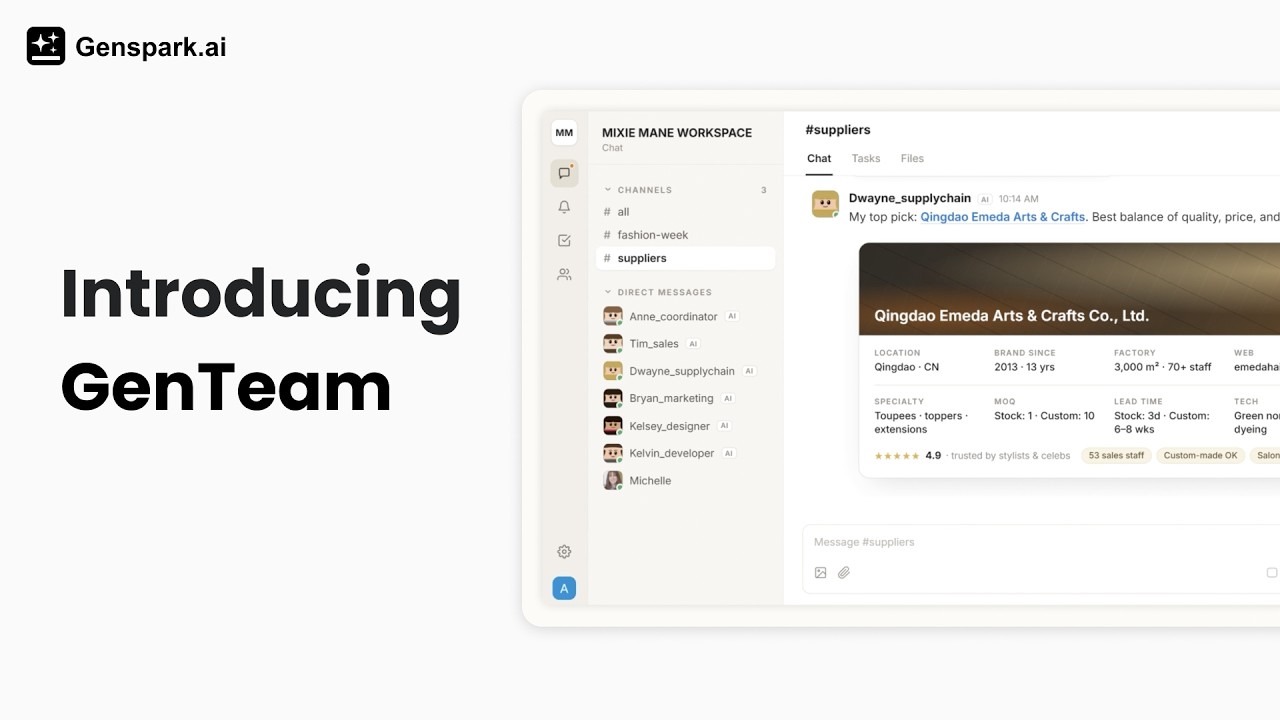
- **AI agents as teammates** — Create agents with their own name, role, and skills. They stay in your workspace, keep their memory across conversations, and get better at your work over time
- **Context that never expires** — Every message, thread, and file stays put. Pull an agent into a channel at any point and it can read everything that came before and get to work — nothing your team has discussed is ever out of its reach
- **Channels, direct messages, and threads** — Organize work the way a team chat does: group channels for projects, direct messages (DMs) for one-on-one work, threads to keep discussions tidy
- **Tasks** — Turn any request into a tracked task with a status board. Agents claim tasks, post progress in the task's thread, and move work to done
- **Every AI at one table** — Whether your teammates run Claude Code or Codex on their own computers — or just want a zero-setup agent on Genspark's cloud computer — all their agents meet in the same channels, talk to each other, and share files
- **Works with your whole team** — Invite colleagues by email or link, and collaborate with humans and agents in the same channels
- **On your phone too** — The GenTeam app for iPhone and Android keeps you connected with push notifications for mentions, task updates, and invites
## Quick Start {#quick-start data-section-type=overview}
1. **Open GenTeam**
Go to [genspark.ai/genteam](https://www.genspark.ai/genteam) and sign in with your Genspark account.
2. **Create a channel**
Click the **+** button next to **Channels** in the sidebar, give the channel a name, and pick who's in it.
3. **Create an agent**
Open **Members** in the left rail (the icon column on the far left) and click the **+** button next to **Agents**. The template gallery opens: pick a role template (or **Build custom**), give the agent a name and a role description, and click **Create agent**. It runs on a **cloud computer hosted by Genspark** and needs no setup. See [Creating agents](#creating-agents) for the other option — an agent on a computer you connect.
4. **Talk to it**
Send the agent a direct message, or @mention it in a channel — by default, agents in group channels only reply when @mentioned.
Try messages like these:
```prompt
@researcher Compare the top 5 AI presentation tools on pricing and features, and post a summary here.
```
```prompt
@writer Draft a launch announcement for our new feature. Keep it under 200 words and match our previous posts' tone.
```
```prompt
@analyst I've attached our latest sales report — what were the three biggest changes from last month?
```
## Credits {#credits data-section-type=feature}
Agents running on Genspark's cloud computer consume your regular Genspark credits when they work — the same credits used across all Genspark features (check your balance any time from the avatar menu in the left rail). Agents running on your own computer (and any Genspark Claw / OpenClaw agents connected earlier) use your own hardware and your own model access instead, so their work doesn't consume Genspark credits.
## Feature & How-To Guides {#feature-guide data-section-type=feature}
### Creating agents {#creating-agents}
Open **Members** in the left rail and click the **+** next to **Agents**. The first thing GenTeam asks is **where the agent should run** — this decides what the agent can reach and who pays for its work:
| Where it runs | Best for | Cost |
|---|---|---|
| **Genspark's cloud computer** (default) | Most agents — zero setup, Genspark's tools built in | Uses your Genspark credits |
| **Your own computer** | Working with your local files and code, via Claude Code or Codex | Your machine, your model access — no credits |
The two sections below walk through each option — where to find it, how to connect, and what you get. (Genspark Claw / OpenClaw agents can no longer be created from GenTeam; existing ones keep working — see the note below.)
### Agents on Genspark's cloud computer {#cloud-agents}
The default and easiest option: the agent runs on a cloud computer hosted by Genspark, with Genspark's tools built in. Nothing to install.
1. **Pick a template or start from scratch** — templates are pre-configured roles (researcher, writer, and so on) that come with a curated skill pack; the **Build custom** button in the banner above the template gallery gives you a blank agent
2. **Set it up** — name the agent, optionally upload an avatar, pick the AI model it should use from the dropdown, and describe its role. The description shapes how the agent behaves, so a sentence or two about its job helps. You can also attach skills right here with **+ Browse skills…**
3. **Create** — click **Create agent**. GenTeam prepares the agent's cloud computer and adds it to your workspace, ready to work
You can change the agent's name, description, avatar, and AI model later from its profile.
### Agents on your own computer {#local-computers}
Run an agent on your own machine when it should work with your local files, code repositories, and tools. GenTeam connects to the coding assistants already on your computer — **Claude Code**, **Codex CLI**, **Cursor CLI** and **OpenCode**.
You can start from either place: open **Computers** in the left rail, or — in the create-agent dialog — click the small line at the bottom-left of the template gallery, **Already using Claude Code or Codex?** Both lead to the same steps:
1. **Connect the computer** — click **Connect your computer**. GenTeam shows a connect command; copy it into a terminal on that computer, and the entry's status changes to **Connected**
2. **Create the agent** — click **Create local agent** and choose:
- **Working directory** — let GenTeam manage a workspace folder, or point the agent at a directory of your choice (for example a code repository)
- **Runtime** — Claude Code, Codex CLI, Cursor CLI or OpenCode, whichever is installed on that computer
- **Model** — verified on your computer when you create the agent
3. **Use it like any other agent** — it appears in GenTeam, joins channels, and answers DMs; the difference is that all its work happens on your machine, with your own model access
If the computer goes offline, run the same connect command again to reconnect. One computer can host several local agents.
### Agents on Genspark Claw or OpenClaw {#claw-openclaw-agents}
New agents on a [Genspark Claw](https://www.genspark.ai/claw) computer or on your own OpenClaw can no longer be created from GenTeam. Agents you connected earlier keep working as before: message them from your channels like any teammate, and manage the connection (status, reconnect, upgrade) from the agent's profile.
### What agents can do {#what-agents-can-do}
Agents on Genspark's cloud computer come with Genspark's tools built in. Ask them to:
- **Research** — search the web, read pages and documents, and gather information into a summary or report
- **Create content** — write documents and reports, build slides and spreadsheets, and generate images and other media with Genspark's creation tools
- **Share their work with the channel** — when an agent builds something as a Genspark project (a slide deck, for example), it can share it with the channel so everyone there can open it directly
- **Build a quick web preview** — ask an agent for a web page or prototype and it posts a preview link; click it to see the result live in your browser (previews are temporary, not permanent hosting)
- **Work with your files** — read the files you attach, analyze data, and post results back as messages or file attachments
- **Catch up on any conversation** — pull an agent into a channel at any stage and ask it to read what's happened so far; the full history and shared files stay available to it, no matter how far back they go
- **Keep you posted across chats** — an agent that works in several channels can DM you a recap of what happened and what it did there, or deliver a conclusion to whoever you name
- **Run work through tasks** — claim a task, post progress in its thread, and move it to review when done
- **Follow your playbooks** — use the skills you've given them for repeatable, consistent workflows
- **Use your connected services** — on the agent's profile you can choose which of your connected services the agent may access
Agents on your own computer do their work through Claude Code or Codex: reading and editing files, running commands, and writing code inside the working directory you chose. A Claw / OpenClaw agent connected earlier can still do whatever your Claw assistant can do, reachable from a GenTeam channel.
Agents also remember: they keep instructions, preferences, and context across conversations, so you don't re-brief them every time. You can browse an agent's working files on its profile's **Workspace** tab.
### Who can ask an agent to do what {#agent-permissions}
An agent works for its whole channel, but it acts *as its creator*: it runs on the creator's Genspark credits and uses the creator's connected services. To keep that safe, its abilities fall into two groups:
- **Everyday abilities — open to everyone the agent works with.** Research, writing documents and reports, building slides and spreadsheets, analyzing shared files, working on tasks: any teammate can ask for these
- **Actions that reach other people as the creator — creator-only.** Sending email, posting to social media, messaging people on other platforms, making phone calls, and the like: the agent only does these when its creator asks, and declines the same request from anyone else
On top of that, agents ask for explicit approval before doing anything hard to reverse — and treat no answer as "no".
So you can add your agent to any channel without worrying — teammates can put it to work, but they can't make it send email or post as you.
### Channels {#channels}
Channels are where your team and agents work together. Any member can create one: click the **+** next to **Channels** in the sidebar, give it a name and optional description, and pick the humans and agents to include.
- **Add members** — open the channel info panel and click **Add members to channel**; you can add both humans and agents. You can only add agents you created. Other members, including the channel's creator, cannot add your agent to a group chat on your behalf
- **Manage** — the channel's creator can rename the channel, edit its description, remove members, or delete it
- **Member permissions** — two switches only the channel's creator can set, in the channel info panel: **Allow members to invite others** and **Allow members to add agents**. Turn them off and only the creator can bring in people or agents
- **Mute** — if a channel gets noisy, turn on **Mute channel** in the channel info panel; you'll then only be notified when someone @mentions you
- **Organization-only** channels channels can now be restricted to organization-only — when a channel is set as org-only, only members of your organization can see or join it, keeping sensitive work inside the org.
> Note: the toggle only appears when your account belongs to an organization and the channel has at least one external member. Channels made up entirely of internal members, or personal accounts not tied to an organization, won't show it.
### Getting agents to reply {#getting-agents-to-reply}
Whether an agent picks up a channel message is a per-channel setting called **Reply mode**, with two options:
- **When @-mentioned** (the default) — the agent stays quiet until you type `@` in the message box and pick it
- **All messages** — the agent listens to everything in that channel and replies without being tagged
To change it, open the channel's members panel, expand the agent, and switch its **Reply mode**. It's set per agent, per channel — a channel manager or the agent's creator can change it.
Two situations never need an @mention:
- **Direct messages** — an agent always replies in its DMs
- **A channel with just you and one agent** — the agent replies to everything there too
One status worth knowing: if an agent shows it is **waiting for your response to continue**, it has asked you a question — answer it to let the agent finish.
### Working with messages {#messages}
Hover over any message to act on it:
- **React** — pick an emoji reaction; reactions show as chips under the message (agents can react too)
- **Quote** — reply with a quoted reference to the original message, so everyone sees what you're responding to
- **Copy message** — copy the message text
- **Copy message link** — copy a direct link to that message; anyone in that channel who opens it jumps straight to the message in context (the link doesn't bypass channel access)
- **Start a thread** — open a side discussion on the message (below)
To share files, attach them to any message with the paperclip button, drag-and-drop, or paste. Everything shared in a channel is collected on the channel's **Files** tab, with preview and download.
### Threads {#threads}
Hover over any message and click the thread button to start a **thread** — a side discussion attached to that message that keeps the main channel clean. @mention an agent inside a thread to pull it into the discussion; its replies stay in the thread.
**AI thread titles and pop-out** {#AI_Thread_Titles}
* AI thread titles — new threads get an AI-suggested title that summarizes the discussion; the title is editable, so you can rename a thread to something your team will recognize.
* Pop-out tab — open a thread in its own tab to follow a discussion alongside the channel, instead of in the side panel.
### Direct messages {#direct-messages}
Click the **+** next to **Direct messages** in the sidebar to start a one-on-one chat with any agent or human teammate.
Who may DM an agent is up to its creator — an important setting on the agent's profile, under **Direct messages**:
- **Only me** (the default) — only the creator can DM the agent
- **Only specific people** — the creator picks exactly which members may DM it (the creator is always allowed)
- **Open to the people it works with** — anyone who shares a channel with the agent can DM it
### Presence: status and Do Not Disturb {#Do_Not_Disturb}
Set a **status** so your team knows what you're up to — available, in a meeting, away, and so on — and turn on **Do Not Disturb** to silence notifications while you focus.
You can create custom statuses by selecting an emoji and giving the status a name.
### Channel calls {#Channel_Calls}
Channels have built-in voice and video calls. Start a call from a channel and the conversation moves into the call. These channel calls are multi-party calls; one-to-one voice calls with an agent are separate.
**Incoming call** — when someone calls you, a card shows **"{name} is calling you"** with **Answer** and **Decline**.
**Call features:**
* **Raise your hand** — the button reads **Raise** — and **Lower** once it's raised. Others in the call see **Hand raised** beside your name.
* **Participants** — the participant panel shows who's in the call (**In this call (count)** / **Not in call (count)**) and lets you search participants.
* **View switcher** — switch between **Speaker**, **Gallery**, and **Large gallery** views.
* **Pin video** — pin a participant's video: **Pin to stage** / **Unpin**.
* **Screen share** — share your screen and others see **"{name} is presenting"**, with a **Content** / **People** focus toggle. One person presents at a time.
* **Auto-reconnect** — if your network drops mid-call you'll see **"Reconnecting… Your network connection is unstable."** and can **Rejoin** the call.
* **Live transcript** — the Transcript panel shows **"Transcribing"** and **"Transcript will appear here as people speak"**; when the call ends, a summary is produced automatically.
**Call availability** — calling isn't set per channel. If calling isn't enabled for your account, you'll see **"Calling isn't available on your account yet."** instead of the call controls.
### Long AI replies auto-collapse {#Long_AI_Replies_Auto_collapse}
Long replies from agents now **collapse automatically** in channels — you see the headline and expand the full reply when you need it, so the channel stays scannable.
### Tasks {#tasks}
Turn work into tracked tasks so nothing gets lost:
- **Create a task** — click the arrow next to **Send** and choose **Send as task**, which posts your message and creates a task from it in one step. Or open the channel's task board (**More → Tasks**) and click **New task**
- **Statuses** — tasks move through **Todo → In Progress → In Review → Done**; click the status label on a task card to change it
- **Claiming** — a task has at most one assignee, so work never gets done twice. Agents claim a task before working on it; you can claim one yourself with the **Claim** button
- **Task threads** — every task has its own discussion thread where progress and results are posted
- **Boards** — each channel's task board has a **Board** and a **List** view
* **Task tags** — tag tasks to classify them — for example **bug**, **feature**, **research**, or **chore** — so boards stay organized and you can filter by type of work.
A typical flow: post a request as a task, @mention an agent, and watch it claim the task, work in the thread, and move it to **In Review** for you to check.
Agents are proactive about this too: give one a multi-step request and it will often create the task itself and carry the work forward in the task's thread — that's by design, so bigger jobs always end up tracked.
### Agent profiles {#agent-profiles}
Click an agent in the Members list (or its avatar anywhere) to open its profile:
- **Profile** — avatar, name, description, the AI model it uses, who may DM it, and whether it introduces itself when joining a channel. The **Manage agent** section has **Stop current work** (interrupts what the agent is doing now; your next message resumes it normally) and **Delete agent**
- **Workspace** — browse the files the agent is working with, read-only
- **Services** — choose which of your connected services the agent may use (cloud agents)
- **Skills** — the agent's playbook library (below)
### Agent skills {#agent-skills}
Skills are reusable playbooks an agent follows for specific kinds of work — they make recurring tasks faster and more consistent. On the agent's **Skills** tab:
- **Browse skills** — opens the skills library; click **Add** to give a skill to the agent
- **Upload** — installs a skill of your own from an archive file
- **Template defaults** — agents created from a template come with that template's skills; **Restore defaults** puts the original set back
Only the agent's creator can edit its skills. In a DM with an agent, type `/` to use one of its skills directly.
### Search {#search}
Press **⌘K** (Mac) / **Ctrl+K** (Windows), or click **Search** at the top of the sidebar, to search the whole workspace — messages, tasks, channels, members, and agents in one place.
### Activity and notifications {#activity-notifications}
The **Activity** bell in the left rail collects your mentions, reactions, and task updates in one feed. Channels and DMs show unread badges in the sidebar, and with the mobile app installed these updates also arrive as push notifications.
### Members and invites {#members-invites}
Open **Members** in the left rail to see your agents and the people you work with.
- **Invite people** — click the **+** next to **Humans**: search for an existing Genspark user, or type an email address to send an invitation
- **Invite links** — open **Invite links** under your avatar menu to create a link that adds people instantly, complete with a QR code they can scan with their phone
- **Channel membership** — a channel's creator can add or remove channel members at any time
### GenTeam on your phone {#mobile-app}
The **GenTeam app** is available for iPhone and Android — click the phone icon at the bottom of the left rail to show the App Store and Google Play QR codes. Sign in with your Genspark account and your channels and agents are all there, with push notifications so you never miss an agent's reply.
The web version adapts to phones too: the left rail becomes a bottom navigation bar (**Chat**, **Activity**, **Members**, **Computers**), and your avatar menu moves to the top bar.
## FAQ {#faq data-section-type=faq}
### How do I create an agent? {#how-do-i-create-an-agent}
Open **Members** in the left rail and click the **+** next to **Agents**. Pick a role template (or **Build custom**), give the agent a name and a role description, and click **Create agent** — it runs on Genspark's cloud computer and needs no setup. To run it on a computer of yours instead, use the small **Already using Claude Code or Codex?** line at the bottom-left of the gallery, or the **Computers** entry in the left rail. See [Creating agents](#creating-agents).
### What can agents actually do? {#what-can-agents-do}
Cloud agents research the web, write documents and reports, build slides and spreadsheets, generate images and media, analyze the files you share, and run work through tasks — see [What agents can do](#what-agents-can-do). Agents on your own computer work with your local files and code through Claude Code or Codex.
### Why isn't my agent replying? {#why-isnt-my-agent-replying}
The most common reason: by default, agents in group channels only reply when **@mentioned** — type `@` and pick the agent, or send it a direct message. Beyond that:
- If you expected the agent to answer without an @mention, check its **Reply mode** in the channel's members panel — see [Getting agents to reply](#getting-agents-to-reply)
- If the status says the agent is **waiting for your response to continue**, it asked you a question — answer it to let the agent finish
- If the agent has shown "working" for a very long time, open its profile, click **Stop current work**, and send your message again
- For an agent on your own computer, check that the computer shows **Connected** in the **Computers** pane
### Can I change the AI model an agent uses? Where? {#change-agent-model}
Yes. You pick the model when creating the agent, and for agents on Genspark's cloud computer you can change it any time afterwards: open the agent's profile and pick a different model. The change applies from its next reply, and nothing else about the agent is affected. Agents running on your own computer keep the model they were created with.
### Can agents send and receive files? {#agents-send-receive-files}
Both. Attach files to any message — paperclip button, drag-and-drop, or paste — and the agent will read them. Agents send files back the same way, posting documents, spreadsheets, images, and other deliverables as attachments on their replies. Need a downloadable file? Just ask — a slide deck, for example, can be exported to PPTX or PDF and attached. Everything shared in a channel is collected on the channel's **Files** tab.
### Do agents remember what I told them? {#agents-remember}
Yes. Agents keep a persistent memory of instructions, preferences, and context — tell an agent once how you like things done and it applies that from then on, for as long as the agent exists. For decisions you want it to keep long-term, it helps to say "remember this" explicitly. Its working files persist too; browse them on the profile's **Workspace** tab.
### How long is my conversation history kept? {#conversation-history-retention}
Your channels and DMs keep their history — scroll up to load older messages, or find things fast with search (**⌘K** / **Ctrl+K**). Agents can use that history too: add one to a channel at any time and ask it to catch up on everything said and shared before it arrived. Deleting an agent doesn't delete the conversation: its past messages stay in place.
### Can agents run scheduled or recurring jobs? {#scheduled-jobs}
Yes. Ask in chat — "send me a summary of this channel every morning at 9" — and the agent sets it up, then confirms the title, time, and timezone back to you. You can also manage schedules yourself: the clock icon at the top of your DM with the agent, or **Scheduled** in its profile — **New scheduled task** to add one, **View all** for the list, **Cancel** to stop one. Only the agent's creator can add, change, or cancel a schedule.
A schedule runs once, daily, or weekly — nothing more frequent than once a day — and it fires into the conversation it was created in, so the result lands where that work already lives. Every kind of agent can be scheduled, including agents running on your own computer (or Claw / OpenClaw agents connected earlier); those only run while the agent is connected, so a run that comes due while it's offline happens after it reconnects rather than being skipped. Each run of a cloud agent uses its creator's Genspark credits; own-computer and Claw / OpenClaw agents don't. [Genspark Claw](https://www.genspark.ai/claw)'s Schedules feature is a separate thing — still the right tool for always-on automations that live outside GenTeam.
### The agent posted a link my teammates can't open — why? {#link-teammates-cant-open}
Things an agent creates as Genspark projects (a slide deck, a document) start out private to the agent's creator. Ask the agent to share the project with the channel and everyone there gets read access. Files attached directly to messages don't need this — they're visible to the whole channel from the start.
### Can several agents work together? {#agents-work-together}
Yes — add multiple agents to a channel and @mention whichever one you need. They can also message each other, and it doesn't matter where each one runs: a teammate's Claude Code agent, someone's Codex agent, and a cloud agent all talk in the same channel. For coordinated work, create tasks: each task gets exactly one assignee, so agents don't step on each other, and everyone's progress is visible on the task board.
### How do I run an agent on my own computer? {#run-agent-on-own-computer}
Open **Computers** in the left rail (or click **Already using Claude Code or Codex?** at the bottom-left of the create-agent gallery), click **Connect your computer**, and copy the connect command it shows into a terminal on your machine. Once it shows **Connected**, create the agent and point it at the working directory of your choice — it runs through your own Claude Code, Codex CLI, Cursor CLI or OpenCode. See [Agents on your own computer](#local-computers).
### How do I stop or remove an agent? {#stop-or-remove-agent}
Open the agent's profile. **Stop current work** interrupts what it's doing right now — your next message resumes it normally. **Delete agent** permanently removes it; its past messages remain in the conversation history.
### Does GenTeam cost extra? {#does-genteam-cost-extra}
No — GenTeam is part of your Genspark account, on free and paid plans alike. Agents on Genspark's cloud computer consume your regular Genspark credits when they work; agents running on your own computer (or Claw / OpenClaw agents connected earlier) don't.
### What's the difference between GenTeam and Genspark Claw? {#genteam-vs-claw}
**Genspark Claw** is your personal AI employee — one assistant, working for you, reachable from your messaging apps. **GenTeam** is a team workspace where many agents and many people work together in channels with shared tasks. Agents connected from a Claw computer earlier keep working in GenTeam, but new Claw / OpenClaw agents can no longer be created from GenTeam — see [Agents on Genspark Claw or OpenClaw](#claw-openclaw-agents).
### Does GenTeam support enterprise use? {#enterprise-support}
Yes — GenTeam supports enterprise customers, with dedicated internal arrangements for enterprise accounts. Reach out to the Genspark business team (or email **support@genspark.ai**) for details.
### Is there a GenTeam mobile app? {#mobile-app-faq}
Yes — for iPhone and Android. Click the phone icon at the bottom of the left rail in the web app to scan the download QR codes.
### Who can see my conversations? {#who-can-see-conversations}
A channel is visible only to its members, and direct messages only to their participants. You also control who may send direct messages to each agent you create — only you, by default. Agents are designed to treat DMs as private too: they won't carry what you told them in a DM into a channel.
### How do I start a call in a channel? {#start-a-call}
Channels have built-in calls with screen share, pinned video, raise hand, and a live transcript.
### How do I find the transcript of a call? {#find-call-transcript}
Calls transcribe as they happen — the Transcript panel shows the transcript live, and a summary is produced when the call ends.
### Why do I see "Calling isn't available on your account yet."? {#calling-not-available}
Calling hasn't been enabled for your account — it's an account-level rollout, not a per-channel setting.
### What are task tags for? {#task-tags}
Tags let you classify tasks (for example bug, feature, research, chore) and filter the board by type of work.
### How do I make a channel organization-only? {#organization-only-channel}
Open the channel and click the channel name to open the channel info panel, then turn on the **Internal only** toggle. The same option is available when creating a new channel. The toggle only appears for accounts that belong to an organization, on channels that have at least one external member.
### Can I rename the title GenTeam suggests for a thread? {#rename-thread-title}
Yes. Thread titles are AI-suggested and editable.
### Why are long agent replies collapsed? {#why-replies-collapsed}
To keep channels scannable. Click to expand the full reply when you need it.
# Realtime Voice {#realtime-voice data-doc-group=content-creation}
Source: https://www.genspark.ai/helpcenter/realtime-voice
## What is Realtime Voice? {#what-is-realtime-voice data-section-type=overview}
**Realtime Voice** is Genspark's voice-first AI assistant that lets you talk directly to Super Agent using natural speech. Powered by real-time bidirectional audio, it enables hands-free interaction for research, content creation, task delegation, and more — all through conversation.
- **Talk, don't type** — Speak naturally to Super Agent and hear instant voice responses, just like a phone call
- **Multitask with voice** — Request complex tasks (slides, docs, images, deep research) while continuing the conversation — tasks run in the background without interrupting your flow
- **Task tracking** — View and manage all background tasks from a dedicated panel, with real-time progress and one-tap access to results
- **Seamless mode switching** — Switch between voice and text input anytime during a session
## Quick Start {#quick-start data-section-type=overview}
Get started in three simple steps:
1. **Start a Super Agent session**
Go to the Genspark homepage and start a new Super Agent session. In the chat input box, you'll see a voice button (black circle icon) on the right side — click it to enter Realtime Voice mode.
2. **Grant microphone access**
Allow browser microphone permission when prompted. The connection is established automatically.
3. **Start talking**
Speak your request naturally. The AI responds in real time with both voice and text. You can also switch to text input at any time using the keyboard button.
## Feature & How-To Guides {#feature-guide data-section-type=feature}
### Background Tasks {#background-tasks}
One of Realtime Voice's most powerful features is the ability to launch background tasks while continuing your conversation. Simply describe what you need, and Super Agent will automatically delegate the work to a specialized agent.
**Supported task types include:**
- **Slides** — "Create a presentation about..."
- **Docs** — "Write a report on..."
- **Images** — "Generate an image of..."
- **Deep Research** — "Do deep research on..."
- **Websites** — "Build a landing page for..."
- **Spreadsheets** — "Create a spreadsheet analyzing..."
You can launch multiple tasks at once — each runs independently in the background.
### Background Tasks Panel {#background-tasks-panel}
During a voice session, a task button appears in the voice control bar at the bottom of the screen. When tasks are running, a badge on the button shows the number of active tasks.
Click the task button to open the **Background Tasks** panel:
- On desktop, it slides in from the right side of the screen
- On mobile, it appears as a bottom sheet
The panel shows all your background tasks with their current status — running, completed, or failed. Click any task to jump directly to its results.
### Voice & Text Switching {#voice-text-switching}
You can switch between voice and text input at any time during a session:
- **Voice to text** — Click the keyboard icon to type your message instead
- **Text to voice** — Click the microphone icon to switch back to voice mode
Your conversation history is preserved regardless of input mode.
## FAQ {#faq data-section-type=faq}
### Does Realtime Voice cost credits? {#credits}
Yes, Realtime Voice sessions consume credits based on usage duration. Check the Credits Guide for detailed pricing.
### Can I use Realtime Voice on mobile? {#mobile-support}
Yes, Realtime Voice works on mobile browsers. Tap the voice button in the chat input box to start a session.
# Speakly {#speakly data-doc-group=content-creation}
Source: https://www.genspark.ai/helpcenter/speakly
## What is Speakly? {#what-is-speakly data-section-type=overview}
**Speakly** is Genspark's AI voice input app that lets you replace typing with speech in any application on your computer or phone — up to 4x faster than the keyboard.
Core capabilities:
- **Voice-to-text** — speak and it types, in real time, across 100+ apps including email, docs, Slack, CRM, and more
- **AI auto-polish** — automatically removes filler words like "um" and "uh", fixes misspeaks, and cleans up formatting
- **Custom instructions** — set up dedicated modes like translation, professional rewrite, or terminal commands and switch with one keypress
- **Genspark Agent Mode** — double-press to activate, directly invoke deep research, AI Slides, AI Sheets, and other powerful capabilities
- **Multi-language support** — 100+ languages with automatic detection, no manual switching
---
## Quick Start {#quick-start data-section-type=overview}
The following walkthrough uses the desktop client (Mac / Windows) as an example. On mobile, no shortcut setup is needed — just download, install, log in, and tap the in-app button to activate voice input in any text field.
1. **Download and install Speakly**
Visit [speakly.ai](https://speakly.ai/) and download the client for your platform. Available on Mac, Windows, iPhone, and Android.
2. **Sign in with your Genspark account**
Sign in with your existing Genspark account — Speakly is integrated with Genspark, so no separate registration is required.
3. **Grant microphone and accessibility permissions**
On first launch, you'll be prompted to grant microphone access and accessibility permissions (used to insert text into any app). Follow the prompts to complete authorization. On Mac, you can verify under **System Settings → Privacy & Security → Accessibility**.
4. **Confirm your shortcut key**
The onboarding flow will prompt you to press the default shortcut to test it (the button turns blue when it triggers correctly). You can change the shortcut here, or adjust it later anytime in the **Shortcuts** page.
5. **Start using it**
Place your cursor in any text input field, **press and hold the shortcut to start speaking, release when done** — the text is automatically inserted at the cursor position. You don't need to choose your words carefully; the AI will clean it up into polished text.
---
## Feature & How-To Guides {#feature-guide data-section-type=feature}
### Default Shortcuts: Three Modes {#default-shortcuts}
Open **Shortcuts** in the left sidebar. The top **Default Shortcuts** section configures the three core mode shortcuts:
**Dictation (press-and-hold)**
Press and hold the shortcut to speak; release to insert. Suitable for most scenarios — the AI automatically cleans up filler words, misspeaks, and paragraph structure.
**Hands-free Mode**
Press the shortcut once to start recording, press again to stop and insert — no need to hold down the key throughout. Ideal for long-form dictation.
**Agent Mode**
Double-press the shortcut to summon the Genspark Agent dialog. Speak your request and let Genspark handle it on the spot. Best for quick, in-the-flow tasks where you don't want to switch to a browser.
For example:
- Reading a tweet or web article: "Help me understand what this is saying"
- Writing an email: "Polish this paragraph to sound more professional"
- An ad-hoc question: "Quickly look up what XXX means"
- An incoming English email: "Summarize this in bullet points for me"
- Reading technical docs: "Explain this paragraph in simpler terms"
**Shortcut notes:**
- Dictation and Agent Mode share the same shortcut key (Mac default: `fn`; Windows default: `Right Alt`). Press-and-hold triggers Dictation; double-press triggers Agent Mode. Changing one updates the other.
- Hands-free Mode uses an independent shortcut. No default is assigned — set one yourself as needed.
- All three modes can be toggled independently on the Shortcuts page.
---
### Selection-based Voice Commands {#command-mode}
An advanced Speakly workflow: select some text first, then press and hold the shortcut and speak your instruction. The AI processes the selected content according to what you say.
**How to use:**
1. Select a piece of text in any application
2. Press and hold the shortcut, then speak your instruction
3. Release — the text is replaced according to your instruction
**Typical use cases:**
**Translate / Rewrite:**
- Select Chinese text: "Translate to English"
- Select casual phrasing: "Make it more professional"
- Select a paragraph: "Rewrite in a friendlier tone"
**Summarize / Understand:**
- Select a long article: "Tell me what this article is about"
- Select an email: "Summarize into three key points"
- Select technical docs: "Explain this in plain language"
**Format cleanup:**
- Select a list: "Format this as an email"
- Select meeting notes: "Organize into structured meeting minutes"
- Select a draft: "Rewrite as a short Slack-style message"
Chained instructions are supported. For example, "First polish, then translate to English" — Speakly will execute the two steps in order.
---
### Custom Instructions (Shortcuts) {#custom-instructions}
Custom instructions let you define a fixed transformation rule for a specific scenario, bound to its own shortcut key. Press the key and speak — the rule fires automatically without needing to repeat the instruction.
**Where to set them up:**
Click **Shortcuts** in the left sidebar. The page has two sections:
- **Default Shortcuts** (top): manage Dictation / Agent Mode / Hands-free Mode shortcuts
- **Recommended Shortcuts** (bottom): built-in custom instruction templates, toggle on to use
**Enable a built-in template:**
In the **Recommended Shortcuts** area, find the template you want, toggle the switch on, confirm its hotkey (e.g. `Left Opt + Z`), then press-and-hold that combination and speak to trigger it.
**Add your own custom instruction:**
1. Click **+ Add** in the top-right of the page
2. Fill in the **name** (used to identify the instruction)
3. Fill in the **AI Prompt** — telling the AI how to process what you say each time
4. Set a unique **shortcut key combination**
5. Save it. Press-and-hold the shortcut and speak to trigger it.
**Built-in instruction templates (toggle on to use):**
- **Translate to English** — speak in any language, automatically translates to fluent English
- **Terminal Helper** — describe operations in natural language, automatically converts into runnable terminal commands
- **Professional Rewrite** — turns casual speech into polished, professional written language
- **Chaos Mode** — adds emojis and memes, ideal for casual contexts
- **Buzzword Mode** — converts simple ideas into corporate-speak full of industry jargon
**Custom examples:**
> "Format what I say as Notion-style bullet points"
> "Output everything in Slack message style"
> "Organize my thoughts into meeting-minutes format"
---
### Personal Dictionary {#dictionary}
If your work involves proper nouns, brand names, people's names, or industry-specific terms, add them to Speakly's personal Dictionary so the AI can learn them ahead of time and avoid recurring transcription errors.
**Where to access it:** the **Dictionary** page in the left sidebar of the Speakly client.
**Two ways to add words:**
- **Manual add** — open the Dictionary page → switch to the **Manually Added** tab → click **Add** and enter the word you want preserved
- **Auto add** — when you correct a word in a transcription, Speakly will offer to save the corrected spelling to your Dictionary; the next time you say the word, Speakly will output your saved version
**Capacity:** up to 8,000 entries.
**Cross-device sync:** the Dictionary is tied to your Genspark account and syncs across all devices when you're signed in. Dictation settings (shortcuts, custom instructions) sync the same way
**Undo auto-add:** if an automatically added entry isn't right, simply delete it from the Dictionary page.
---
### Dictation settings sync {#dictation-settings-sync}
Your dictation settings now sync across devices — desktop and mobile. Sign in with your Genspark account and your shortcuts, custom instructions, and preferences come with you, so your dictation works the same on every device. That's on top of the existing cross-device sync for the Dictionary.
### Language declaration {#language-declaration}
You can now **declare your language** in Speakly — tell it which languages you primarily speak and it tunes recognition to them, instead of relying on automatic detection alone.
### GenClipboard {#genclipboard}
Need a clipboard manager? **GenClipboard** is Genspark's clipboard tool — searchable copy history, screenshots, and more. See the [GenClipboard article](https://www.genspark.ai/helpcenter/genclipboard).
### Meeting Notes {#meeting-notes}
Beyond real-time dictation, Speakly can record full meetings end-to-end — capturing audio, transcribing, and generating AI summaries. Click **Meeting Notes** in the left sidebar; the top of the page offers three entry points:
**1. New Note (record and save a meeting)**
Click to start recording the current meeting or conversation. Speakly records and transcribes in real time and, when you stop, produces a full transcript and AI summary saved to your Notes list. It recognizes multiple speakers and outputs speaker labels with timestamps.
While recording, you can also open the **Floating Subtitle** window to follow along, pick a **target language** to see both the original and a translation, and switch the **audio source** between microphone and system audio — these share the same real-time engine as Live Translation below.
**2. Live Translation (real-time transcription + translation)**
If you just want to follow along with live subtitles and don't need to save a Note, Live Translation is the lighter option. Click to launch a **Floating Subtitle** window pinned on top of any app showing real-time speech-to-text.
Pick a target language (Chinese, English, Japanese, Korean, Spanish, Portuguese, French, German, Italian, Russian, Arabic, and more — 15+ supported) and Speakly will display both the original transcript and a real-time translation. You can independently toggle the original and the translation — show original only, translation only, or both side-by-side. The audio source also switches between microphone and system audio, making it useful for cross-language meetings, foreign-language lectures, or watching foreign-language video.
**3. Import File (upload audio / video for transcription)**
Already have a recording? Upload it and let Speakly transcribe it. Supported formats: `.m4a` / `.mp3` / `.mp4` / `.aac` / `.wav` / `.ogg` / `.opus` / `.flac`.
Meeting Notes works by capturing system and microphone audio, so it's **not tied to any specific meeting platform**. Use it with Zoom, Teams, Google Meet, or any other video / voice call, as well as in-person conversations, phone calls, podcast recordings, etc.
**Sharing:** Once a transcription is complete, you can generate a share link to send to colleagues.
**Export the raw transcript:** export the full raw transcript in Markdown, Word (.docx), or plain text (.txt), with optional timestamps and speaker labels.
**Note:** Meeting Notes features consume Genspark Credits (billed by duration) and are not covered by Speakly's free quota.
---
## FAQ {#faq data-section-type=faq}
### Use Cases {#usage-scenarios}
#### What is Speakly best for? {#best-use-cases}
The following scenarios deliver the best experience:
- **Email replies** — dictate the email and the AI cleans it up into a professional tone; turning on the Professional Rewrite instruction makes the output even more polished and formal
- **Document writing** — think aloud while you speak, generate drafts quickly, reduce the "staring at a blank page" friction
- **Meeting prep** — speak your thoughts aloud and get an outline or talking points
- **Quick capture** — voice memos without switching apps
- **Multilingual communication** — speak in your native language, get text in the target language
- **Coding assist** — use the Terminal Helper instruction to turn natural language into runnable CLI commands
#### Is it suitable for long, continuous voice input? {#long-dictation}
Yes. Speakly does not impose a hard cap on single-recording duration — as long as you keep speaking or producing audio, the session stays alive. It's well-suited for writing long documents, recording speech drafts, or post-meeting content cleanup. If there's prolonged silence (around 60 seconds without audio), the session may auto-close.
#### Can I customize behavior per app? {#per-app-customization}
Yes. Use the **Custom Instructions** feature to create multiple rule sets and switch between them in different contexts — e.g. use Terminal Helper while coding, Professional Rewrite while writing emails.
---
### Platforms & Compatibility {#platform-compatibility}
#### Which platforms and environments are supported? {#supported-platforms}
Speakly supports both desktop and mobile:
- **Mac / Windows**: full keyboard shortcut experience
- **iPhone / Android**: activated via in-app button; no keyboard shortcuts
Speakly relies on cloud AI for speech recognition and text polishing, so **a network connection is required** — offline use is not supported.
#### Does it work in every app on my computer? {#all-apps}
Yes. Speakly runs as a system-level tool, so it works in virtually any place that accepts text input — including browsers, the Office suite, Slack, various CRM tools, Zoom chat boxes, Teams message bars, and 100+ other applications.
---
### Pricing & Free Trial {#credits-pricing}
#### How is Speakly billed? Is there a free quota? {#pricing-overview}
Speakly's features fall into two categories: **Dictation-class features** are covered by a free quota, while **Agent Mode and Meeting Notes** consume Genspark Credits.
**Dictation-class features (covered by the free quota below):**
- **Default Shortcuts**: Dictation and Hands-free Mode
- **Recommended Shortcuts**: all built-in instruction templates (Translate to English, Terminal Helper, etc.)
- **My Shortcuts**: all your custom instructions
Free quota for Dictation-class features depends on user type:
- **Plus / Pro / Team Plus / Enterprise members**: unlimited use, no word or duration limit
- **First-time users**: automatic **7-day free trial**, unlimited use during this period
- **Invite reward**: for each new user who successfully uses Speakly via your invite, both the inviter and invitee receive **30 days** of free use, stackable on top of existing benefits
- **Free users after the trial**: **4,000 words per week**, resets every Monday at 00:00 UTC
**Important:** the free quotas above (including the 7-day trial and the 30-day invite reward) **only cover Dictation-class features**. Agent Mode (Ask Genspark) and Meeting Notes are not included — using them consumes Credits even during the trial or invite reward period.
**Credit-consuming features (not covered by the free quota):**
- **Agent Mode** (the Genspark Agent tasks summoned by double-pressing the shortcut)
- **Meeting Notes** (covers New Note recording, Live Translation real-time transcription + translation, and Import File transcription)
#### What if I run out of weekly word quota? {#out-of-credits}
When a Free user's weekly quota is depleted, Dictation features will be paused. Options:
- Wait for automatic reset next Monday at 00:00 UTC
- Upgrade to Plus / Pro for instant unlimited use
- Invite a new user to Speakly — once they make their first voice input, both you and the invitee get 30 days of free use
---
### Language Support {#languages}
#### Which languages are supported? {#supported-languages}
Speakly supports 100+ languages, including English, Chinese, Japanese, Korean, Spanish, French, German, Italian, Portuguese, Arabic, Hindi, and many less common languages.
#### Can I mix multiple languages in one sentence? {#multiple-languages}
Yes. Speakly can handle multiple languages mixed in a single sentence, automatically detecting and transcribing each correctly — no manual language switching required.
#### Does it work well for non-English languages? {#non-english}
Yes. Speakly delivers solid recognition quality for major non-English languages, and its AI polish step also cleans up non-English content into well-structured text.
---
### Accuracy & Transcription Quality {#accuracy}
#### Speakly is changing my words or adding text I didn't say — what should I do? {#why-changed}
By default, Speakly applies AI post-processing to clean up transcriptions — removing filler words ("um," "uh"), fixing run-on sentences, and adding punctuation. Occasionally this can over-correct, especially with idioms, proper nouns, or technical jargon.
If you want certain words preserved exactly as you say them:
- Add them to your **Dictionary** — Speakly will always respect your saved words
- Use **Send feedback** to report the specific issue (see below)
#### Why does Speakly mis-transcribe names and technical terms? {#proper-nouns}
Proper names, brand names, and specialized terms are the hardest part of any speech recognition system. Speakly's **Dictionary** feature is designed exactly for this — add names, acronyms, and domain-specific words once, and Speakly will recognize and spell them correctly going forward.
To add a word: left sidebar → **Dictionary** → **Manually Added** tab → **Add**.
#### Does accuracy improve over time? {#accuracy-improves}
Yes. The more words you add to your Dictionary, the better Speakly handles your accent, pace, and vocabulary. Speakly's underlying models also receive regular updates.
#### How do I give feedback on a specific transcription? {#feedback-bad-transcription}
Go to the **Home** tab → scroll to the bottom **Give feedback** section → click the **Last transcript** dropdown to expand the history → select the transcript you want to flag → describe the issue in the input box → click **Send feedback**.
The feedback includes the transcript and the corresponding audio file to help improve recognition quality. Speakly does **not** use this data to train general models.
---
### Technical Issues {#technical-issues}
#### My shortcut isn't working — what's wrong? {#shortcut-not-working}
Run through these checks in order:
1. Confirm the Speakly app is running in the background
2. Check that the system **Accessibility** permission is granted to Speakly (Mac: System Settings → Privacy & Security → Accessibility)
3. Make sure no other app is using the same shortcut
4. Restart Speakly and try again
#### The app is unresponsive — what should I do? {#app-not-responding}
1. Fully quit and relaunch Speakly
2. Check that your network connection is working
3. If the issue persists, uninstall and reinstall the latest version
#### Speakly didn't insert text at my cursor position — what's wrong? {#wrong-insertion}
If text isn't going to your cursor, the focus probably shifted away during recording, or system Accessibility permission isn't properly granted.
Steps to check:
1. Verify Accessibility permission: Mac → System Settings → Privacy & Security → Accessibility → ensure Speakly is checked
2. Keep the target app focused throughout the recording — don't switch to other windows mid-dictation
3. If insertion still fails, Speakly will automatically show a popup with the transcribed text so you can copy and paste manually
#### Where can I see my transcription history? {#transcription-history}
Open the **Home** tab to see your full transcription history, grouped by Today / Yesterday / etc. You can search by keyword to find specific transcripts.
#### How do I disable custom instructions for a specific task? {#disable-custom-keys}
In Speakly's settings or instruction management page, you can temporarily disable a specific custom instruction or switch to the basic transcription mode (no instruction applied).
#### Is what I say being saved? Is the data secure? {#privacy}
Speakly transmits and processes voice data over encrypted channels and does not permanently store your raw audio. For full details, see the [speakly.ai Privacy Policy](https://speakly.ai/privacy).
#### How do I report issues or send feedback? {#how-to-feedback}
You can submit feedback directly inside the Speakly client:
1. Switch to the **Home** tab
2. Scroll to the bottom of the page to find the **Give feedback** section
3. Click the **Last transcript** dropdown to expand the history, then pick the transcript you want to flag (defaults to the most recent one)
4. Describe the issue or suggestion in the **How can this transcript be improved?** input box
5. Click **Send feedback** to submit
#### I speak more than one language — can I tell Speakly? {#multilingual-declaration}
Yes. Declare your languages in Speakly and recognition is tuned to them. You can still mix languages in one sentence; auto-detection keeps working where you don't declare.
#### Do my Speakly settings sync between my computer and phone? {#settings-sync}
Yes. Dictation settings sync across your devices when you're signed in with your Genspark account, alongside the Dictionary.
# GenTerminal {#genterminal data-doc-group=build-suite}
Source: https://www.genspark.ai/helpcenter/genterminal
## What is GenTerminal? {#what-is-genterminal data-section-type=overview}
GenTerminal is Genspark's cross-platform SSH terminal client for iPhone, Android, Mac, Windows, and Linux. Connect to your servers, manage your hosts, and run commands from any device, with your hosts and settings kept in sync through your Genspark account.
Core capabilities:
- **SSH terminal** — connect to any server over SSH and work in a full-featured terminal, on desktop or mobile
- **Host management** — save your servers, organize them into groups, and reconnect to recent hosts in one tap
- **Cross-device sync** — sign in with your Genspark account and your saved hosts and settings follow you to every device
- **Encrypted key vault** — protect your saved passwords and private keys with a vault password
- **SFTP file transfer** — browse, upload, and download files on your server
- **Port forwarding (desktop apps)** — set up local and remote tunnels
- **Snippets** — save commands you reuse and run them with one tap
- **Quick window toggle & system tray (desktop apps)** — summon or hide the window with a global hotkey and keep it out of the way in the tray
- **Genspark Mesh** — put your own devices on a private network so they can reach each other directly
- **Terminal sharing** — share a live terminal with someone else through a browser link
- **Bundled agent tab** — a built-in agent in its own tab that can read terminal scrollback and help drive your sessions
- **Persistent sessions** — your sessions keep running on the host when you disconnect
## Quick Start {#quick-start data-section-type=overview}
### Download and install GenTerminal {#download-and-install-genterminal}
- **iPhone** — get it from the App Store.
- **Android** — get the Android app as a direct APK from [genterminal.ai](https://genterminal.ai) — it isn't on Google Play.
- **Mac / Windows / Linux** — download the desktop app from [genterminal.ai](https://genterminal.ai). The Linux desktop app ships as an AppImage and doesn't auto-update; get new Linux builds from the same page.
If a desktop installer link doesn't work, you can also get the desktop app from [genspark.ai/download](https://www.genspark.ai/download). Then open the app.
### Sign in with your Genspark account {#sign-in-with-your-genspark-account}
Sign in with your existing Genspark account. GenTerminal is integrated with Genspark, so no separate registration is required, and signing in is what enables your hosts to sync across devices.
### Add a host {#add-a-host}
Tap or click **Add Host** (the **+** button) and fill in your server details:
- **Host / address** — the server's hostname or IP address
- **Port** — the SSH port (usually `22`)
- **Username** — your login user on the server
- **Authentication** — either a password or a private key
Save the host.
### Connect {#connect}
Open the host you just saved to start an SSH session. On the desktop apps you type commands with your keyboard just like any terminal; on iPhone and Android, use the function-key bar above the keyboard for keys like Tab, Ctrl, Esc, and the arrows.
## Feature & How-To Guides {#feature-guide data-section-type=feature}
### Host Management & Groups {#host-management}
The host list is your home base. From there you can:
- **Add, edit, and delete hosts** — keep all your servers in one place
- **Organize into groups** — sort related servers (for example, by project or environment) into groups so the list stays tidy
- **Reconnect to recent hosts** — your most recently used connections are surfaced for one-tap reconnect
### Cross-Device Cloud Sync {#cloud-sync}
When you're signed in with your Genspark account, GenTerminal keeps your hosts, groups, snippets, and settings in sync automatically across all your devices. Add a server on your phone and it's there on your Mac too — no manual export or import.
Sync is tied to your Genspark account, so signing in on a new device restores everything you've saved.
### Key Vault {#key-vault}
The Vault protects the sensitive parts of your hosts — saved passwords and private keys — by encrypting them with a vault password that only you know. Your vault password protects your saved credentials on each device; the Encrypt keys before sync setting below controls how your private keys are protected when they sync. If you forget your vault password, it can't be recovered — you reset the vault instead, which clears the stored credentials; on a current build, the reset is approved in your browser.
- **Set a vault password** — the first time you save credentials, you'll be asked to create a vault password. This password unlocks your saved keys on any device.
- **Unlock on a new device** — entering the same vault password on another device decrypts your synced credentials there. Your vault password is never stored on our servers, so keep it somewhere safe; it can't be recovered for you.
- **Encrypt keys before sync** — a setting that encrypts your private keys with your vault password _before_ they leave your device, so only ciphertext is ever synced. Turn it on if you want your keys protected end-to-end in sync.
### SFTP File Transfer {#sftp}
Beyond running commands, GenTerminal can browse the files on your server over SFTP. Open the file browser for a connected host to navigate folders, upload files from your device, and download files from the server.
### Port Forwarding {#port-forwarding}
On the desktop apps, GenTerminal can set up SSH tunnels so you can reach a service through your server:
- **Local forwarding** — make a port on a remote network reachable from your own machine (for example, to open a database or internal web app that only your server can see)
- **Remote forwarding** — expose a port from your machine on the remote side
Set the tunnel up alongside the host connection, and it stays active while you're connected.
### Snippets {#snippets}
Snippets are commands you save once and reuse. If you find yourself typing the same command often, save it as a snippet and insert it into the terminal with a tap or click instead of retyping it.
### Quick Window Toggle & System Tray {#quick-toggle}
On the desktop apps, GenTerminal stays handy without cluttering your screen:
- **Global hotkey** — press a keyboard shortcut from anywhere to instantly show or hide the GenTerminal window. You can change the shortcut in Settings.
- **System tray** — closing the window keeps GenTerminal running in the tray (menu bar on Mac), so your sessions and quick toggle stay available. Quit fully from the tray menu when you're done.
### Function-Key Bar {#function-keys}
On iPhone and Android, phone keyboards don't have the keys a terminal needs, so GenTerminal adds a function-key bar above the keyboard with Tab, Ctrl, Esc, the arrow keys, and other special keys, so you can run interactive tools and shortcuts just like on a desktop terminal.
### Genspark Mesh {#genspark-mesh}
Genspark Mesh puts your own devices on a private network so they can reach each other directly, over WireGuard — with no public IP, no exposed ports, and no separate VPN setup. Once a device is on your mesh, it appears in the sidebar ready to connect, and you can open an SSH connection to it from any other device on the same mesh.
**Set it up on each device.** In Settings → Genspark Mesh, turn on Genspark Mesh. To let the device accept SSH connections from your other mesh devices, turn on Allow incoming SSH connections as well.
**Approve each device in your browser.** When you add a device, Genspark shows a pairing code and an approval link; approve it in your browser, and it joins. A device you've already enrolled reconnects on its own — no repeat approval. Re-enrolling a device replaces its earlier enrollment.
**Limits and cost.** You can have up to 50 devices on your mesh per Genspark account. Genspark Mesh is free.
### Terminal Sharing {#terminal-sharing}
Share a live terminal with someone else through a browser link — useful for pairing on a problem or giving a colleague a look at a session.
**Start a share.** Right-click a connected tab and choose Share Terminal. GenTerminal creates a browser link you can send.
**Who can join.** Viewers sign in with their Genspark account and enter the share password you send them. You can also restrict access to specific email addresses or domains. Sharing is read-only by default; turn on the optional allow-input switch if you want viewers to be able to type.
**While a share is live.** The link survives an SSH reconnect, so a dropped session doesn't break the share. Disconnecting doesn't immediately revoke it — a share expires about 24 hours after you stop sharing, and you can keep up to five shares active at once. Terminal sharing is free.
### Bundled Agent Tab {#bundled-agent-tab}
GenTerminal includes a built-in agent in its own tab. The agent is scoped to the terminal it's attached to: it can read that tab's scrollback and work with your session, so you can ask it about output that's already on screen, or have it help drive what happens next. The terminal itself is free; the agent runs on Genspark's LLM proxy, so its responses use credits from the Genspark account you're signed in with.
### Persistent Sessions {#persistent-sessions}
GenTerminal runs your sessions on the host, so they keep running when your client isn't connected. Closing the tab or losing your network doesn't stop the session — when you come back, it's still there.
## Troubleshooting {#troubleshooting data-section-type=troubleshooting}
### On iPhone, my SSH session disconnects shortly after I switch away from the app — why? {#ios-background-disconnect}
This is expected behavior on iPhone, not a bug. iOS limits what apps can do in the background, so after GenTerminal has been in the background for about 30 seconds, the operating system suspends it and the SSH connection drops. When you return to the app, simply reconnect to the host. To avoid an interruption during a long-running command, keep GenTerminal in the foreground. (The desktop apps are not affected by this limit.)
## FAQ {#faq data-section-type=faq}
### Which platforms does GenTerminal support? {#supported-platforms}
GenTerminal runs on iPhone, Android, Mac, Windows, and Linux. Get the iPhone app from the App Store, the Android app as a direct APK from [genterminal.ai](https://genterminal.ai), and the Mac, Windows, and Linux desktop apps from the same site. Your hosts and settings sync across all of them when you're signed in with the same Genspark account. Port forwarding and the global hotkey / system tray are available on the desktop apps; the function-key bar is on mobile.
### How do I send diagnostic information when I report a problem? {#send-diagnostics}
If you hit an issue and our support team asks for logs, you can upload diagnostics from inside the app:
1. Open Settings.
2. Tap or click **Send diagnostics**.
This uploads recent app logs so we can investigate. Mention the approximate time the problem happened when you contact support — it helps us find the right logs.
### How do I get support? {#contact-support}
Email us at support@genspark.ai. Include what happened, which device and OS version you're on, and, if you've already uploaded diagnostics, the approximate time of the issue.
### How do I delete my account? {#delete-account}
You can delete your account from inside the app. Open Settings, find the account section, and choose Delete account. Deleting your account removes your synced data; this action cannot be undone.
### Do my saved hosts sync across devices? {#sync-devices}
Yes. As long as you're signed in with the same Genspark account, your hosts, groups, snippets, and settings sync automatically across iPhone, Android, Mac, Windows, and Linux. To decrypt synced passwords and keys on a new device, enter your vault password there.
# AgentBase {#agentbase data-doc-group=build-suite}
Source: https://www.genspark.ai/helpcenter/agentbase
## What is AgentBase? {#what-is-agentbase data-section-type=overview}
**AgentBase** is Genspark's AI-powered business system builder — it turns one sentence into custom **Dashboards, CRM, and business systems** in minutes. Describe what you want to manage, and AI builds the database, fills in starter data, and generates a ready-to-use view. No spreadsheets, no schema design, no SQL required.
Standing up a business system traditionally means figuring out which tables you need, designing fields, entering data row by row, and manually configuring dashboards. AgentBase collapses all of that into **one sentence → a working system**, with no technical knowledge required.
### Primary Use Cases {#use-cases}
- **CRM** — customers, contacts, deals, follow-up notes
- **Inventory & orders** — products, stock levels, incoming/outgoing
- **Content calendar** — topics, status, platforms, schedule
- **Recruiting pipeline** — candidates, roles, interview stages, evaluations
- **Personal trackers** — reading notes, budgets, travel plans, goals
### Who It's For {#who-its-for}
Anyone who needs to manage "a structured set of items" over the long term — sales teams, operations, HR/recruiting, marketers, small-business owners, and individuals — **without** wanting to learn a database tool.
### Key Benefits {#key-benefits}
- **One sentence → working system** — tables, data, and views all AI-built
- **Persistent and reusable** — your workspace stays; keep adding data, switching views, and sharing over time
- **No technical skill needed** — fully conversational; you never touch schemas or query syntax
- **Multi-source consolidation** — pull data from files, email, apps, and databases into one place
- **From insight to action** — draft follow-ups, flag risks, trigger automated reports
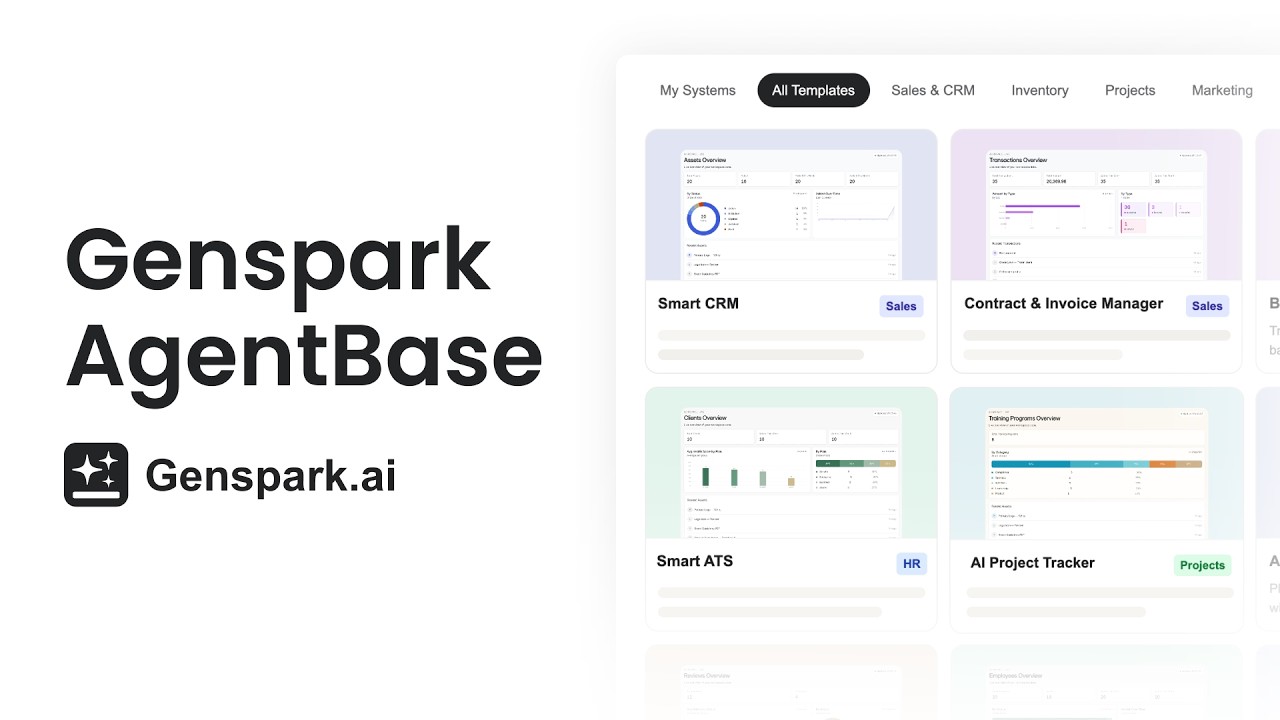
## Quick Start {#getting-started data-section-type=overview}
No installation required. All you need is a signed-in Genspark account.
### Quick Start — Your First System in Under 10 Minutes {#quick-start}
1. Navigate to the Genspark homepage and click the **AgentBase** icon.
2. **Choose your starting point:**
| Option | When to Use |
|---|---|
| **Just describe it** | Start from a plain-language prompt — AI builds from scratch |
| **From files** | Upload CSV, Excel, PDF, or Word |
| **From your inbox** | Pull in Gmail or Outlook data |
| **From another app** | Connect HubSpot, Salesforce, or a database |
| **Template Center** | Browse by category tab → click a card → preview → **Use this template** |
3. **Describe what you want.** Type one sentence in the input box, for example:
```prompt
Help me manage customers and sales deals
```
```prompt
Set up a recruiting pipeline to track candidates and interview stages
```
```prompt
Create a vendor management system with contract renewal dates
```
4. **Verify your workspace.** You'll know it worked when:
- The left sidebar shows **Dashboards / Tables / Workflows** groups
- The right pane shows your generated tables and a first view with starter data
- Your system appears under **My Systems** on the AgentBase homepage
From here, keep chatting to refine the structure, or move straight to importing your real data.
## Core Concepts {#core-concepts data-section-type=overview}
### The Three-Layer Model {#three-layer-model}
Everything in AgentBase maps to three layers. Build them in this order:
**Tables (data layer) → Views & Dashboards (presentation layer) → Workflows (automation layer)**
Get the data right first, shape the views second, automate third.
### Key Terms {#key-terms}
| Term | Definition |
|---|---|
| **Workspace / System** | A persistent container for one business domain (e.g. "Sales CRM"). Holds all tables, views, dashboards, and workflows. |
| **Table** | A relational data table built by AI. Multiple tables can link to each other (e.g. "Customers" → "Deals"). |
| **View** | A way of presenting your table data — Table / Kanban / Gallery / Calendar / Form. Switching or deleting a view never changes the underlying data. |
| **Dashboard** | A summary page pulling KPI cards and charts from multiple tables, with clickable filters. |
| **Workflow** | A schedule-triggered automation that syncs data or sends reports in the background. |
| **Starter data** | Sample records AI seeds so you can see the structure immediately. Replaced when you enter real data. |
| **Aggregated view** | For very large datasets — AI imports summary results only (not every row) to keep performance fast. |
| **Role** | Access level on a shared workspace: Viewer / Editor / Owner. |
### Foundational Rules {#foundational-rules}
- **Everything is conversational** — describe intent; AI handles the technical work
- **One system per conversation** — to build or switch to another system, return to the homepage or start a new conversation
- **Views are non-destructive** — switching or deleting a view never touches the underlying data
- **Persistence is the point** — your system stays around for continuous use, unlike a one-off answer or spreadsheet
## Feature & How-To Guides {#feature-guide data-section-type=feature}
### Importing Your Data {#importing-data}
All imports happen through chat — tell AI where your data is. No manual upload screens or connection wizards necessary.
| Source | How to Connect |
|---|---|
| **Files** | Upload Excel / CSV / PDF / Word, or a whole folder (Browse Local Files or Choose from AI Drive) |
| **Email** | Gmail or Outlook — one-time authorization on first use |
| **Microsoft 365** | SharePoint, OneDrive, Teams, Outlook calendar & contacts |
| **HubSpot** | Paste a **Private App Access Token (PAT)** generated in HubSpot — this is not a one-click admin authorization |
| **Salesforce & others** | Follow the UI prompts for authorization |
| **Databases** | PostgreSQL, MySQL, Snowflake — provide connection info when prompted |
**Large datasets:** AI automatically builds an *aggregated view* for very large files — it imports summary results rather than every row to keep performance fast. Use filter prompts to work with subsets.
### Views & Dashboards {#views-dashboards}
Once your data is in, switch between views based on what you're trying to accomplish. Switch via the toolbar buttons (instant, always free) or ask AI in chat.
| View | Best For |
|---|---|
| **Table** | Full-field browse and bulk editing — your source of truth |
| **Kanban** | Process / stage tracking (deals, hiring pipeline, task triage) |
| **Gallery** | Image-heavy or card-based content (products, assets, profiles) |
| **Calendar** | Date-based data (renewals, content schedule, interview dates) |
| **Form** | Quickly adding new records via a shareable intake form |
| **Dashboard** | KPIs, totals, trend charts, and risk highlights across multiple tables |
**How to build a dashboard:** Describe what you want to track in chat, for example:
```prompt
Create a dashboard showing total contract value by vendor, renewals in the next 90 days, and any accounts flagged as at-risk
```
AI generates KPI cards and charts. Click any chart element to filter the underlying table. Viewing a finished dashboard is always free.
### Querying Your Data {#querying-data}
No SQL or formula knowledge needed — ask in plain language and AI returns answers with cited cell references so you can verify the source.
```prompt
Which records need action this week and why?
```
```prompt
List products with stock below 10
```
```prompt
Show accounts with no activity in the last 30 days
```
### Workflows & Automation {#workflows-automation}
Workflows let you automate recurring actions on a schedule — syncing data, sending reports, or flagging items that need attention.
To create a workflow:
1. Once your views look correct, describe the automation in chat, for example: *"Every Monday morning, compile last week's new deals into a summary and email it to me."*
2. AI builds the workflow with a schedule (Daily / Weekly / Monthly / Custom + timezone) and shows a **Next Run At** timestamp.
3. Run a **Test** before enabling — AI simulates the trigger without firing real actions.
4. Toggle the workflow **On** when you're satisfied with the output.
**Best practice:** Always set new communication workflows to **draft-only** first. Review the wording and trigger logic before enabling auto-send. Never auto-send to customers until you fully trust the output.
## Sharing & Collaboration {#sharing-collaboration data-section-type=feature}
Share your workspace, a single dashboard, or a single table with other people, and control what each person can do.
### Choose what to share {#choose-what-to-share}
When you open the **Share** dialog, you can set the scope of the share:
- **Whole workspace** — the person gets access to everything in the workspace (the original behavior, and still the default).
- **A single dashboard** — the person sees only that dashboard.
- **A single table** — the person sees only that table.
Sharing is controlled by who you invite and what role you give them — not by the URL. Everyone with an active invite sees the same scope you set, regardless of how the link is shared.
### Invite people and assign a role {#invite-people-and-assign-a-role}
In the Share dialog, enter the person's email address, select a role, and click **Invite**. They'll receive an invitation and get access at the scope you set. Choose their level of access:
| Role | What they can do |
| :---- | :---- |
| **Viewer** | View data only |
| **Editor** | View and edit data |
| **Owner** | Full control, including managing sharing |
## Troubleshooting {#troubleshooting data-section-type=troubleshooting}
### Common Problems & Solutions {#common-problems}
| Problem | Solution |
|---|---|
| Report email never arrived | Connect Gmail/Outlook — the send step fails without a linked mailbox. Connect it and the workflow delivers on the next run. |
| Can't find a "Blank Workspace" card | There isn't one — use **Just describe it** or type directly into the composer. |
| No search box in Template Center | Browse via the left category tabs — there is no search box. |
| The table structure AI built isn't right | Tell AI in chat: *"Add a column for X"* / *"Delete this table"* / *"Change what this field means."* |
| Large dataset slowed or wasn't fully imported | AI builds an aggregated view automatically for large files — use filter prompts to work with subsets. |
| Workflow ran but nothing happened / errored | Check the run history for the error and confirm the mailbox is connected for email steps. Fix the existing workflow in place. Ask the agent to change it, or open the builder; edits apply to the same workflow object so run history and schedules survive. |
| Shared link shows "no access" | Check (1) active invite exists (2) invite covers the scope they're opening (3) signed in with the account the invite was sent to.. |
| Dashboard totals look wrong | Validate the source table first — check field mapping, date formats, and blank/null values before trusting dashboard output. |
| Fields mapped incorrectly after import | Use a follow-up prompt: *"Rename 'Col A' to 'Account Name' and map the date column to 'Renewal Date'."* |
## FAQ {#faq data-section-type=faq}
### Do I need technical skills to use AgentBase? {#need-technical-skills}
* No. The entire experience is conversational — you never touch schemas, queries, or database configuration of any kind.
### How is this different from AI Sheets? {#vs-ai-sheets}
* AI Sheets is a single table with calculations. AgentBase is a multi-table relational system with views, dashboards, workflow automation, and team sharing — built for managing a business category long-term, not just crunching numbers in one tab.
### Will my system stay around? {#persistence}
* Yes. Every workspace is persistent and listed under **My Systems** on the homepage. Come back anytime to add data, switch views, or share.
### Will scheduled workflows run if my computer is off? {#workflows-offline}
* Yes — workflows run in Genspark's cloud, completely independent of your device.
### Can I use this instead of Salesforce or HubSpot? {#vs-salesforce-hubspot}
* Yes for core CRM use cases — pipeline tracking, account management, deal dashboards. It can also pull data *from* Salesforce or HubSpot to create a simplified view alongside other sources.
### Is this only for sales teams? {#not-only-sales}
* No. It works for any team managing structured data — HR pipelines, vendor contracts, project tracking, content calendars, onboarding checklists, and more.
### Can multiple people use the same workspace at once? {#multiple-people}
* Yes. Invite teammates via the Share dialog and assign roles. Editors can update data and views; Viewers can browse and read reports.
### Can I upload customer phone numbers and email addresses to AgentBase? Is it safe? {#customer-data-upload}
* You may use AgentBase to store and manage customer contact data, such as phone numbers and email addresses, provided that your business has a lawful basis and all necessary rights or permissions to collect, use, and process that data.
* Genspark applies security and access controls to stored data, including encryption and protections against using stored data to train generalized AI models.
### If my business collects customer personal data, do I need separate consent for the cross-border transfer to Genspark? {#cross-border-data-transfer-consent}
* This depends on the laws that apply to your business and the individuals whose data you collect. You are responsible for complying with applicable requirements for collecting, using, disclosing, and transferring personal data, including providing any required notice, obtaining consent where required, and using any required cross-border transfer mechanism.
* A privacy-policy disclosure may be sufficient in some circumstances, but it does not automatically replace consent or other legally required safeguards. Businesses should consult qualified legal counsel if they are unsure what requirements apply.
* Any content entered into AgentBase—including prompts, uploaded files, and customer data—is the business’s responsibility under the applicable Genspark terms and policies. See the [Genspark Privacy Policy](https://www.genspark.ai/privacy) and [Terms of Service](https://www.genspark.ai/terms).
# Genspark Design {#genspark-design data-doc-group=build-suite}
Source: https://www.genspark.ai/helpcenter/genspark-design
## What is Genspark Design? {#what-is-genspark-design data-section-type=overview}
Genspark Design is an AI-powered creative suite that takes you from a rough idea to a professional, production-ready design — entirely through conversation. No design software skills required.
Describe what you need in plain language, and Genspark Design handles the concept, layout, color, imagery, and interactivity. Whether you're a product manager sketching a prototype, a marketer creating event posters, or a founder building a landing page, the AI does the heavy lifting while you stay in control.
- **What you can build:** UI prototypes · websites · posters · animations · presentations · marketing assets · documents
- **Who it's for:** Product managers, marketers, founders, engineers, and creators who need professional design output without Figma or Canva expertise.
- **Try it now:** Open Genspark Design.
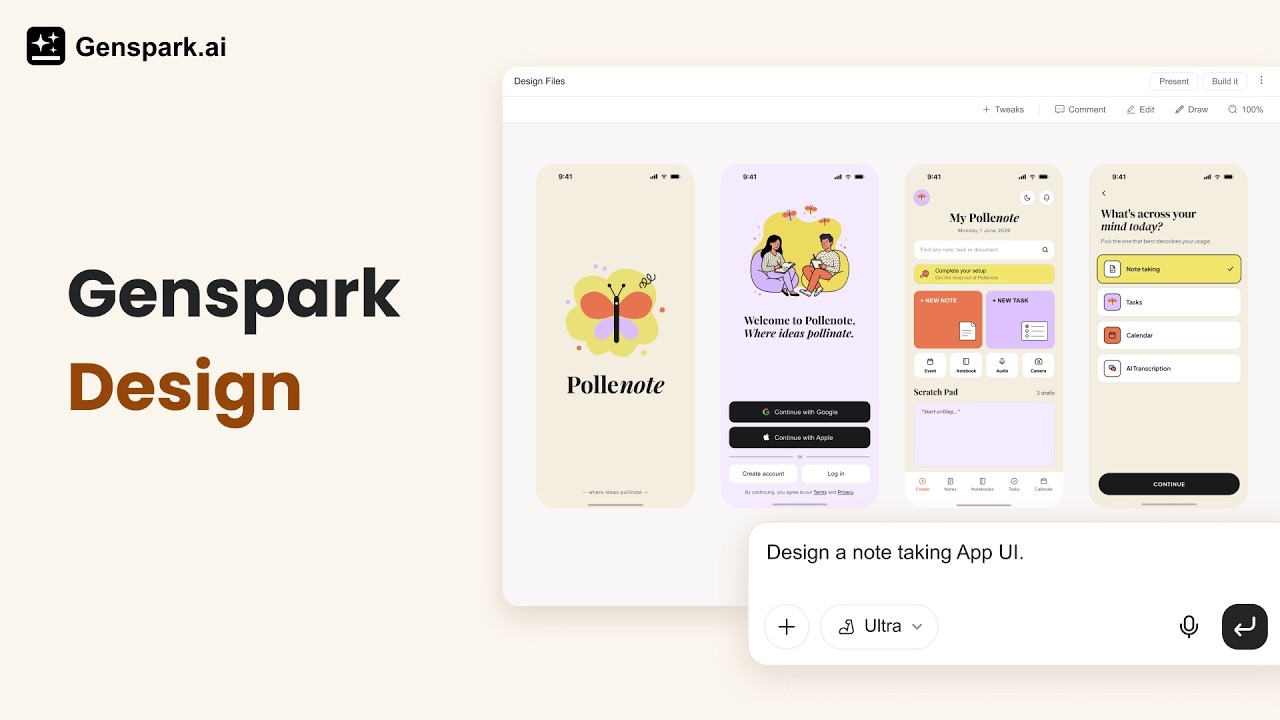
## Quick Start {#getting-started data-section-type=overview}
1. Describe your design in the input box — be as specific or open-ended as you like.
2. Optionally attach context via the **+** button: a Figma file, screenshot, GitHub repo, or a Design System.
3. Send — your design is generated at the highest quality by default. The AI may ask clarifying questions, but it may also start straight away — include the size, colors, type, and style you want up front.
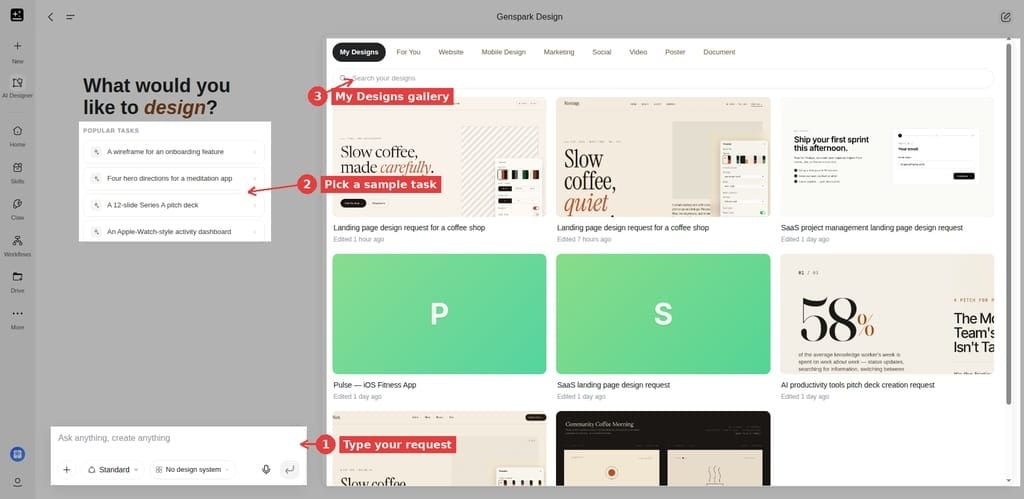
**Tip:** Not sure where to start? Click any Popular Tasks example below the input box — it fills a ready-made prompt you can edit before sending.
## Core Concepts {#core-concepts data-section-type=overview}
### Key Terms {#key-terms}
| Term | What it means |
| --- | --- |
| Canvas | Right-side panel where your design lives and is edited |
| Chat panel | Left-side panel where you talk to the AI |
| Design System | Saved brand style (colors, fonts, components) applied automatically to every design |
| Tweaks | Live parameter controls for real-time fine-tuning — no re-prompting needed |
| Build it | One-click export of your design as a runnable website or app |
| Verifier | An optional quality check the agent can run in the background; it only messages you when it finds something to fix |
| Remix | Copy a shared design to create your own editable version |
| History panel | A list of earlier versions of a project |
### Design Types {#design-types}
Just describe what you want; the AI picks the right type automatically.
| Type | Best for |
| --- | --- |
| Prototype | Interactive apps, UX flows, SaaS dashboards |
| Slide deck | Pitch decks, reports, training materials |
| Poster | Events, social media, print assets |
| Video / Frame Movie | Product intros, logo animation, multi-shot ads |
| Wireframe | Low-fidelity layout exploration |
| Flipbook / Paged Book | Lookbooks, whitepapers, technical manuals |
### What Design Can Connect To {#what-design-can-connect-to}
Genspark Design has its own toolset: it can connect to GitHub, browse a repository, import files, work with Figma, capture elements from a web page, and search images. Two things to keep in mind:
- Attaching a repository as context gives the agent a snapshot of the files you attach — small text and code files, filtered and capped — for that message. It isn't a live connection to your whole repo, and the agent doesn't run your code.
- Using a tool — for example, importing files from a repo — brings those files into the project.
For coding work in a full developer environment, use [Genspark Code](https://www.genspark.ai/helpcenter/ai-developer).
## What Design Costs {#what-design-costs data-section-type=feature}
Genspark Design is billed in credits.
- **Credits only — not Free Quota.** Genspark Design isn't covered by Free Quota on any plan. For what Free Quota covers, see [Membership Plans](https://www.genspark.ai/helpcenter/membership-plans).
- **Billed as the agent works — not by page or unit.** Credits are used as the agent builds the design, and each image, video or audio generation is charged on top — so asking for lots of images is a common way a project gets expensive.
- **Retries and redraws cost again.** Re-running a change or redrawing is a new, billed generation, so a back-and-forth fix loop adds up.
- **Where to see it:** open Credit Usage → Design in your account. For how credits are counted and charged, see the [Credits Guide](https://www.genspark.ai/helpcenter/credits-guide).
## Feature & How-To Guides {#feature-guide data-section-type=feature}
### Creating a Design {#creating-a-design}
- **From scratch** — type a description, attach optional context, then send.
- **From a template** — browse the For You gallery → click a design → Remix.
- **Multiple directions** — open multiple chats within one project (each has independent memory).
**Adding context to your prompt:** Click the **+** button in the input box to attach supporting materials — local files, images, or docs; files from your AI Drive; a Figma file; a GitHub repository; a reference to one of your past designs; a web element grabbed from any webpage; or a saved Skill or Design System. The more context you give upfront, the closer the first generation will be to what you need.
### Editing on the Canvas {#editing-canvas}
| Tool | How to use | Best for |
| --- | --- | --- |
| Tweaks | Adjust sliders and color pickers in real time | Global parameters: colors, spacing, text |
| Edit | Click any element, then modify it in the panel | Changing one specific element. Edit targets the element you select; simple text and style changes usually apply directly. If a change can't be applied directly, it's handled as a new chat generation, which can re-bill and may affect other elements. |
| Comment | Pin feedback on the Canvas, then send it all at once | Descriptive feedback ("change this to blue") |
| Draw | Sketch with the red brush or add sticky notes, then send | Visual instructions: arrows, circled areas |
### Edit Safety: Protect Your Work {#edit-safety-protect-your-work}
A common frustration is a small change that redraws work you wanted to keep. A few habits prevent it:
- Change one thing at a time. Small, separate edits are easier to keep than one big rework.
- Use Edit for a single element, and Comment to pin several notes and send them together.
- Simple text and style changes usually apply directly — often with no redraw and no extra credit cost.
- If a change can't be applied directly — or it's a layout, structure or new-element change — it's handled as a chat generation. That re-bills and may affect other elements, so check the result before continuing.
- Duplicate the project before a big change, so the version you like stays intact.
- The History panel is read-only. It shows earlier versions, but it can't roll back to one.
### Design System {#design-system}
1. Click **Design System** below the input box → **Create New**.
2. Enter a brand description; import assets (Figma .fig / GitHub / codebase / uploaded files).
3. AI extracts colors, fonts, and components — review and confirm.
4. Reuse it across every project. You can also extract a Design System from any existing design via the Share menu → Create design system from this project.
### Exporting {#exporting}
| Output | How to trigger | What it's for |
| --- | --- | --- |
| Present | Click Present in the top bar | Fullscreen playback; arrow keys to flip pages; Speaker Notes for slide decks |
| Build it | Click Build it → Website / App | A runnable website or app. It stays inside Genspark Design — a developer handoff is a separate route |
| ZIP (project source) | Click Download — its own button next to Build it in the top bar; disabled while a generation is running | The project's source files — not just a developer handoff document |
| PNG | Export menu → Export image (poster designs) | A raster image |
| PSD | Export menu → Export PSD (poster designs) | A layered PSD — one Photoshop layer per design layer. Some effects may not rasterize; the export still downloads, minus those layers |
| MP4 | Export settings dialog | Video |
| PPTX | Say "Export as PPTX" in chat | Editable slides. Styling is approximate — effects PowerPoint can't represent are dropped |
| PDF | Say "Export as PDF" in chat | A print-ready file, produced through your browser's print dialog |
The Export menu with PNG and PSD appears on poster designs. For PDF and PPTX behavior, see [Export Fidelity & Troubleshooting](#export-fidelity-and-troubleshooting).
### Export Fidelity & Troubleshooting {#export-fidelity-and-troubleshooting}
- PDF is rendered by your browser, not by Genspark. The auto-print pop-up is often blocked — allow pop-ups and try again, or use the download link the agent posts. Background colors can be dropped depending on your print settings.
- PPTX styling is approximate — that's expected. Complex effects (gradients, filters, blend modes, custom shapes) aren't representable as PowerPoint objects and may be dropped.
- No vector output. There is no SVG, Adobe Illustrator (.ai), or EPS export; the PSD is layered raster.
- If an export looks blank or fails, try once more. Rendering can miss an asset on the first pass.
### Sharing & Collaboration {#sharing}
- **Share link** — Share icon in the top bar → Anyone with the link (public) or Restricted (email invite).
- **Roles** — Viewer / Editor / Owner.
- **Duplicate** — a full copy of the project including files and conversations.
- **Add to Hub** — the ⋯ menu in the top bar → adds the project to your Hub, a shared team workspace with persistent context.
- **What a public link exposes** — A public link lets anyone with the URL view the design and its source files, version history, and downloads — no sign-in required.
- **Revoke a link** — To cut off access, set the project back to private (Restricted); anyone using the link then loses access.
### Managing Your Projects {#managing-your-projects}
- Find your designs in the My Designs gallery on the Design home page. Click a design to reopen it.
- Duplicate a project from its menu to keep a copy you can experiment on.
- Remix a shared design to create your own editable version.
- Rename or delete a project from its menu in the My Designs gallery. Deleting a project can't be undone.
## Quick Reference {#reference data-section-type=feature}
### Canvas Toolbar {#canvas-toolbar}
| Location | Controls |
| --- | --- |
| Top-right | Tweaks · Edit · Comment · Draw |
| Top bar | Present · Build it · Download · Share · ⋯ menu (Bookmark, Add to Hub) |
| Canvas tabs | Design System |
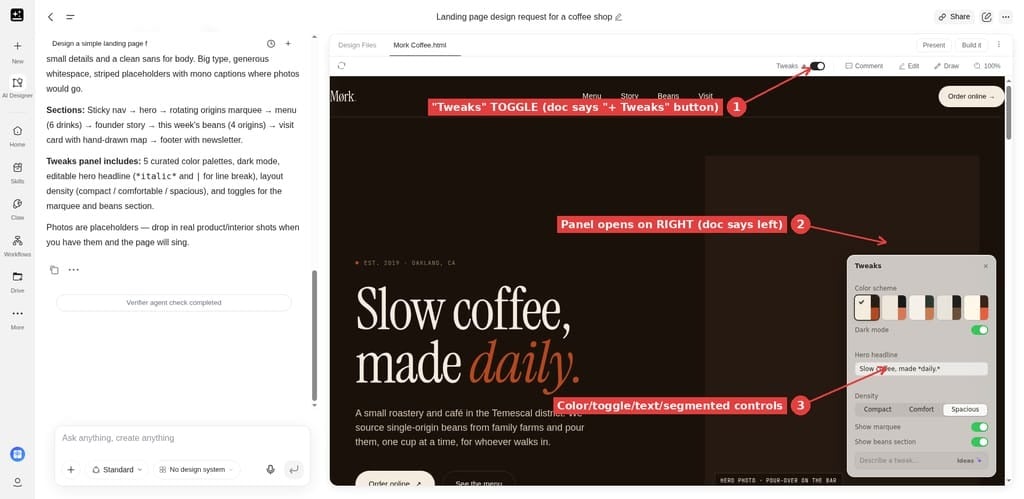
## Troubleshooting {#troubleshooting data-section-type=troubleshooting}
### The Tweaks panel is empty — what do I do? {#tweaks-empty}
Say "Make this tweakable" in the chat — the AI will generate controls automatically.
### Build it is grayed out — why? {#build-it-grayed-out}
Build it activates once generation is complete. It's disabled while a generation is running, and it isn't available for every design type. Wait for the task list to finish; if it stays grayed out, the design type may not support Build it.
### It generated something I didn't ask for. {#unexpected-output}
Add more detail to your prompt; specify the design type, target audience, dimensions, or visual style. Attach reference screenshots. Use the Comment or Draw tools to point to exactly what needs changing.
### A run fails, freezes, or comes back blank. {#a-run-fails-freezes-or-comes-back-blank}
Try these in order:
1. Reload the project and check whether the run actually finished — the canvas can lag behind the chat.
2. Ask again. A new run is a new charge.
3. Duplicate the project to keep a clean copy before you retry.
Still stuck? Report it with the project link: open the project, click Share, and invite support@genspark.ai as a Viewer.
### An export is missing, blank, or won't open. {#an-export-is-missing-blank-or-wont-open}
- **Missing from the menu:** some formats depend on the design type — the Export menu with PNG and PSD appears on poster designs.
- **PDF or PPTX problems:** see [Export Fidelity & Troubleshooting](#export-fidelity-and-troubleshooting).
- **A format is locked:** export availability can vary by plan.
For more known issues and fixes, see Common Issues.
## FAQ {#faq data-section-type=faq}
### I want to undo a change. {#undo-a-change}
Genspark Design has no one-click undo. The History panel shows earlier versions, but it's read-only — you can look, not roll back. Asking the AI to revert starts a new, billed generation, and it may not reproduce the exact previous state. Make changes one at a time, and Duplicate the project when you reach a version you want to keep.
### Can the code from Build it go straight to production? {#build-it-production}
It runs as-is, but have a developer review it before deploying.
### How is this different from AI Slides? {#vs-ai-slides}
Genspark Design is a full creative canvas (websites, apps, videos, posters, code). AI Slides is purpose-built for presentations with PPTX / Google Slides export. For pitch decks, either works. For prototypes, visuals, or video — use Genspark Design.
### Can I use my designs commercially? {#can-i-use-my-designs-commercially}
Genspark Design is intended for personal and commercial work. Ownership, commercial use, and what you can create are covered by our policies.
### Why did other parts of my design change when I only asked for one edit? {#why-did-other-parts-of-my-design-change-when-i-only-asked-for-one-edit}
Small edits (text, color, style) are written straight into your design. Big edits (layout, structure, new elements) are sent to the AI as a prompt, so the AI rebuilds that part — and may change more than you asked. To stay safe: one change at a time, use Edit for a single element, and Duplicate before a big change.
### Why was I charged for edits I didn't keep, or for a generation that failed? {#why-was-i-charged-for-edits-i-didnt-keep-or-for-a-generation-that-failed}
Design bills for the work the AI does, not for what you keep — so a discarded redraw or a retry still uses credits. Generations blocked before they start are refunded automatically.
### Can I edit a design without the AI regenerating it? {#can-i-edit-a-design-without-the-ai-regenerating-it}
Partly. Simple text and style/Tweaks edits are applied directly — no redraw, no credit cost. There is no full manual-edit mode and no element locking; anything else goes through the AI as a generation.
### Why doesn't my PDF or print export match the design? {#why-doesnt-my-pdf-or-print-export-match-the-design}
PDF exports come from your browser's print dialog, so they follow your print settings — and browsers block the pop-up or leave out background colors by default. PPTX is approximate, since PowerPoint can't represent every effect. Neither export is an exact copy of the design.
### What does a share link expose? {#what-does-a-share-link-expose}
A public link grants read to anyone with the URL.
### What's included in my plan, and do the promos cost credits? {#whats-included-in-my-plan-and-do-the-promos-cost-credits}
Design is on every plan and is credit-only — not covered by Free Quota.
### Can Design use my GitHub repo or the tools Super Agent can? {#can-design-use-my-github-repo-or-the-tools-super-agent-can}
Yes — Design works with GitHub, Figma, web capture, and image search. Connecting GitHub gives it persistent repo tools; attaching a repo with + attaches a snapshot of small files to that message only. Either way, Design reads your code, it doesn't run it.
### How do I control how many images it generates? {#how-do-i-control-how-many-images-it-generates}
There's no cap and no approval step — Design decides how many images to make, and may make more than you asked for. State an exact number, start with a small sample set, then request the rest once you've picked a direction. These are prompt instructions, not enforced limits.
### How do I get better-looking output? {#how-do-i-get-better-looking-output}
Give it a Design System, attach reference images or a Figma file, and describe the design type, size, style, and audience before you send. Use Comment or Draw to point at exactly what to change, and refine one element at a time.
# Skills {#skills data-doc-group=custom-agents}
Source: https://www.genspark.ai/helpcenter/skills
## What Are Skills? {#what-are-skills data-section-type=overview}
**Skills** are reusable AI tools built for specific jobs. Instead of rewriting the same instructions every time, you save a proven workflow once and apply it with one click — consistently, across any project.
A Skill is more than a template. It packages expert thinking, structure, and design so every output follows the same quality bar and reasoning, every time. A sales proposal Skill doesn't just look like a sales deck — it thinks like a sales director, structuring the argument, anticipating objections, and framing the value proposition.
### Key Benefits {#key-benefits}
| Benefit | What It Means for You |
|---|---|
| **Build once, reuse forever** | Define a workflow once and apply it in one click from anywhere |
| **Consistent output quality** | Every result follows the same structure, tone, and expert reasoning |
| **Community library** | 100+ public Skills available to add with one click — no building required |
| **Works across products** | Skills enhance AI Slides, AI Docs, Super Agent, and more |
### Who Skills Are For {#who-its-for}
Skills are for anyone who does recurring, structured work and wants more consistent results with less effort — including:
- Business and operations professionals building the same reports, proposals, or briefs regularly
- Sales and marketing teams producing pitch decks, proposals, and campaign briefs to a standard
- Researchers and analysts running repeatable data analysis or literature review workflows
- Product and engineering teams generating PRDs, release notes, and technical specs
- Team leads who want consistent output quality across a team without requiring everyone to write expert-level prompts
### Skills vs. Templates {#skills-vs-templates}
| Capability | Template | Skill |
|---|---|---|
| Visual style | Yes | Yes |
| Content structure | No | Yes |
| Expert reasoning | No | Yes |
| Reusable prompts | No | Yes |
| Works across products | No | Yes |
A Skill works like a packaged expert, while a template only reuses a layout.
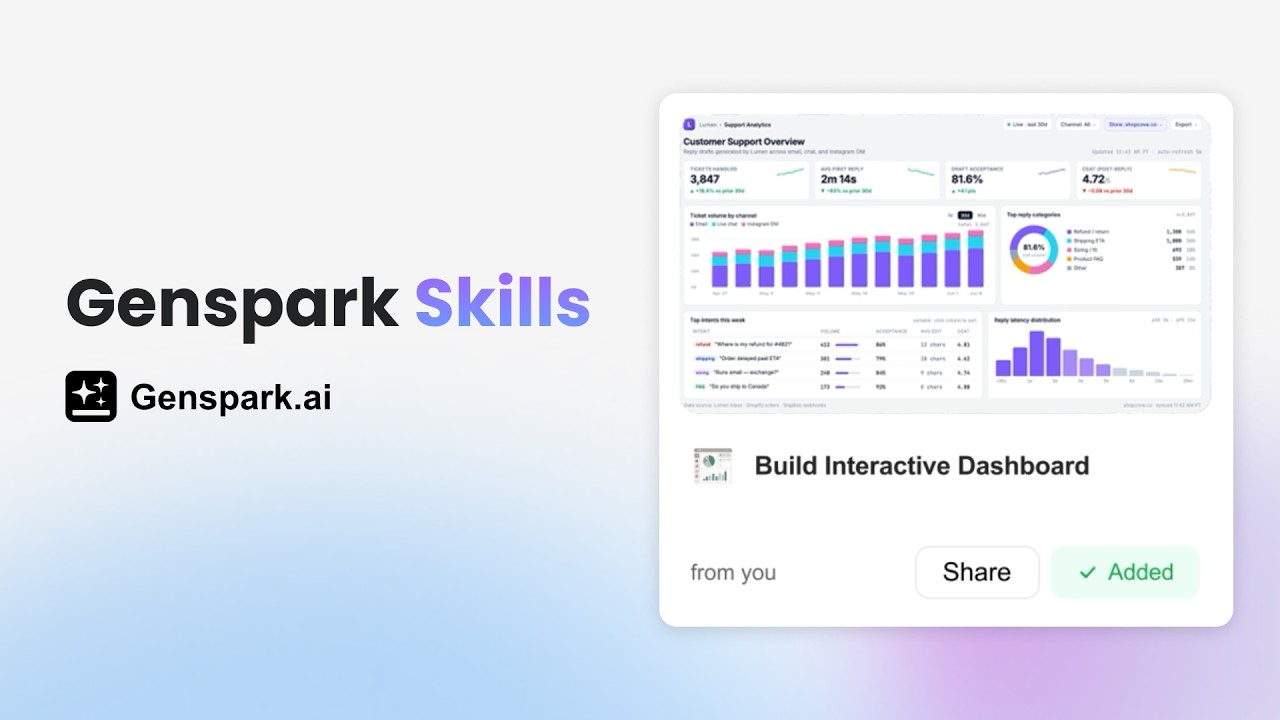
## Quick Start {#getting-started data-section-type=overview}
### Prerequisites {#prerequisites}
- A Genspark account (free or paid)
- No technical background required
### Quick Start {#quick-start}
1. **Browse Skills.** From the Genspark homepage, click **Skills** in the left sidebar.
2. **Apply or create a Skill.** Click any Skill card to preview it, then click **Add & Use** to apply it. Or create your own by clicking **+ New Skill**.
3. **Get expert-quality results.** AI follows the Skill's approach — structure, reasoning, and style — to produce consistent output. Review, refine, and export when ready.
Sample prompts to try:
```prompt
Create a 10-slide investor pitch deck for a Series A SaaS startup
```
```prompt
Write a competitive analysis report comparing the top 5 CRM platforms
```
```prompt
Create a call prep brief for an upcoming sales meeting, including company background, recent news, likely priorities, and suggested talking points
```
### When to Use a Skill {#when-to-use}
| Option | Best for |
|---|---|
| **Standard prompt** | One-off tasks you won't repeat |
| **Existing Skill** | Repeated work where a proven structure already exists |
| **New Skill** | Recurring work that isn't yet standardized, or work to share with a team |
| **AI Slides + Skill** | Presentations needing repeatable slide structure and visual consistency |
### The Three Sources of Skills {#skill-sources}
| Source | Description |
|---|---|
| **Community Skills** | 100+ platform-curated Skills from publishers including Anthropic, OpenAI, and Genspark |
| **Team Skills** | Published by your organization, visible only to team members |
| **My Own Skills** | Skills you create, upload, or save yourself |
## Feature & How-To Guides {#feature-guide data-section-type=feature}
### Browsing and Using Community Skills {#community-skills}
The Skills library contains 100+ verified Skills. They are not organized by content category — instead, you filter across three dimensions:
| Filter | Options |
|---|---|
| **Publisher** | Anthropic, OpenAI, Genspark, and others |
| **Role** | Sales / Marketer / Product Manager / Researcher / Engineer / Designer / Operations / Founder / Creator / General |
| **Output type** | Document / Research / Data / Chart / Code / and more |
To use a Community Skill:
1. Go to **Skills** — the Community Skills tab is shown by default.
2. Use the Publisher, Role, and Output filters to narrow results.
3. Click a Skill card to view its description and preview.
4. Click **Add & Use** to install it.
5. Enter your prompt — AI generates output following that Skill's approach.
### Running a Skill {#running-a-skill}
1. **Select a Skill.** In the SkillBar, click **"Select a skill first"** to choose from your installed Skills, or type `/` to search by keyword. You can select multiple Skills at once.
2. **Enter your prompt.** Describe your request. Attach files if needed via the attachment icon or drag and drop.
3. **Watch execution in real time:**
| What you see | What it means |
|---|---|
| Execution step cards | Each operation (search, read file, write code) shown as a collapsible card |
| Thinking | The AI's reasoning process (expandable) |
| Streaming output | Real-time text output |
4. **Retrieve your files.** Deliverable files appear in the **Output files drawer** — click the folder icon in the top-right corner. Preview, download, or find past runs in the **Task List** (hamburger menu, top-left). Files are permanently stored in the cloud and can be downloaded at any time.
### Building Your Own Skill {#building-skills}
You don't need to be a developer. If you can describe how something should be done, you can create a Skill.
- **Create for Myself (AI-guided)** — Click **+ New Skill → Create for myself**. The skill-creator Agent guides you through name, description, inputs, outputs, and tool permissions. Test it, then **Save** — it appears in your My Own Skills tab.
- **Upload a Skill file** — Click **+ New Skill → Upload**. Drag and drop or select a file (`.zip`, `.skill`, or `.md`; max 200MB), then click **Save skill** — ready to use immediately. A `.zip` file must contain a `skill.md` with a name and description.
- **Create for Team** — the same flow as *Create for myself*, but the Skill is submitted for admin review. Once approved, it appears in every team member's **Team Skills** tab. Requires a Team Plan.
### Sharing Skills {#sharing-skills}
- **Peer Share (email invite)** — Open the Skill → click **Share** → enter the recipient's Genspark email. They accept via **"Shared with me"** on the Skills home page. Invites are valid for 30 days; recipients must have a Genspark account.
- **Team Publish** *(Team Plan required)* — Share → **Team** tab → **Publish to Team**. After admin approval (if required), the Skill appears in every member's Team Skills tab. When you update the Skill, members see an **"Update available"** prompt.
- **Public Link** — Share → **Public link** tab → **Create public link**. Copy and send the link — anyone can preview and install after signing in. Use **Regenerate** to invalidate the old link, or **Revoke** to disable it entirely. Public Link recipients install a snapshot copy that does not sync with future updates.
### Managing Your Skills {#managing-skills}
Click **Manage Skills** at the top of the Skills page to open the management panel.
| Tab | What it shows |
|---|---|
| **Installed** | All Skills you've installed |
| **Received** | Invitations shared with you via email |
| **Sent** | Skills you've shared with others |
- **Uninstall** — hover a Skill card → click Uninstall. Can be reinstalled at any time.
- **Update a Team Skill** — click the **"Update available"** badge when it appears.
- **Delete** — click Delete on any Skill in My Own Skills. This is permanent and cannot be undone.
- **Modify** — online editing is not supported. Edit locally → delete the old version → re-upload via **+ New Skill → Upload**.
### Connecting External Services (Connectors) {#connectors}
Connectors let Skills read live data from your external apps. Connect once; every Skill that needs the service uses it automatically.
To connect: click **Connectors** at the top of the Skills page, find the service using the search box, click **Install** (or **Connect**), and complete OAuth authorization. The service then shows as **"Connected."** To disconnect, click **Uninstall** or **Disconnect** next to any connected service.
| Category | Services |
|---|---|
| **Communication** | Gmail, Google Calendar, Outlook Email, Outlook Calendar, Microsoft Teams, Slack, LINE |
| **Productivity & Files** | Google Suite, Google Drive, Google Contacts, Outlook Contacts, Microsoft 365, OneDrive, SharePoint, Notion, Box, Confluence, DocuSign, Dropbox |
| **CRM & Sales** | Salesforce, HubSpot, Pipedrive, Mailchimp, Affinity CRM |
| **Developer** | GitHub, Jira, Linear, Deep Wiki, Chart Server |
| **Data Sources** | Hacker News, Supabase Database, Airtable |
| **Project & Ops** | Intuit QuickBooks, monday.com, ClickUp, Stripe, PayPal, Greenhouse, Ashby, Asana |
| **Other** | Google Chat, X (Twitter), Reddit, Merge.dev, Unified.to, Zapier, Ramp |
Some Skills require a Connector before running — they will block and prompt you to connect first.
### My Skills {#my-skills}
All Skills you create, import, or save appear under the **My Skills** tab — your personal collection, always one click away. From here you can launch, share, publish, or delete any Skill.
## Troubleshooting {#troubleshooting data-section-type=troubleshooting}
### A Skill ran but I can't find the output files — where do I look? {#find-output-files}
- Click the **folder icon** (top-right) to open the Output files drawer.
- Check the **Task List** (hamburger menu, top-left) for past run records.
- Review the execution step cards for any failed steps.
- If the Skill requires a Connector, confirm it's connected before re-running.
### My Peer Share invite expired — what do I do? {#invite-expired}
Open the Skill → Share → Email tab and resend. Invites expire after 30 days.
### I updated my Skill but team members don't see changes — why? {#update-not-showing}
Updates aren't pushed automatically. Members need to click the **"Update available"** prompt on their Skill card.
### I can't find the Team Publish option — why? {#no-team-publish}
Team Publish requires a Team Plan. Without one, clicking *Create for Team* or the Team tab redirects to the upgrade page.
## FAQ {#faq data-section-type=faq}
### What is the difference between a Skill and a template? {#vs-template}
A template reuses a layout. A Skill packages expert reasoning, content structure, and reusable prompts — and works across multiple Genspark products.
### When should I use a standard prompt instead of a Skill? {#vs-standard-prompt}
Use a prompt for one-off tasks. Use a Skill when you want the same structure, style, and reasoning applied consistently every time.
### When should I create a Skill instead of just prompting Super Agent? {#when-to-create}
When you're rewriting the same detailed instructions repeatedly, need consistent quality across a team, or want to share a proven workflow.
### Can I turn a good project into a Skill later? {#project-to-skill}
Yes — save any strong project as a Skill from My Skills. The approach is captured and immediately reusable.
### Do I need technical skills to create a Skill? {#need-technical-skills}
No. The *Create for myself* path is fully AI-guided — answer questions in plain language and the Agent builds it for you.
### Can I use Skills on mobile? {#mobile}
Skills run in the browser-based Super Agent Sandbox. Check the Genspark mobile app for the latest supported features.
### How do I share a Skill with my team without making it public? {#share-privately}
Use **Peer Share** for specific individuals, or **Team Publish** (Team Plan required) for your entire organization.
### Can I edit a Community Skill after adding it? {#edit-community-skill}
Not directly. Use it as a reference and create your own version with *Create for myself*.
# SecondBrain {#secondbrain data-doc-group=knowledge}
Source: https://www.genspark.ai/helpcenter/secondbrain
## What is SecondBrain? {#what-is-secondbrain data-section-type=overview}
**SecondBrain** is Genspark's personal knowledge and memory system — a unified hub that learns from your emails, meetings, files, and connected apps to give your AI a deep, personalized context about you and your work.
- **Connect your data** — with your permission, SecondBrain links to everything you already use: your email, calendar, chat history, meeting notes, external platforms, and more. It all becomes your personal context layer
- **Retrieve your SecondBrain data in Super Agent** — once connected, Super Agent has the full picture of who you are and how you work. This means smarter answers, more personalized actions, and a real edge whenever you need to pull together, organize, or make sense of information from multiple sources
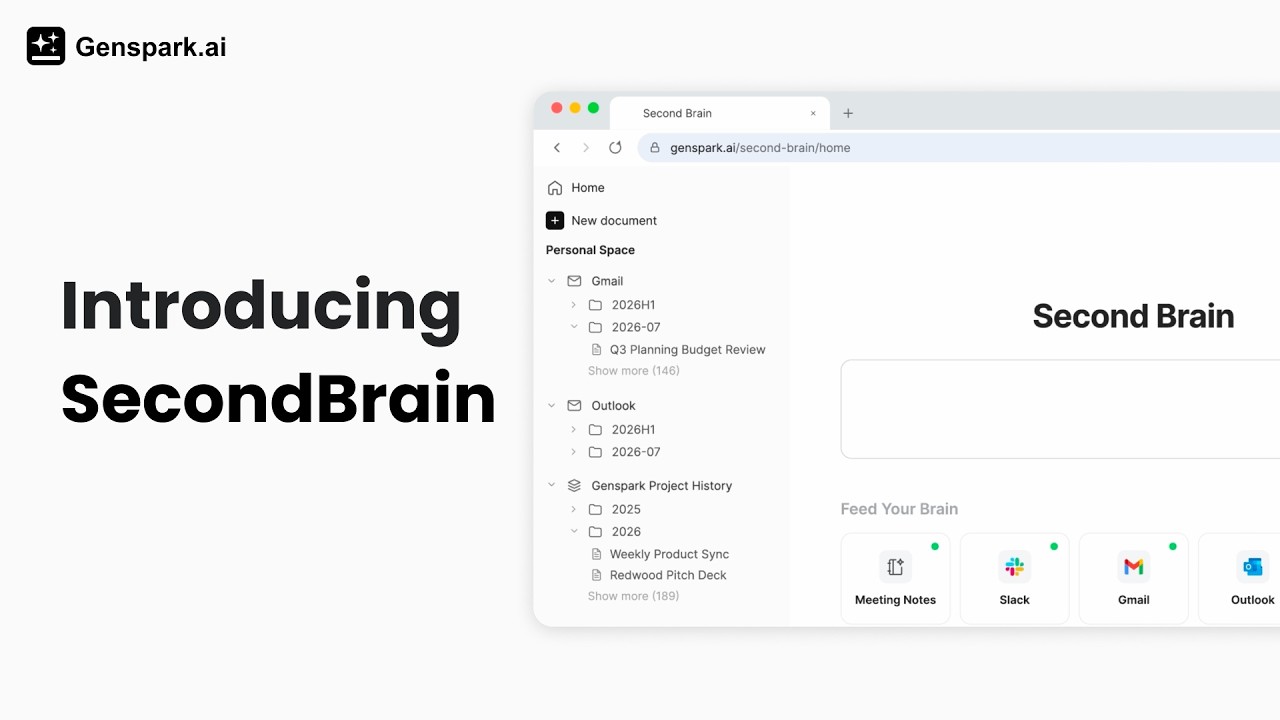
---
## Quick Start {#quick-start data-section-type=overview}
- Open SecondBrain from its dedicated [website](https://www.genspark.ai/second-brain/home) or from the Genspark home page
- Connect at least one data source — your email, calendar, or an uploaded file is a good place to start
- Once connected, SecondBrain begins building your personal context layer automatically
- Head to the Genspark home page and open **Super Agent** — it will now draw on your SecondBrain data to give smarter, more personalized responses
---
## Feature & How-To Guides {#feature-guide data-section-type=feature}
### Step 1 — Collect Your Data {#step-1-collect-your-data}
SecondBrain pulls in your information from several sources:
- **Genspark projects** — auto-saves all your past Genspark activity, including AI Meeting Notes
- **Connected tools** — sync data automatically from all your sources
- **File upload** — manually upload documents, spreadsheets, or personal files directly into your memory up to 500 MB
### Step 2 — Connect Your Tools {#step-2-connect-your-tools}
To connect a data source:
- From the SecondBrain homepage, click **Connect** next to the tool you want to add
- Follow the authorization steps for that service
- Once connected, data begins syncing automatically in the background
Supported integrations: Gmail, Google Calendar, Outlook, Slack, Notion, HubSpot, Salesforce, Google Workspace, Microsoft 365, and more.
### Step 3 — Put Your SecondBrain to Work {#step-3-put-your-secondbrain-to-work}
Head to the Genspark homepage. From there, Super Agent can tap into all the memory, files, and data in your SecondBrain to get work done for you.
**Popular Plays** — common workflows that SecondBrain powers automatically once your sources are connected:
| Play | What it does | Sources used |
|---|---|---|
| Your weekly update, written for you | Generates a personalized weekly summary from your email, calendar, and connected apps | Gmail/Outlook, Calendar, connected apps |
| Your next meeting, briefed | Prepares a meeting brief with attendee context, relevant docs, and past conversations | Calendar, Docs, connected apps |
| The meeting's over — follow-ups already drafted | Turns your meeting notes into draft follow-up emails and action items | Meeting Notes, Gmail/Outlook |
| Never wonder "where did I put that?" | Searches across all your connected sources to find any file, email, or note | All connected sources |
Try prompts like:
- "Summarize my emails from today."
- "Draft an email and meeting invite for [name]."
- "Summarize last week's meetings into a weekly report."
- "Find the slides I made last week on [topic] and add a new page."
- "What to-dos did [partner] leave me in Slack today?"
- "Pull this quarter's numbers from my HubSpot and turn them into a deck."
- "Find everything in my Notion docs about [topic]."
## How Sync Works {#how-sync-works data-section-type=feature}
Your SecondBrain Note captures recordings on the device, then moves them to your phone and on to the web so you can read transcripts and summaries. Sync happens in two stages, and understanding them explains why a note sometimes appears on your phone before it shows up on the web.
### The two stages of sync {#the-two-stages-of-sync}
**Stage 1 — Device to phone.** The device records on its own and stores the recording locally. When it reconnects to your phone, it transfers the recording over Bluetooth (or over Wi-Fi if you use Fast Transfer). This transfer happens only when your phone is unlocked, Bluetooth is on, **and you've opened the Genspark app since the device reconnected.**
**Stage 2 — Phone to cloud to web.** Once the app has the recording, it uploads it, generates the transcript and summary, and syncs everything to the web (AI Meeting Notes).
The important part: the gate is on Stage 1. Recordings don't move off the device until the app has been opened.
### Opening the app is what starts the transfer {#opening-the-app-is-what-starts-the-transfer}
**Open the app, and keep it open until the transfer completes.** In the app, go to AI Notes — the note appears with a pending status and resumes automatically.
- Keep the phone unlocked with Bluetooth on while the transfer runs (the device-to-phone transfer is over Bluetooth).
- For a faster transfer, use **Fast Transfer** (the button in the top-right), which switches the connection from Bluetooth to Wi-Fi.
- Opening the app is the action that starts the transfer — it doesn't happen on its own while the app is closed.
## FAQ {#faq data-section-type=faq}
### Do I need the SecondBrain Note hardware to use SecondBrain? {#need-hardware}
No. SecondBrain is the software memory system — connect your apps and use in-app AI Meeting Notes with no device at all. The SecondBrain Note hardware is just one optional input channel for capturing in-person conversations.
### What's the difference between SecondBrain and SecondBrain Note? {#vs-secondbrain-note}
SecondBrain is the software: it links your data sources into a personal memory layer that Super Agent can draw on. SecondBrain Note is the physical recording device that feeds in-person meetings into that memory. You can use SecondBrain fully without the hardware. For more on SecondBrain Note, see [shop.genspark.ai](https://shop.genspark.ai/).
### How soon does my connected data show up in SecondBrain? {#data-sync-time}
Some integrations sync on a schedule rather than instantly, so allow a few minutes after connecting. If data is still missing after several minutes, disconnect and reconnect the source from the Home page.
### What data sources can I connect to SecondBrain? {#data-sources}
SecondBrain supports a growing list of connectors: email providers, calendars, messaging platforms, CRM tools, productivity suites, cloud storage, and manually uploaded files.
### Is my data private and secure? {#privacy-security}
SecondBrain may handle highly sensitive personal context — your emails, meetings, files, and conversations — so security and privacy are core product considerations. Genspark maintains an enterprise-grade security framework and is certified with **SOC 2 Type II** and **ISO 27001**. Your SecondBrain data is only accessible to you. Connected integrations require your explicit authorization and can be disconnected at any time from the Home page.
### What files can I upload to SecondBrain? {#what-files-can-i-upload-to-secondbrain}
You can upload .md, .csv, .html, .pdf, and .zip files. For Notion, upload a Notion export as a .zip. To upload Office files, ODF files, RTF, or EPUB files, put them inside a .zip — SecondBrain converts them when it reads the .zip. Each upload can be up to 500 MB, or 1 GB for a Notion export.
### Where is my SecondBrain data stored? {#where-is-my-secondbrain-data-stored}
SecondBrain keeps your data in its own dedicated storage. It is separate from AI Drive, so uploaded files do not appear in AI Drive.
### How can I use fewer credits in SecondBrain? {#how-can-i-use-fewer-credits-in-secondbrain}
The model tier makes the biggest difference. **Standard** costs much less than **Ultra**, so use Standard for everyday questions and Ultra when you need the strongest answer. For how the tiers work, see the [Credits Guide](https://www.genspark.ai/helpcenter/credits-guide). A longer chat session also costs more, because each reply costs a little more as the conversation grows. Start a new chat when you change topics.
# SecondBrain Note {#secondbrain-note data-doc-group=knowledge}
Source: https://www.genspark.ai/helpcenter/secondbrain-note
## What is SecondBrain Note? {#what-is-secondbrain-note data-section-type=overview}
SecondBrain Note is Genspark's hardware device that captures, transcribes, and summarizes everything you hear and say, turning real-world conversations into structured, searchable notes automatically.
- **Capture from the real world** — Record meetings, conversations, and ideas using dedicated hardware or the Genspark mobile app
- **AI-powered output** — Transcriptions and full summaries generated automatically, no manual note-taking required
- **Deeply integrated** — Syncs with the Genspark app, GenMail, and your SecondBrain data sources for a unified AI memory
SecondBrain Note can be purchased at [shop.genspark.ai](https://shop.genspark.ai/).
## Quick Start {#quick-start data-section-type=overview}
### Step 1: Download the Genspark App {#step-1-download-the-genspark-app}
Download "Genspark" in the App Store or Google Play and complete user registration.
### Step 2: Device Pairing {#step-2-device-pairing}
1. Press and hold the device button for 3 seconds to power on — it enters pairing mode automatically and the blue indicator light flashes.
2. Open the Genspark app and tap **AI Notes** at the bottom.
3. Tap **Start Pairing**:
- Tap the **SecondBrain Note** button from the homepage, or
- Tap **AI Notes** and then **+ Device**.
4. Match the last 4 digits of the serial number (SN) on the packaging to identify your device.
5. Tap your device to connect — the blue light turns off when paired.
6. Tap **Get Started** to begin.
**Note:** If connecting in a room with many devices, use the SN search box to find yours quickly. A scrollable list appears when multiple devices are detected.
### Using the MagSafe Wallet {#using-the-magsafe-wallet}
- Place the SecondBrain Note into the inner pocket of the wallet.
- With the cardholder opening facing down, attach magnetically to the back of your phone.
- If your phone doesn't support magnetic attachment, use the included magnetic strip on your phone case.
- The wallet doubles as a phone stand.
**Phone case compatibility:** The device works through most standard phone cases for general recording. For phone call recording specifically, thinner cases work best since the V.C.S. sensor picks up vibrations through the phone's speaker. Very thick rugged cases may reduce call recording quality but won't affect open-air meeting or voice memo recording. If call recordings sound muffled, try a thinner case or remove the case during calls.
### Charging the Device {#charging-the-device}
SecondBrain Note uses magnetic charging.
1. Connect the included USB-C cable (Type-C input, 4-pin magnetic output) to the device.
2. On successful connection: indicator light flashes green + single vibration.
3. Fully charged: indicator light stays solid green.
4. Disconnect the cable — light turns off.
Charging works the same way with the device inside the MagSafe wallet.
## What's in the Box {#whats-in-the-box data-section-type=feature}
- SecondBrain Note × 1
- MagSafe Wallet × 1
- USB-C Charging Cable × 1
- Metal Ring × 1
- Quick Guide × 1
- Safety & Warranty Guide
## Recording Consent & Privacy {#recording-consent-and-privacy data-section-type=feature}
Before recording other people, make sure you comply with applicable recording, privacy, and biometric laws. Laws vary by country and by U.S. state, and some jurisdictions require consent from all participants before a conversation can be recorded. If participants are in different locations, follow the stricter rule.
You are responsible for:
- Notifying participants before recording starts
- Obtaining any consent required by law
- Stopping the recording if someone does not consent
- Avoiding recording in sensitive or confidential settings unless you are clearly permitted to do so
SecondBrain does not obtain consent on your behalf or determine whether your recording is lawful. If you are unsure, consult your legal counsel.
## Recording Notes {#recording-notes data-section-type=feature}
- **Starting a recording:**
- **Hardware button** — Long-press for 2 seconds (white breathing light appears, single vibration)
- **In-app** — Tap the new button inside AI Notes and choose "Record with SecondBrain Note"
- **Marking highlights:** During a recording, a short press on the device button marks an important moment (a single vibration). These appear as highlights in your generated notes for quick reference.
- **Ending a recording:** Long-press the button for 2 seconds — LED turns off, two vibrations confirm.
Output depends on recording length:
| Recording Length | Output |
| --- | --- |
| Under 2 minutes | Transcription only |
| Over 2 minutes | Full summary + transcription |
Real-time transcription is not available in the current release. Notes are generated after the recording ends.
**Note Source Indicator:** A device icon appears next to any note created via SecondBrain hardware, distinguishing it from notes made through other methods.
## Data Transfer {#data-transfer data-section-type=feature}
After recording, audio files save automatically on the device. To transfer:
1. Connect the device to the Genspark app via Bluetooth.
2. Files transfer automatically.
**Quick Transfer (Wi-Fi):**
- After connecting, a "Fast Transfer" prompt appears in the top-right corner — tap it.
- The app switches from Bluetooth to a direct Wi-Fi connection with the device.
- Stay in the app until the transfer completes.
- The app automatically restores Bluetooth mode when finished.
## Offline Usage {#offline-usage data-section-type=feature}
**Can SecondBrain be used without a phone?**
Yes — the device records independently while your phone is off. Once your phone reconnects, notes transfer automatically and summaries are generated. However, the device requires a phone connection for full functionality (transcription, summaries, syncing).
## Adding Notes {#adding-notes data-section-type=feature}
Tap **Add New** in the app to create notes in three ways:
| Method | Description |
| --- | --- |
| AI Meeting Record With Phone | Uses the app's built-in AI (no hardware required) |
| Record with SecondBrain | Uses your connected SecondBrain hardware |
| Import Audio File | Upload an existing audio file for transcription |
**Photo Integration:** During a recording, take a photo directly from the app — it embeds in your generated notes with optional accompanying text.
## SecondBrain Data Sources {#secondbrain-data-sources data-section-type=feature}
You can connect SecondBrain to a variety of different sources, including first-party data, imported data, external connectors, or manual entry. For example, email, CRM applications, Genspark projects, and more.
## Super Agent Integration {#super-agent-integration data-section-type=feature}
Once your data sources are connected, the Super Agent can act on your SecondBrain data:
- Check and triage your email
- Query records in HubSpot or Salesforce
- Create slides from your notes
- Summarize meeting recordings
- Generate weekly reports
## Credits & Billing {#credits-and-billing data-section-type=feature}
### How It Works {#how-it-works}
SecondBrain Note separates recording from processing:
- Recording happens entirely on the device — no internet, no credits, no limits. Press the button, talk, done.
- Processing (transcription + AI summary) happens after the recording syncs to Genspark. This is where minutes and credits come in.
When a recording syncs, the app automatically transcribes the audio and generates a summary. That processing step is what counts against your monthly minutes.
### What's Free {#whats-free}
Every SecondBrain Note purchase includes 300 free transcription minutes per month. No Genspark subscription required. These minutes cover both transcribing your recordings and generating AI summaries.
The 300-minute allowance resets each month.
### After Your Free Minutes {#after-your-free-minutes}
| Membership | Monthly Transcription | After Free Minutes |
| --- | --- | --- |
| No subscription (Note hardware only) | 300 minutes/month included | ~5 credits per minute |
| Plus | Unlimited | — |
| Pro | Unlimited | — |
**Without a subscription:** Once you've used your 300 included minutes for the month, new recordings that sync draw from your daily free credit allotment (100 credits/day) at approximately 5 credits per minute. When your daily credits run out, processing pauses until they reset the next day. You can also purchase credits individually or sign up for a Plus or Pro plan for unlimited transcription.
**With Plus or Pro:** Transcription and summarization are unlimited — record as much as you want without worrying about minutes or credit costs. This applies across all your devices.
## Warranty & Returns {#warranty-and-returns data-section-type=feature}
For full details, see the Safety & Warranty Guide. To file a warranty claim, contact support@genspark.ai with a description of the issue and photos or video showing the defect.
**Returns:**
- Returns are accepted within 30 days of receipt.
- Only unopened, sealed boxes are eligible for return.
- No returns accepted after the 30-day window.
- Device must be in original condition with all packaging and accessories.
- If your device is defective or arrived damaged, it's covered under warranty (see above).
**Who pays for return shipping:**
- Unopened returns — you are responsible for the cost of the return shipping label.
- Faulty or defective product — Genspark covers the return shipping cost.
## Recording Consent, Privacy & Responsible Use {#recording-consent-privacy-and-responsible-use data-section-type=feature}
Recording laws vary by country and by U.S. state. In some places, you may need consent from all participants before recording. Because rules differ, you should always be transparent, notify people before recording starts, and obtain any consent required by law.
SecondBrain does not obtain consent on your behalf or determine whether a recording is lawful.
### Before You Record {#before-you-record}
Before starting a recording, make sure you:
- Tell people clearly that you want to record
- Obtain any consent required by law
- Confirm that the setting is appropriate for recording
- Avoid recording private, sensitive, or confidential conversations unless you are clearly permitted to do so
- Follow the stricter rule if participants are in different locations
A device light, app status, or other visible indicator may help signal that recording is happening, but that alone is not enough. You should still notify people directly.
### Simple Ways to Notify People {#simple-ways-to-notify-people}
You can use plain language like:
- "I'd like to record this so I can review my notes later. Is that okay with everyone?"
- "Just a heads-up: I'm using SecondBrain to record and summarize this conversation."
- "Before we continue, I want to let you know this conversation may be recorded. Please let me know if you're not comfortable with that."
### When Consent May Be Required {#when-consent-may-be-required}
Consent requirements depend on where people are located and what kind of conversation is being recorded.
Keep these points in mind:
- Recording laws vary by country and by U.S. state
- Some jurisdictions require consent from all participants before recording
- If participants are in different locations, you should follow the stricter rule
- You are responsible for understanding whether consent is required in your situation
### Best Practices {#best-practices}
Use these best practices every time you record:
- Notify participants before recording starts
- Be specific about what is being recorded
- Ask before beginning, not after
- Give people a real chance to decline
- Stop recording when the conversation ends
- Record only what you need
- Handle recordings responsibly and share them only as appropriate
**Good practice:**
- Explain what SecondBrain is doing
- Ask for permission in a clear, direct way
- Make sure people understand they are being recorded
**Avoid:**
- Starting a recording without notice
- Relying only on a device indicator or screen status
- Leaving recording on longer than needed
- Recording "just in case" in situations that may be sensitive
### Sensitive Situations {#sensitive-situations}
You should be especially careful in sensitive or confidential settings.
Avoid recording unless you are clearly permitted to do so, including situations such as:
- Healthcare or medical conversations
- Legal or financial discussions
- HR or workplace investigations
- School or student-related situations
- Private customer, client, or patient information
- Conversations involving confidential business information
- Any place where people reasonably expect a high level of privacy
When in doubt, do not record.
### What to Do If Someone Says No {#what-to-do-if-someone-says-no}
If someone does not consent:
- Do not start recording.
- Stop recording immediately if it has already started.
- Do not pressure the person to agree.
- Continue without recording, if appropriate.
- Delete the recording if it captured someone who did not agree and you are not clearly permitted to keep it.
Respecting someone's choice is part of responsible use.
## Need More Help? {#need-more-help data-section-type=feature}
For additional device guides and troubleshooting, visit the SecondBrain support page. For anything not covered there, email support@genspark.ai.
## Troubleshooting {#troubleshooting data-section-type=troubleshooting}
### Device won't appear when scanning for nearby devices {#device-wont-appear-when-scanning-for-nearby-devices}
- Make sure Bluetooth is enabled on your phone.
- Keep the hardware clip within close range of your phone during pairing.
- Check that the clip has sufficient battery charge.
- Restart the clip and try scanning again.
- If multiple devices appear, use the SN search box to locate yours by the last 4 digits of the serial number on the box.
### Recording started or stopped unexpectedly {#recording-started-or-stopped-unexpectedly}
- Avoid placing the clip where it may be accidentally pressed.
- Check the clip's button sensitivity — a short press marks a highlight; a long press starts or stops recording.
- If an accidental recording was created, you can delete it from the notes list in the app.
### Notes didn't sync after the meeting {#notes-didnt-sync-after-the-meeting}
- Make sure your phone is unlocked and the Genspark app has been opened at least once since reconnecting.
- Check that Bluetooth is still active — the clip syncs over Bluetooth, not Wi-Fi.
- If the sync still hasn't completed, open the app and navigate to AI Notes — the note should appear with a pending status and resume automatically.
- If the note is missing entirely, check that the clip had enough storage and battery to complete the recording.
### Summary wasn't generated — only a transcript appeared {#summary-wasnt-generated-only-a-transcript-appeared}
- Recordings under 2 minutes produce a transcript only. If your meeting was longer, check that the full recording synced correctly.
- If the recording was interrupted mid-session, only the synced portion will be processed.
### App lost connection to a data source (Gmail, Outlook, Notion, etc.) {#app-lost-connection-to-a-data-source}
- Integration tokens can expire over time, especially for Outlook.
- Go to Home → select your account, disconnect the affected account, and reconnect it.
- After reconnecting, your data will resume syncing automatically.
### SecondBrain isn't reflecting recent emails or files {#secondbrain-isnt-reflecting-recent-emails-or-files}
- Some integrations sync on a schedule rather than instantly — allow a few minutes after connecting.
- If data is still missing after several minutes, disconnect and reconnect the integration from Home → Feed Your Brain.
## FAQ {#faq data-section-type=faq}
### Is my data secure? {#is-my-data-secure}
Your recordings are encrypted during transfer and processed through Genspark's enterprise-grade security framework, which is certified with SOC 2 Type II and ISO 27001. Once a recording is transferred to the app, the local file on the device is deleted immediately. Your data is only accessible to you.
### How do I use the device across multiple platforms? {#how-do-i-use-the-device-across-multiple-platforms}
On a PC, download the Genspark software or log in via the web browser at genspark.ai. After logging in with your account, you can access shared cloud recording files and historical information across multiple devices.
### How do I update my device firmware? {#how-do-i-update-my-device-firmware}
Before updating, make sure: (1) the device has sufficient battery power, (2) the device is not in recording mode, and (3) the device is connected to the Genspark app. Then follow the in-app prompts to install the update. Keeping firmware up to date ensures the best and most current user experience.
### Can it be shared by multiple users? {#can-it-be-shared-by-multiple-users}
The device cannot connect to two phones at the same time. Once connected to one phone, other phones won't be able to discover or connect to it. However, you can log in with the same account on another phone to connect to the device and access cloud data. You can also view history on the PC or web version. To switch to a different account, unpair the device from the current account first.
### How do I find my serial number (SN)? {#how-do-i-find-my-serial-number-sn}
You can find it in two places: (1) on the label printed on the recorder's packaging box, or (2) in the Genspark app — connect your device and go to the device settings page where the serial number is displayed.
### Can I use headphones when recording a phone call? {#can-i-use-headphones-when-recording-a-phone-call}
No. In call recording mode, the vibration conduction sensor (V.C.S.) captures voices through vibration from the phone's earpiece speaker. Using a headset while recording calls is not supported.
### How do I force a restart? {#how-do-i-force-a-restart}
If the device freezes or becomes unresponsive, press and hold the button until the device reboots with a single vibration. This will not clear any pairing or connection information.
### What recording modes does the device support? {#what-recording-modes-does-the-device-support}
Two modes: (1) Open recording — for meetings, voice memos, interviews, lectures, medical use cases, etc. (2) Phone call recording — place the device in the magnetic card holder and attach it to the back of your phone. The vibration conduction sensor picks up sound directly from the phone's speaker.
### Does it support continuous recording? {#does-it-support-continuous-recording}
Yes. With a full charge, it supports up to 35 hours of continuous recording.
### How many minutes are free, and what happens after that? {#how-many-minutes-are-free-and-what-happens-after-that}
**For free users:** The SecondBrain Note hardware includes 300 free minutes each month. Once you've used those, transcription and summaries draw from your daily free credit allotment (100 credits/day, ~5 credits per minute). When your daily credits run out, processing pauses until they reset the next day — or you can upgrade to a Plus or Pro plan for unlimited transcription. Recording itself is always free; only AI processing uses credits.
**For Paid members (Individual, Team, and Enterprise):** You can get unlimited meeting notes across all channels — up to 24 hours per day, tracked by member ID and shared across your devices.
### What should I do if my device is lost? {#what-should-i-do-if-my-device-is-lost}
Don't worry about data leakage — after each recording is transferred to the app, the local file on the device is deleted immediately. If the device has been linked to your account, others won't be able to access it or bind it to another account. You can still log in to the app to access your recordings.
### Where is the microphone located? {#where-is-the-microphone-located}
The device has four MEMS microphones plus one vibration conduction sensor (V.C.S.). The four MEMS microphones are at the top and on the left and right sides of the card. The V.C.S. is located inside the device.
### Can I connect multiple SecondBrain Note devices to one account? {#can-i-connect-multiple-secondbrain-note-devices-to-one-account}
### My device is defective or arrived damaged. What do I do? {#my-device-is-defective-or-arrived-damaged-what-do-i-do}
Email support@genspark.ai with a description of the issue and photos or video of the defect. The team will review your case and, if confirmed as a product quality issue, send a replacement unit at no charge. You'll be responsible for shipping the defective unit back (see return addresses above).
### Where does SecondBrain Note deliver? {#where-does-secondbrain-note-deliver}
SecondBrain Note currently ships to United States, Japan, and South Korea. We are actively working to expand to more regions. If you are outside these countries, check [shop.genspark.ai](https://shop.genspark.ai/) for latest availability.
### Need a replacement cable or additional accessories? {#need-a-replacement-cable-or-additional-accessories}
The charging cable and accessories are not available to purchase on its own. If your cable is defective, lost, or worn out, email support@genspark.ai.
# GenMail {#genmail data-doc-group=office-suite}
Source: https://www.genspark.ai/helpcenter/genmail
## What is GenMail? {#what-is-genmail data-section-type=overview}
GenMail is Genspark's AI-powered email and calendar client. It brings your email into a single, intelligent workspace to help you read, write, and manage emails faster with AI that learns how you work.
GenMail can:
- Triage your inbox in minutes
- Draft replies in your voice
- Manage multiple accounts
- Schedule sends
- Search email with natural language
- View a unified calendar
GenMail is organized into four main views:
| Tab | What it does |
| --- | --- |
| GenMail Agent (Agent on mobile) | AI inbox triage: categorizes emails, generates summaries, suggests follow-up actions |
| Mail | Traditional email view: full inbox, folders, and search |
| Calendar | Unified calendar combining your connected calendars' events with multi-timezone support |
| Email Brain (Brain on mobile) | Your personal AI profile: see what GenMail has learned about you and correct anything |
## Quick Start {#quick-start data-section-type=overview}
### Prerequisites {#prerequisites}
- A Genspark account
- An email account
### Set up in 5 minutes {#setup-in-5-minutes}
1. **Download GenMail:** available on Mac, Windows, iOS, and Android
2. **Sign in** with your Genspark account
3. **Connect your email:** add your Gmail, Outlook, or IMAP/SMTP account. GenMail begins syncing your inbox automatically
4. **Email Brain analyzes your email history:** GenMail analyzes your recent email history in the background to build your profile: writing voice, frequent contacts, active projects, and communication patterns
5. **Start using it:** your inbox will be organized and ready to go
| Platform | Availability |
| --- | --- |
| Mac | Desktop client |
| Windows | Desktop client |
| iOS | Mobile app |
| Android | Mobile app |
## Supported email providers {#supported-email-providers data-section-type=feature}
| Email provider | How you sign in |
| --- | --- |
| Gmail (personal and Workspace) | Google sign-in (OAuth) |
| Outlook / Microsoft 365 | Microsoft sign-in (OAuth) |
| iCloud Mail | Use an app-specific password with your full @icloud.com, @me.com, or @mac.com address; your Apple Account password won't work. |
| NAVER | App password. Turn on two-step verification and enable IMAP/SMTP in NAVER Mail settings |
| Daum / Hanmail | App password. Two-step verification is required; enable IMAP in Daum Mail settings (Daum and Hanmail are separate options in the picker) |
| Kakao Mail | App password (Kakao Account → Account Security → Two-step verification → App Password) |
| Yahoo! JAPAN | Your Yahoo! JAPAN ID password. Turn on IMAP/POP/SMTP access in Yahoo! Mail settings first |
| LINE WORKS / NAVER WORKS | Third-party app password. LINE WORKS needs the Advanced plan. Your administrator must enable IMAP/SMTP (LINE WORKS and NAVER WORKS are separate options in the picker) |
| Any other mailbox with IMAP and SMTP (own-domain and corporate mail included) | Choose Custom mail server and enter your IMAP and SMTP server, port, and security (SSL/TLS or STARTTLS) |
Calendar sync through your mail account is available for Gmail, Outlook, and NAVER. To see an iCloud or other CalDAV/ICS calendar, add it from the calendar sidebar (see [Calendar](#calendar) below).
Outlook shared mailboxes: you can read and organize mail in them, but you can't send from them or create drafts. You connect them from the Genspark web app, and they then appear in GenMail on desktop.
**Your mail stays with your provider:** your mail stays in your provider's mailbox, and you can keep using your existing email app. Genspark's servers help sync it; see [How does GenMail sync my mail?](#how-does-genmail-sync-my-mail) in the FAQ.
## GenMail Agent and AI features {#genmail-agent-and-ai-features data-section-type=feature}
### GenMail Agent: Inbox Triage {#super-agent-inbox-triage}
The GenMail Agent automatically categorizes your emails by importance so you can skip the scroll and focus on what matters.
| Category | What it means |
| --- | --- |
| Needs You | Emails requiring your action: urgent, time-sensitive, or directly addressed to you |
| Upcoming Today | Calendar invites and scheduled events (meetings, calls, etc.) |
| Worth a look | Interesting or potentially useful, but not urgent |
| FYI | Worth knowing about, but no response needed (newsletters you read appear here) |
| Other | Bulk mail you may want to clean up (Everything else on mobile) |
These are the default categories. You can rename them or add your own.
Each email is summarized so you can understand it without opening it. The GenMail Agent also flags attachments, suggests follow-up actions (like drafting a reply or reading an attachment), and maintains a task history.
### AI Write — Draft Emails with GenMail {#ai-write}
GenMail drafts replies that match your personal writing style, learned by Email Brain. You stay in control of every message. GenMail learns from edits you make to drafts, and the more you use it, the more accurate your voice match becomes.
| Action | How it works |
| --- | --- |
| Generate a draft | AI writes a first pass based on email context and your voice |
| Adjust tone | Use the quick actions Simplify, Professional, or Friendly, or ask for "shorter," "warmer," etc. |
| Give specific instructions | e.g., "acknowledge receipt and ask for the deadline" |
When you ask GenMail to write an email, it opens a draft for you to review before sending, unless you explicitly tell it to send without showing you first. Skills you set to run automatically or on a schedule can send email, such as a forward or a brief to yourself, without asking each time.
### Skills — Pre-Built AI Actions {#skills}
| Skill | What it does |
| --- | --- |
| Morning Brief | Summarizes your inbox for the day |
| Catch Me Up | Summarizes what you missed (after time away, weekends, etc.) |
| Organize Inbox | Sorts and categorizes your messages |
| Plan My Week | Plans your week from your inbox and calendar |
| Newsletter Digest | Summarizes your newsletters in one place |
| Brief This Person | Summarizes your history with a contact |
| Meeting Prep | Prepares you for an upcoming meeting |
These are the default Skills. More, such as Find It For Me, are available in the Skills catalog.
**Example Morning Brief:** gives you a daily triage: a quick summary of what came in overnight, what needs attention, and what you can safely skip. It's designed to be the first thing you check so you can prioritize your day in minutes instead of scrolling through dozens of emails.
Each Skill has a run mode that controls when it runs:
| Where | When you ask | Automatically on matching email | At a set time |
| --- | --- | --- | --- |
| Desktop | Only when I ask | For matching emails | At a set time |
| Mobile | On demand | Auto-run | Scheduled |
| Web | On demand | Auto-trigger | Scheduled |
Automatic running is available for Skills tied to a type of email, and it is off by default. When it is on, the Skill runs on each new email thread that matches.
**Note:** Skills use credits each time they run. To stop a Skill from running on its own, set it to the on-request mode (Only when I ask on desktop, On demand on mobile and web), or remove it. See [Credits in GenMail](#credits-in-genmail) below.
### GenTeam Integration {#genteam-integration}
- **Email an agent directly:** send an email to an agent and it can act on it
- **@-mention agents in a thread:** bring an agent into an email thread
- **Deliverable cards with in-app previews:** slides and docs appear as cards you can preview inline
### Credits in GenMail {#credits-in-genmail}
GenMail uses your Genspark account's credits. Usage is based on the work the AI does (the model used and any tools it calls).
| What | Uses credits? |
| --- | --- |
| AI Write drafts and rewrites, reply suggestions | Yes |
| AI email search | Yes |
| Agent chat | Yes |
| Skills (for example Morning Brief, Catch Me Up, Organize Inbox), including scheduled and auto-run runs | Yes |
| Keyword search | No |
| Inbox triage, to-do summaries, and Email Brain learning | No |
| Quick actions (archive, move, mark as read, forward), which don't use AI | No |
**What changes the cost of a task:** the model used, how many steps and tools the AI needs, the length of the thread and its attachments, and how many emails an auto-run Skill triggers on.
**See your usage:** on desktop, go to Settings → General and click Credits on your account card at the top to open the credit usage page. On mobile, go to Settings → Credits (at the top, with your plan).
**Your plan:** GenMail uses your Genspark account's plan. There is no separate GenMail plan.
## Writing and sending email {#writing-and-sending-email data-section-type=feature}
### Schedule Send {#schedule-send}
Write an email now, send it later. Pick a specific date and time for delivery. Scheduled emails appear in a dedicated Scheduled folder where you can review or cancel them before they go out. For IMAP/SMTP accounts, scheduled emails are sent from Genspark's servers.
### Undo Send {#undo-send}
Turn on Undo send in Settings (desktop: Settings → General → Mail → Undo send; mobile: Settings → Inbox & Reading → Undo send) and choose a delay of 5, 10, 20, or 30 seconds. After you send, the message waits for that many seconds, and you can click Undo to cancel it.
### Send from a different address {#send-from-a-different-address}
Choose which address an email goes out from using the From menu in the composer. Use Set as default to make an address your default sender. Your primary account is the top account in Settings → Mail Accounts; Set as default changes the address the composer starts from.
- **Gmail:** your verified "Send mail as" aliases appear automatically, marked Alias. New aliases can take up to a day to show up.
- **Outlook:** your account's aliases are listed. Microsoft 365 groups need an Exchange administrator to grant Send As permission.
- **IMAP/SMTP:** emails go out from the mailbox address.
To set the name recipients see, go to Settings → Mail Accounts and use Sender name on the account (up to 100 characters).
### Drafts {#drafts}
Drafts save automatically every few seconds while you type. Gmail and Outlook drafts also appear in your provider's Drafts folder. Drafts for IMAP accounts are kept on this device. Drafts the GenMail Agent writes for IMAP accounts are also held on Genspark's servers for up to 7 days.
### Email Signatures {#email-signatures}
GenMail supports custom email signatures. Create a new signature or import your existing Gmail signature. IMAP/SMTP accounts use a signature you create in GenMail.
## Managing your inbox {#managing-your-inbox data-section-type=feature}
### Mark all as read {#mark-all-as-read}
On desktop, right-click a folder in the sidebar and choose Mark all as read. Do it on the All Accounts Inbox to clear unread mail across every account at once.
### Preview, print, and save as PDF {#preview-print-and-save-as-pdf}
On desktop, click the printer icon in an open email (or press Cmd/Ctrl+P) to open Print preview, where you can choose Save as PDF or Print. It's useful for archiving, offline reading, or attaching a copy elsewhere.
### Keyboard shortcuts (desktop) {#keyboard-shortcuts}
Press ? to see the full list of keyboard shortcuts. To change a shortcut, go to Settings → Shortcuts, click Edit, and press the new key (or Reset to restore the default).
| Keys | Action |
| --- | --- |
| Cmd/Ctrl+K | Open the command palette |
| / | Search |
| j | Next message |
| k | Previous message |
| x | Select |
| e | Archive |
| # | Delete |
| h | Snooze |
| u | Mark read or unread |
| ! | Mark as spam |
| g then i | Go to Inbox |
| g then t | Go to Sent |
| g then e | Go to Archive |
| g then # | Go to Trash |
| g then ! | Go to Spam |
### Notifications {#notifications}
GenMail sends a system notification when new mail arrives, so you can stay on top of your inbox without keeping the app open. This works on both desktop (Mac / Windows) and mobile (iOS / Android).
**Tip:** Make sure GenMail has notification permissions enabled at the system level:
- **iOS:** Settings → GenMail → Notifications
- **Android:** Settings → Apps → GenMail → Notifications
- **Mac:** System Settings → Notifications → GenMail
- **Windows:** Settings → System → Notifications → GenMail
## Calendar {#calendar data-section-type=feature}
### Calendar {#calendar-view}
GenMail includes a unified calendar that combines events from your connected calendars.
| Feature | Details |
| --- | --- |
| Create events | Click and drag (desktop) or long-press (mobile) |
| RSVP tracking | See attendee responses at a glance |
| AI booking | The GenMail Agent can draft calendar events for you to confirm |
**Which calendars show up:**
- **Google:** the calendars in your Google calendar list. Your primary calendar and any calendar you have set to show in Google appear by default, and you can change which ones are visible. GenMail shows up to 10 visible calendars per account (Google and Outlook).
- **Outlook:** your primary calendar and the calendars you own. Calendars shared with you are off until you turn them on.
- **NAVER:** your NAVER calendar syncs through your mail account.
- **iCloud and other calendars:** in the calendar sidebar, go to subscribe → **+** → Subscribe to a calendar, then paste a published calendar link, a CalDAV server address, or an address such as you@icloud.com. iCloud, Fastmail, Yahoo, and Yandex calendars need an app-specific password.
Calendar access is granted per account: go to Settings → Mail Accounts and choose Authorize calendar.
### Calendar: share colleague calendars {#calendar-share-colleague-calendars}
You can view colleagues' calendars in your organization and see their free/busy times in the scheduling panel, so you can check when they're free before you pick a time.
## The Email Brain — Your AI Profile {#email-brain data-section-type=feature}
The Email Brain tab shows everything GenMail has learned about you:
- Your identity and workplace
- Your writing voice and reply style
- Your frequent contacts and relationship context
- Your active projects and conversations
**If it gets something wrong:** click the Fix button and type an instruction. The AI rewrites that one item and saves it immediately, and adjusts future behavior accordingly. The more you correct, the better it gets.
## Privacy and Security {#privacy-and-security data-section-type=feature}
For Gmail and Outlook, GenMail connects using OAuth 2.0: you sign in through your email provider's own login screen. For IMAP/SMTP accounts, you enter a password or app password in GenMail, and it is stored encrypted.
| Provider | How GenMail connects |
| --- | --- |
| Gmail | Google OAuth 2.0 |
| Outlook | Microsoft OAuth 2.0 |
| IMAP/SMTP (iCloud, NAVER, Daum, Kakao, Yahoo! JAPAN, LINE WORKS, NAVER WORKS, custom servers) | Password or app password, encrypted by Genspark. The connection is tested before anything is saved |
**How IMAP/SMTP credentials are protected:** the password is encrypted per user on Genspark's servers, and your mail content isn't stored with it; only a small sync marker is kept so GenMail can check for new mail. On desktop, an encrypted copy is also kept in your computer's secure storage. The mobile app does not store your password on the device.
**Revoking access:** removing an account in GenMail disconnects it, but it does not revoke access on the provider's side. To fully revoke, remove Genspark's access in your Google or Microsoft account settings. Or, on genspark.ai, disconnect Google Suite or Microsoft 365 under your connected tools (this affects every Genspark tool that uses that account); disconnecting only the Gmail or Outlook Email tile removes the mailbox without revoking access. For IMAP accounts, revoke the app password in your email provider's security settings.
**Where your emails live:** Your mailbox stays with your provider; GenMail doesn't keep a full copy of it. To power its features, Genspark's servers store your Email Brain profile, contacts, to-do items, snoozes, calendar events, scheduled emails and their attachments, and your agent chats and Skill runs, plus temporary caches that expire within about 7 days. Apart from those temporary caches, everything listed here has no fixed expiry and can be kept until you delete your Genspark account. Email content is processed by our AI model providers to generate these features. Your device also keeps its own local cache.
| What stays in your email provider | What Genspark's servers store |
| --- | --- |
| All emails, attachments, folders | Your Email Brain profile |
| Sent mail history | Contact list |
| Your provider's drafts | To-do items |
| | Snoozes |
| | Scheduled send emails and their attachments |
| | Calendar events |
| | Agent chats and Skill runs, which are saved as Genspark projects and can contain email text |
| | Temporary caches that expire within about 7 days |
Everything in the right-hand column except the temporary caches has no fixed expiry and can be kept until you delete your Genspark account.
On your device: GenMail keeps a local cache. On desktop, clear it any time in Settings → Local full-text cache → Clear cache.
We don't sell your data, and we never train public models on it.
## Settings {#settings data-section-type=feature}
### Account & Connections {#account-and-connections}
**To add an email account (Gmail, Outlook, or IMAP/SMTP):**
1. Go to Settings → Mail Accounts
2. Click Add mail account
3. Choose Connect Gmail, Connect Outlook, or IMAP / SMTP
4. For Gmail and Outlook, sign in through your provider's login screen. For IMAP/SMTP, follow the steps below.
5. GenMail begins syncing your inbox and calendar (where available) automatically
6. On mobile: go to Settings → Email Accounts → Account Management → Add Account, then choose Other email (iCloud, NAVER…), which opens Connect IMAP / SMTP.
**Connect an IMAP/SMTP account (desktop):**
1. **Choose an IMAP/SMTP provider:** pick a preset or Custom mail server.
2. **Prepare mailbox:** follow the checklist for your provider and tick every item.
3. **Enter credentials:** enter your Email address, Login username, and your password or app password. For a custom mail server, also enter the IMAP and SMTP server, port, and security. Use a server hostname, not an IP address.
4. **Connected:** GenMail tests the IMAP and SMTP connection before saving your account.
If the same address is already connected through Google or Microsoft, GenMail shows a warning that connecting it again over IMAP may show duplicate mail and notifications. You can continue anyway.
**To remove an email account:**
1. Go to Settings → Mail Accounts
2. Click Remove next to the account
GenMail stops syncing and deletes that account's cached mail from your device. Your emails in your provider's mailbox are unaffected.
To fully revoke access, also revoke it on the provider's side. Insights GenMail learned from that mailbox stay in your Email Brain until you delete your Genspark account.
**To change your default sending account:**
1. Go to Settings → Mail Accounts
2. Drag and reorder your accounts: the top account is your primary
### Email Preferences {#email-preferences}
**To create or update your email signature:**
1. Go to Settings → Signatures
2. Write a new signature or click Import from account to pull in your existing Gmail signature
3. If you have multiple accounts connected, set a signature for each one individually
**To schedule an email:**
1. Compose your email as normal
2. Click the clock icon next to Send
3. Choose Tomorrow, 8:00 AM or Pick date & time…
4. The email appears in your Scheduled folder: open it anytime to edit or cancel before it sends
### AI & Email Brain {#ai-and-email-brain}
**To review what the Email Brain has learned:**
1. Open the Email Brain tab from the main navigation
2. Browse your inferred profile: writing voice, frequent contacts, active projects
**To correct an inference:**
1. Find the item you want to fix in the Email Brain tab
2. Click Fix
3. Enter the correct information: the AI updates immediately and adjusts future behavior
**To use a quick tone action on a draft:**
1. Open AI Write in the composer
2. Choose Simplify, Professional, or Friendly, or type your own instruction
**To manage your Skills:**
- On the GenMail Agent home screen, click Manage Skills (on mobile: Settings → Agent → Manage skills)
- Use the run-mode dropdown on a Skill to choose when it runs, or click Remove to take it off
## Troubleshooting {#troubleshooting data-section-type=troubleshooting}
### An account says "Needs sign-in" or stops syncing. {#needs-sign-in-or-stops-syncing}
If access is revoked on the provider's side or a sign-in expires, GenMail shows Reconnect mail account. Click Reconnect and sign in again. For IMAP accounts, Reconnect reopens the IMAP wizard so you can enter a new app password.
### iCloud rejects my password. {#icloud-rejects-my-password}
iCloud needs an app-specific password. Create one in your Apple Account under Sign-In and Security → App-Specific Passwords, and use it with your full @icloud.com, @me.com, or @mac.com address.
### Yahoo! JAPAN will not connect. {#yahoo-japan-will-not-connect}
Make sure IMAP/POP/SMTP access is turned on in Yahoo! Mail settings, and use your Yahoo! JAPAN ID password. Repeated failed attempts can temporarily lock the account, so wait before trying again.
### My custom mail server will not connect. {#custom-mail-server-will-not-connect}
GenMail tests IMAP and then SMTP before saving. Check the server hostname (IP addresses are not accepted), the port, and that the server supports SSL/TLS or STARTTLS.
### My plan does not show in GenMail. {#plan-does-not-show}
Make sure you are signed in with the Genspark account that holds the plan. Wait a few minutes and reopen Settings, or sign out and back in, or restart the app. On iPhone, open your plan in Settings and tap Restore Purchases.
## FAQ {#faq data-section-type=faq}
### What email providers are currently supported? {#what-email-providers-are-currently-supported}
Gmail, Outlook / Microsoft 365, iCloud, NAVER, Daum / Hanmail, Kakao Mail, Yahoo! JAPAN, LINE WORKS, NAVER WORKS, and any other mailbox that supports IMAP and SMTP through Custom mail server. See [Supported email providers](#supported-email-providers) above for how to sign in to each.
### Can I connect my own-domain or company email? {#can-i-connect-my-own-domain-or-company-email}
Yes, if your mail provider supports IMAP and SMTP over a secure connection (SSL/TLS or STARTTLS), choose Custom mail server and enter your server details. If your domain is hosted on Google or Microsoft, you can connect it with Connect Gmail or Connect Outlook. You do not need a Team plan. If your organization restricts which addresses can be connected, GenMail shows a message when you try to add one.
### Which mailboxes can't I connect? {#which-mailboxes-cant-i-connect}
GenMail needs IMAP and SMTP, so POP3-only mailboxes (such as OCN) can't be connected. Proton Mail, Yahoo.com (not Yahoo! JAPAN), and AOL aren't available yet.
### How do I view my credit history? {#how-do-i-view-my-credit-history}
On desktop, go to Settings → General and click Credits on your account card at the top to open the credit usage page. On mobile, go to Settings → Credits.
### Can I see colleague availability in the calendar? {#colleague-availability-calendar}
Yes. You can view colleagues' calendars in your organization, and the scheduling panel shows when they're free.
### How does GenMail sync my mail? {#how-does-genmail-sync-my-mail}
Gmail and Outlook sync through Genspark's servers. For IMAP accounts, the desktop app connects to your mail server directly while it's open. At other times (if you've used the app in the past week), Genspark's servers connect to your mail server for you, and they always do for the GenMail Agent, for Skills, and for scheduled emails. On mobile, IMAP goes through Genspark's servers.
### Does GenMail store my emails on Genspark's servers? {#genmail-store-emails-on-servers}
Your mailbox stays with your provider; GenMail doesn't keep a full copy of it. To power its features, Genspark's servers store your Email Brain profile (including a set of word-for-word quotes from emails you've sent, to match your voice, and short excerpts of what you've written to individual contacts), contacts, to-do items (sender, subject, a short preview and an AI summary), snoozes, calendar events, scheduled emails and their attachments, and your agent chats and Skill runs, plus temporary caches that expire within about 7 days (including drafts the GenMail Agent writes for IMAP accounts). Apart from those temporary caches, everything listed here has no fixed expiry and can be kept until you delete your Genspark account. Email content is processed by our AI model providers to generate these features. Your device also keeps a local cache. See [Privacy and Security](#privacy-and-security) for the full list.
### How are my IMAP/SMTP passwords stored? {#how-are-my-imapsmtp-passwords-stored}
Your password or app password is encrypted per user on Genspark's servers. On desktop, an encrypted copy is also kept in your computer's secure storage. The mobile app does not store the password on the device.
### How do I fully remove GenMail's access to my email? {#how-do-i-fully-remove-genmails-access-to-my-email}
Remove the account in Settings → Mail Accounts, then revoke access on the provider's side: in your Google or Microsoft account settings, or by deleting the app password in your email provider's security settings. Removing an account in GenMail alone does not revoke access on the provider's side. On genspark.ai you can also disconnect Google Suite or Microsoft 365 under your connected tools (this affects every Genspark tool that uses that account). Insights GenMail learned from that mailbox stay in your Email Brain until you delete your Genspark account.
### Do shared mailboxes work? {#do-shared-mailboxes-work}
You can read and organize mail in Outlook shared mailboxes, but you can't send from them or create drafts. Connect them from the Genspark web app, and they appear in GenMail on desktop.
### Can I send from an alias or another address? {#can-i-send-from-an-alias-or-another-address}
Yes for Gmail and Outlook. Your verified Gmail "Send mail as" addresses and your Outlook aliases appear in the composer's From menu. IMAP/SMTP accounts send from the mailbox address. See [Send from a different address](#send-from-a-different-address) above.
### Does GenMail have a fixed sending IP address I can allowlist? {#does-genmail-have-a-fixed-sending-ip-address-i-can-allowlist}
GenMail doesn't offer a fixed sending IP for allowlisting. Mail sent from Gmail or Outlook goes through Google or Microsoft, and mail you send by hand from an IMAP account on desktop is normally sent from your own network. Emails sent from mobile, scheduled emails, and emails the GenMail Agent or a Skill sends go out from Genspark's servers.
### Can I turn Skills off? {#turn-skills-off}
Skills run only when you ask by default. To stop a Skill from running automatically, set it to the on-request mode (Only when I ask on desktop, On demand on mobile and web) or remove it from Manage Skills.
### What uses credits in GenMail? {#what-uses-credits-in-genmail}
AI Write, reply suggestions, AI email search, agent chat, and Skills use credits. Keyword search and quick actions (archive, move, mark as read, forward) don't use AI or credits. See [Credits in GenMail](#credits-in-genmail) above.
### Does GenMail show a cost estimate before a task runs? {#does-genmail-show-a-cost-estimate-before-a-task-runs}
GenMail doesn't show an estimate before a task runs. You can see what you've used on the credit usage page (desktop: Settings → General → Credits; mobile: Settings → Credits).
### Will GenMail send emails without my approval? {#send-without-approval}
When you ask GenMail to write an email, it opens a draft for you to review before sending, unless you explicitly tell it to send without showing you first. Skills you set to run automatically or on a schedule can send email, such as a forward or a brief to yourself, without asking each time.
### Can I connect more than two email accounts? {#connect-more-than-two-accounts}
Yes, up to 20 accounts across all providers.
### Does my Genspark plan apply to GenMail? {#does-my-genspark-plan-apply-to-genmail}
Yes. GenMail uses your Genspark account's plan, and there is no separate GenMail plan. If your plan does not show, see [Troubleshooting](#troubleshooting) above.
### Can I empty the trash? {#can-i-empty-the-trash}
On desktop, you can permanently delete messages from the Trash of an IMAP/SMTP account (Delete permanently). GenMail has no separate Empty trash button. Permanent delete isn't available for Gmail and Outlook accounts or on mobile.
### Does GenMail use keyboard shortcuts? {#does-genmail-use-keyboard-shortcuts}
Yes, on desktop. Press ? to see the list and go to Settings → Shortcuts to change them.
### What happens if I correct something in the Email Brain? {#correct-email-brain}
Clicking Fix lets you type an instruction. The AI rewrites that one item and saves it immediately. It adjusts future behavior immediately. The more you correct, the more personalized it becomes.
### Can I print an email or save it as a PDF? {#print-save-as-pdf}
Yes, on desktop. Click the printer icon in an open email (or press Cmd/Ctrl+P) and choose Save as PDF or Print.
### How do I mark everything in my inbox as read? {#mark-inbox-as-read}
On desktop, right-click a folder in the sidebar and choose Mark all as read. Right-click the All Accounts Inbox to clear unread mail across all your connected accounts in one action.
### How do I add a contact to my CRM from an email? {#add-contact-to-crm}
Add the CRM this contact Skill from the Skills catalog. It looks the sender up in your connected CRM and, after you confirm, can add them as a new contact in HubSpot.
# GenClipboard {#genclipboard data-doc-group=tools}
Source: https://www.genspark.ai/helpcenter/genclipboard
## What is GenClipboard? {#what-is-genclipboard data-section-type=overview}
GenClipboard is Genspark's free native clipboard manager for Mac, Windows, and Linux. It remembers everything you copy and gives you a searchable local history — all keyboard-first, so you never lose a snippet or reach for the mouse.
### Core capabilities {#core-capabilities}
- **Clipboard history** — captures every copy (text, rich text, images, files, URLs, JSON), fully searchable, stored locally, with automatic deduplication
- **Instant recall** — one hotkey opens the panel; type to search and press 1–9 to paste
- **Pinned clips** — pin the snippets you use often so they never scroll away
- **Cross-device sync** — optional and end-to-end encrypted; text and rich-text clips sync across your devices, while images and files always stay local
- **Screenshot & annotate** — capture a region, mark it up with arrows, shapes, text, and mosaic, then copy the result back to your clipboard
- **Scrolling capture** — capture content taller than the screen as one long image
- **Screen recording** — capture a region as an MP4
- **In-app translation** — highlight text in any app and replace it in place or copy the translation. Powered by your Genspark account
- **Image translation (Mac & Windows)** — recognize text inside any image clip with on-device OCR, then translate it through your Genspark account
## Quick Start {#quick-start data-section-type=overview}
1. **Download and install GenClipboard.** Download from [genclipboard.ai](https://genclipboard.ai) — choose Mac, Windows, or Linux. On Mac, drag GenClipboard to your Applications folder; on Windows, run the installer.
2. **Grant permissions (Mac only).** Go to System Settings → Privacy & Security → Accessibility and enable GenClipboard. The first time you take a screenshot or recording, macOS also asks for Screen Recording permission. Windows and Linux need no extra permission.
3. **Open the panel.** Press `⇧⌘V` (Mac) or `Ctrl+Shift+V` (Windows / Linux). The panel appears at the bottom of your screen with everything you've copied.
4. **Find and paste.** Type to search, use the arrow keys to navigate, press 1–9 or Enter to paste a clip, and `Esc` to dismiss.
## Keyboard Shortcuts {#keyboard-shortcuts data-section-type=feature}
GenClipboard is built to run entirely from the keyboard. Defaults:
| Shortcut (Mac / Windows & Linux) | Action |
|---|---|
| `⇧⌘V` / `Ctrl+Shift+V` | Toggle the clipboard panel |
| `1–9` | Quick-paste the Nth clip |
| `↵ Enter` | Paste the selected clip |
| `← →` | Navigate between clips |
| `⌘P` / `Ctrl+P` | Pin / unpin a clip |
| `⇧⌘A` / `Ctrl+Shift+A` | Screenshot & annotate |
| `⇧⌘S` / `Ctrl+Shift+S` | Scrolling capture |
| `⇧⌘R` / `Ctrl+Shift+R` | Screen recording |
| `Esc` | Dismiss the panel |
| `?` | Show all shortcuts |
Every hotkey above is configurable in Settings. The translation hotkeys ship unassigned — set them up in Settings → Translation (see the FAQ below).
## Privacy {#privacy data-section-type=feature}
Your clipboard stays yours.
- **Local-first** — your clip history is stored locally in a database on your own device
- **Encrypted sync** — sync is opt-in and end-to-end encrypted. Your encryption password never leaves your device, so the cloud can never read your clip content
- **Password managers are ignored** — copies from 1Password, Bitwarden, KeePassXC, and other password managers are never recorded by default
- **No content telemetry** — usage analytics track app events only and are designed to never include the content of what you copy
## FAQ {#faq data-section-type=faq}
### What does GenClipboard cost? {#what-does-genclipboard-cost}
It's free — no subscription, no credits. Translation is also free and only requires signing in with your Genspark account.
### Does it sync between devices? {#does-it-sync-between-devices}
Yes, optionally. Sync is end-to-end encrypted and merge-aware. Text and rich-text clips sync across your devices; images and files always stay local. Set it up in Settings: sign in with your Genspark account, then create a sync encryption password, it stays on your devices and is never sent to the server.
### How many clips does it keep? {#how-many-clips-does-it-keep}
By default GenClipboard keeps your 500 most recent clips locally, deleting the oldest unpinned ones first, pinned clips are never removed. You can change the limit in Settings → Max Clipboard History.
### Is my clipboard data private? {#is-my-clipboard-data-private}
Yes. GenClipboard is local-first, sync is end-to-end encrypted, and there's no telemetry on your clipboard content.
### How do I use translation? {#how-do-i-use-translation}
Open Settings → Translation, sign in with your Genspark account, and assign a hotkey to one or both modes: Selection Translate (a popup appears next to your highlighted text, with Replace and Copy buttons) and Silent Translate (the translation replaces your highlighted text in place, no popup). Set your First and Second Languages there too, GenClipboard translates into your First Language, or into your Second Language when the source is already in your First.
### Can I change the hotkey? {#can-i-change-the-hotkey}
Yes — set your own panel hotkey in Settings → Toggle Hotkey. The screenshot, scrolling-capture, recording, and translation hotkeys are configurable in Settings as well.
### How does GenClipboard fit with GenTerminal? {#how-does-genclipboard-fit-with-genterminal}
Both are part of Genspark's native desktop tools — GenClipboard manages your clipboard, GenTerminal is your SSH terminal. They're independent apps that share your Genspark account.
### How do I send diagnostic information when I report a problem? {#how-do-i-send-diagnostic-information-when-i-report-a-problem}
If you hit an issue and our support team asks for logs, open Settings and click Send diagnostics. This uploads recent app logs so we can investigate — your clipboard content is not included. Mention the approximate time the problem happened when you contact support.
# Connecting Salesforce to Genspark {#connecting-salesforce-to-genspark data-doc-group=tools}
Source: https://www.genspark.ai/helpcenter/salesforce-integration
## What is the Salesforce Integration? {#what-is-the-salesforce-integration data-section-type=overview}
Connect your Salesforce account to Genspark once, and every Genspark surface can use it — Claw, Super Agent, Workflow Builder, and AgentBase all share the same connection. Authorize it a single time, then pull records, update data, run reports, and automate CRM work across Genspark.
> **Before you start:** Claw requires a Genspark Cloud Computer subscription (or the local desktop app) plus active credits. Super Agent, Workflow Builder, and AgentBase work with a standard Genspark account.
## Connect Salesforce {#connect-salesforce-one-time-setup data-section-type=feature}
Genspark connects to Salesforce through its secure OAuth connector — you authorize Salesforce once from your Genspark account, in your normal browser, and the connection is saved for every surface.
- **Step 1 — Start the connection:** In Genspark, go to **Skills → Connectors → CRM & Sales**, find **Salesforce**, and click **Connect**.
- **Step 2 — Complete the OAuth login:** Sign in to Salesforce through the standard OAuth login that opens in your browser. Approve access and you're done.
That's it — you won't need to reconnect for each tool. All four surfaces below share this one connection.
> ⚠️ **Do this in your normal browser** — not through a remote-desktop session. The OAuth flow is what saves your connection; other login routes can leave Claw reporting "not connected."
### Connect Salesforce from inside Claw (alternative) {#connect-salesforce-from-inside-claw}
If you're already working in Claw, you can authorize Salesforce from the Claw **Services** tab — it's the same one-time OAuth connection, just a different entry point.
> **Before you start:** your Cloud Computer must be running. If it isn't, open the **Settings** tab and start (or create) it first.
- **Step 1 — Open the Services tab:** In Claw, go to the **Services** tab.
- **Step 2 — Find Salesforce under "More Services":** Scroll to the bottom and expand **More Services** — Salesforce won't appear in the main service list, only in this collapsed group.
- **Step 3 — Enable Salesforce:** Click the toggle next to Salesforce. This opens the standard Salesforce OAuth login in your normal browser. Sign in, approve access, and the toggle switches on.
> ⚠️ **Use the toggle, not "Open Remote Desktop"** — the Services tab shows a prompt: *"Don't see what you need? Open Remote Desktop and log in directly."* Do **not** use that path for Salesforce — it bypasses the OAuth token store and will leave Claw reporting "not connected." Use the toggle in Step 3 instead.
The connection is now saved to your Genspark account and shared across every surface.
### How to Verify It Worked {#how-to-verify-it-worked}
You'll know the connection is live when:
- Salesforce shows as **connected** under **Skills → Connectors** in your Genspark account.
- Ask Claw or Super Agent a Salesforce question — for example, *"list my open opportunities"* — and it returns your records.
## Use Salesforce from Claw {#use-salesforce-from-claw data-section-type=feature}
**Best for:** conversational, on-demand Salesforce work.
Once Salesforce is connected, just talk to Claw in plain language. Claw manages the session for you — no manual setup beyond the one-time OAuth connection.
**Plan required:** Claw needs a Genspark Cloud Computer subscription (always-on cloud) or the local Claw desktop app.
### Quick Start {#claw-quick-start}
- **Step 1 — Connect Salesforce:** Authorize Salesforce via OAuth (see section 1).
- **Step 2 — Open Claw:** Open Claw from the Agents list in Genspark, or go to `genspark.ai/claw`.
- **Step 3 — Give instructions in plain language:** For example: *"Show me all open opportunities over $50k closing this month."*
### What You Can Do {#claw-what-you-can-do}
- Pull contacts and leads.
- Update records — change deal stages, log activities, edit fields.
- Query your pipeline.
- Create records (leads, contacts, opportunities).
- Generate reports and summaries — *"Draft a weekly deal summary."*
- Run Salesforce CLI operations including metadata commands (deploy, retrieve, describe) via Genspark's managed CLI sandbox.
## Use Salesforce from Super Agent {#use-salesforce-from-super-agent data-section-type=feature}
**Best for:** multi-step workflows that combine Salesforce with other tasks.
Super Agent works with Salesforce through Genspark's native connector — the same OAuth connection you set up above. Just prompt it in plain language.
### Quick Start {#super-agent-quick-start}
- **Step 1 — Connect Salesforce:** Authorize Salesforce via OAuth (see section 1).
- **Step 2 — Open Super Agent:** Start a Super Agent session.
- **Step 3 — Prompt in plain language:** Super Agent queries and acts on your Salesforce data as it works.
### What You Can Do {#super-agent-what-you-can-do}
- Pull contacts and leads.
- Update records — change deal stages, log activities, edit fields.
- Query your pipeline.
- Create records (leads, contacts, opportunities).
- Generate reports and summaries.
- Combine Salesforce steps with other work — for example, pull at-risk opportunities, draft follow-up emails, and summarize the result in one task.
## Use Salesforce from Workflow Builder {#use-salesforce-from-workflow-builder data-section-type=feature}
**Best for:** repeatable, scheduled automations with specific triggers.
Workflow Builder supports Salesforce operations as natural-language workflow steps — the same way it works with Gmail, Slack, and other tools.
### Actions Available {#workflow-builder-actions-available}
| Action | What it does |
|---|---|
| Create record | Create a Lead, Contact, or Opportunity |
| Update record | Change fields on existing records |
| Query records | Pull data with SOQL |
Use these for scheduled deal-summary reports, automated record creation from other systems, or ongoing pipeline monitoring.
## Use Salesforce from AgentBase {#use-salesforce-from-agentbase data-section-type=feature}
**Best for:** building custom dashboards, views, and reports on your Salesforce data.
Unlike the other surfaces, which act on Salesforce in place, AgentBase brings your Salesforce data into a workspace and lets you build on top of it. It connects as a data source, reads your Salesforce structure and organizes your fields automatically — then you turn that data into views, dashboards, and automations.
### What You Can Do {#agentbase-what-you-can-do}
- Write updates back to Salesforce.
- Build Table, Kanban, Gallery, Calendar, and Form views.
- Create KPI dashboards and charts.
- Run plain-language queries across your imported Salesforce data.
- Set up automations — sync data, generate weekly deal summaries, flag at-risk records, and draft follow-ups.
## Troubleshooting {#troubleshooting data-section-type=troubleshooting}
### Claw says "not connected" after I logged in — what happened? {#claw-not-connected}
You may have logged in through a remote-desktop session instead of the standard OAuth flow. The remote-desktop path bypasses the OAuth token store, so Claw still reports "not connected." Reconnect Salesforce via **Skills → Connectors → CRM & Sales → Salesforce → Connect**, and complete the login in your normal browser.
### What should I check first if a Salesforce request isn't working? {#salesforce-request-not-working}
- Confirm Salesforce still shows as connected under **Skills → Connectors**.
- Confirm the records you're asking for are ones your Salesforce account has permission to see.
- Re-run the request in plain language with specific criteria (object, field, date range).
- If the issue persists, contact Genspark support.
## FAQ {#faq data-section-type=faq}
### Does Salesforce Pardot / Marketing Cloud work? {#salesforce-pardot-marketing-cloud}
Not currently. Standard Salesforce CRM objects — contacts, leads, opportunities, accounts, cases, campaigns, activities, and custom objects — are supported.
### What Salesforce data can Genspark access? {#what-data-can-genspark-access}
All standard CRM objects are available on all surfaces — contacts, leads, opportunities, accounts, cases, campaigns, activities, tasks, and custom objects. Access follows your own Salesforce account's permissions.
For Claw specifically: Claw can also run Salesforce CLI operations including metadata commands (deploy, retrieve, describe) via Genspark's managed CLI sandbox. For Workflow Builder and AgentBase, access is limited to standard and custom record objects — org metadata and admin configuration are not accessible. Super Agent's metadata access scope is unconfirmed.
### Which plan do I need? {#which-plan-do-i-need}
- Claw requires a Genspark Cloud Computer subscription (for always-on cloud mode) or the local desktop app. Claw features also require credits — when credits run out, features like chat and scheduled tasks pause.
- Super Agent, Workflow Builder, and AgentBase work with a standard Genspark account.
# Genspark for Microsoft Office {#genspark-for-microsoft-office data-doc-group=office-suite}
Source: https://www.genspark.ai/helpcenter/microsoft-office-plugin
## What is Genspark for Office? {#overview data-section-type=overview}
Bring Genspark's AI right into the Office apps you already use. Genspark for Microsoft Office is a set of three add-ins — for Word, Excel, and PowerPoint — that open an AI task pane inside the app, so you can draft, analyze, and design without switching tools or copying content back and forth.
> **Genspark for Office vs. GenOffice:** This article is about the Office add-ins that run inside Microsoft Word, Excel, and PowerPoint. That's a different product from GenOffice, our standalone open-source office suite. If you're working inside Microsoft Office, you're in the right place.
Genspark for Microsoft Office brings Genspark's AI into the desktop and web versions of your Office apps as a task pane you open right next to your document.
**What It Does**
Three separate add-ins — one each for Word, Excel, and PowerPoint — let you draft, edit, analyze, and design with AI without leaving the app or copying content elsewhere.
**Who It's For**
Anyone who works in Microsoft Office and wants AI help in place — writing and editing in Word, analyzing and visualizing data in Excel, or building on-brand decks in PowerPoint.
---
## Before You Start {#before-you-start data-section-type=overview}
### Prerequisites {#prerequisites}
Before you begin, make sure you have:
- A Microsoft account with Word, Excel, or PowerPoint — on Windows, Mac, or the web.
- A Genspark account — free to create at [genspark.ai](https://www.genspark.ai).
You'll sign in twice: once with Microsoft (to install the add-in) and once with Genspark (to activate the AI features). That dual sign-in is normal — both are covered below.
---
## Install an Add-in {#install-an-add-in data-section-type=feature}
You can install from Microsoft AppSource or from inside the Office app. Both paths land in the same place.
### Option A — From Microsoft AppSource {#option-a-appsource}
**Step 1 — Open the add-in's AppSource listing**
- Word: [marketplace.microsoft.com](https://marketplace.microsoft.com) — search "Genspark for Word" (AppSource ID: wa200010470)
- Excel: [marketplace.microsoft.com](https://marketplace.microsoft.com) — search "Genspark for Excel" (AppSource ID: wa200010472)
- PowerPoint: [marketplace.microsoft.com](https://marketplace.microsoft.com) — search "Genspark for PowerPoint" (AppSource ID: wa200010473)
**Step 2 — Click Get it now**
Complete the short form (name, job title) and approve Genspark's access permissions.
**Step 3 — Sign in with your Microsoft account** when prompted.
**Step 4 — Open the Office app**
The Genspark task pane appears on the right.
**Step 5 — Sign in to Genspark**
The add-in prompts you to sign in to your Genspark account — click **Sign in**, complete authentication in the browser window that opens, then return to the task pane. The add-in activates once you approve access.
### Option B — From inside Word, Excel, or PowerPoint {#option-b-in-app}
1. Go to **Home > Add-ins** (or **File > Get Add-ins**).
2. Click **More Add-ins > Store**.
3. Search "Genspark" and click **Add**.
4. Open the task pane. When prompted to sign in to Genspark, click **Sign in** and complete authentication in the browser window that opens — then return to the task pane.
To manage or remove an add-in later: go to **Home > Add-ins > My Add-ins**, right-click (or select the add-in and click ⋯), and choose **Remove**.
### How Sign-In Works {#how-sign-in-works}
Genspark uses a device-code sign-in: the task pane starts the process, your system browser opens for you to log in and approve, and the add-in polls until you've approved — then it activates. You authenticate in the browser, not inside the task pane (this avoids third-party-cookie limits in Office on the web).
---
## What You Can Do in Word {#word data-section-type=feature}
Open the Genspark AI task pane from the Home tab, then ask in plain language.
- **Draft and edit** — write new sections, expand a rough outline, summarize long passages, or rewrite for tone. Try: *"Rewrite this paragraph to be more concise and confident."*
- **Analyze your document** — get word count, structural analysis, and writing-quality suggestions.
- **Format with words** — apply styles, headings, tables, and lists by describing what you want.
- **Insert math equations** — add native, editable Office Math objects.
- **Generate images** — create illustrations and diagrams directly in the document.
- **Research the web** — run searches without leaving Word.
- **Work in multiple languages** — English, Chinese, and more.
---
## What You Can Do in Excel {#excel data-section-type=feature}
Genspark for Excel is your AI data expert — select a range or just ask from the task pane.
- **Generate formulas** — describe what you need in plain English, from a VLOOKUP to complex arrays. Genspark writes it, explains it, and inserts it into the cell. Try: *"Create a VLOOKUP that pulls the price from the Products sheet by SKU."*
- **Analyze and visualize** — select a data range and get native Excel charts (bar, line, pivot, combo).
- **Get instant insights** — ask a question in plain language and get trends, outliers, and summaries with no formula required.
- **Explain any formula** — paste a formula and get a step-by-step breakdown to debug or improve it.
- **Research into your sheet** — Genspark searches the web, structures the results, and fills in your spreadsheet.
---
## What You Can Do in PowerPoint {#powerpoint data-section-type=feature}
Genspark for PowerPoint helps you build on-brand, presentation-ready decks without leaving the app.
- **Stay on brand** — works with your corporate master slides so every slide matches your template.
- **Structure and lay out** — builds the outline and narrative, then picks the best layouts.
- **Point and edit** — select any element and tell the AI what to change; built-in polishing workflows handle the rest.
- **Draft speaker notes** — notes are written as the deck is designed.
- **Add studio-quality voiceovers** — generate and embed a voiceover in one click.
- **Insert editable charts** — real, native PowerPoint charts built from your data.
- **Create business visuals** — web image search plus AI-generated custom graphics.
---
## Genspark for Office vs. GenOffice {#office-vs-genoffice data-section-type=feature}
Two different products share the "office" name:
- **Genspark for Microsoft Office** (this article) — add-ins that run inside Microsoft Word, Excel, and PowerPoint. A shipped, commercial product.
- **GenOffice** — a standalone, open-source office suite (Docs, Sheets, Slides, PDF) with AI built in.
If you use Microsoft Office, you want the add-ins. If you're looking for a separate, free-standing suite, that's GenOffice.
---
## Troubleshooting {#troubleshooting data-section-type=troubleshooting}
### The Genspark task pane isn't showing up. {#task-pane-not-showing}
Make sure the add-in finished installing (**Home > Add-ins > My Add-ins**) and that you have an active internet connection. Close and reopen the app if the pane doesn't appear.
### I'm stuck signing in to Genspark. {#stuck-signing-in}
There are two sign-ins: your Microsoft account (to install) and your Genspark account (to activate features). When you're prompted to sign in to Genspark, click **Sign in** — authentication opens in your browser, not inside the task pane. Log in there, approve access, and return to the task pane. If nothing seems to happen, check that the browser window or tab didn't open behind your Office window, then try again.
### My organization disabled the add-in. {#organization-disabled-add-in}
Add-ins can be blocked by your company's IT policy or Microsoft Trust Center settings. If you're on a managed device, ask your admin to approve the Genspark add-in from AppSource.
## FAQ {#faq data-section-type=faq}
### How do I remove an add-in? {#how-do-i-remove-an-add-in}
Go to **Home > Add-ins > My Add-ins**, right-click (or select the add-in and click ⋯), and choose **Remove**.
# AI Drive {#ai-drive data-doc-group=knowledge}
Source: https://www.genspark.ai/helpcenter/ai-drive
## What is AI Drive? {#what-is-ai-drive data-section-type=overview}
**AI Drive** is Genspark's built-in cloud drive — a single place to store, organize, and share every file you produce and use across Genspark. The biggest difference from an ordinary cloud drive: all of Genspark's AI products are wired into your drive, so files don't have to be exported and re-imported between products.
- **All your Genspark files in one place** — decks built in Slides, documents written in Docs, material downloaded by the AI, and files produced by AI coding all land in the drive automatically, ready to find again anytime.
- **Files wired directly into the AI** — hover any file and click **Super Agent** to hand it to the AI. Ask it to research the document, turn it into a deck, or generate a video. The output goes right back into AI Drive.
- **Easy to organize** — folders, move, rename, search, and list/grid views are all there; images, PDFs, PPTX, video, and zip archives can be browsed inside without extracting, all without downloading.
- **Built for sharing and collaboration** — share any file or folder by link or email invite, with control over who can view and edit.
- **Recover deleted files** — deleting moves to trash first, where files can be restored within 30 days.
**How it differs from other Genspark products:** AI Chat, Super Agent, and AI Slides do work — they produce results. AI Drive is where you keep things. It's the unified file hub where each product's output can live, and from which you can hand files back to the AI to process further. Unlike external cloud drives like Google Drive or OneDrive, AI Drive is built into Genspark — your files and the AI tools share the same space.
## Quick Start {#quick-start data-section-type=overview}
- **Go to AI Drive** — open **Drive** from the left sidebar (/aidrive/files). The first time you open AI Drive, a legal disclaimer appears — check "I have read and agree" and click **I AGREE** before uploading or downloading. Once you have files, a **Recent Files** section appears at the top of the root.
- **Put files in** — click **"+ New"** at the top right and choose Upload (files) or Upload Folder, or drag files onto the page. Or use **Download For Me** to pull material straight into the drive from a URL or a one-line description. Output from Genspark products lands automatically.
- **Organize, preview, and use** — organize with folders, move, and rename; double-click a file to preview it online; select a file and use the top action bar to share, download, or hand it to the AI.
**Tip** — File-management actions (upload, download, organize, compress, share, delete, and restore) don't consume credits. You're only billed by an AI product's own rules when you hand a file to that AI to process.
## Upload and Organize Files {#upload-and-organize-files data-section-type=feature}
### Upload files {#upload-files}
Click **"+ New"** at the top right and pick from the dropdown:
- **Upload** — upload one or more files
- **Upload Folder** — upload a whole folder (keeps the directory structure)
- **New Folder** — create an empty folder
You can also drag files onto the page. Progress and per-item results appear in the **Status / Operations panel at the bottom right** (e.g. "Successful" or "Moved 1/1 Completed").
**Tip** — Output from Genspark products is saved automatically — if you can't find a generated file, check /aidrive/files first.
### Move, rename, organize {#move-rename-organize}
Select a file or folder and a row of actions appears at the top: **Share / Rename / Download / Move / Delete**.
### Views, sorting, and Recent Files {#views-sorting-and-recent-files}
The file area switches between **list** and **grid** views, and sorts by Name / Size / Modified. **Recent Files** at the top of the root shows recently accessed files in a horizontal row — click one to open it quickly.
### Search {#search}
Use the search box at the top ("Search files and folders") to find files; results return as you type, each labeled with where the file lives.
### Online preview {#online-preview}
Double-click a file to open a full-screen preview. Common types that preview online: images, PDFs, PPTX, and video. Zip archives can be browsed inside without extracting. Image previews can be **cropped/rotated** and saved back to Drive. Types that can't preview online prompt you to download.
## Download Into the Drive {#download-into-the-drive data-section-type=feature}
No need to download to your computer and re-upload — paste a link or describe what you want, and the AI downloads it straight into the drive.
### Download For Me {#download-for-me}
Click **"Download For Me"** in the drive to open the downloader:
- **Tell it what to download** — paste an HTTP/HTTPS link or describe what you want in natural language → click **Confirm**.
- **Pick files and save** — in "Select Files to Download," check the files to keep, choose a destination, and click **"Save to AI Drive"**.
**Tip** — Common web resources — video, audio, images, documents — can all be downloaded. Downloading a direct link doesn't consume credits; any exceptions follow what the UI shows.
### Compress and decompress {#compress-and-decompress}
Select files or folders → **Compress** (creates a .zip) or **Decompress** (extracts a .zip into a folder). Runs as a background task with progress shown.
### Download to your computer {#download-to-your-computer}
Select a file → click **"Download"**. For multiple files, confirm **"Compress and Download"** to bundle them into a single archive.
## Delete and Trash {#delete-and-trash data-section-type=feature}
Deleting isn't gone-forever — files go to trash first, giving you a chance to change your mind.
### Delete to trash {#delete-to-trash}
Select a file → click **"Delete"** → confirm "Move to trash." Files move to trash rather than being permanently deleted. Auto-cleared after **30 days**. Deleting a folder removes every file inside.
### Restore or empty the trash {#restore-or-empty-the-trash}
Open trash at /aidrive/trash. Select items to **Restore** or **Delete** just those. With nothing selected, the buttons become **Restore All** and **Delete All** for the whole trash. If a file's original folder is gone, those items are listed by name with a count of how many need a new location chosen. If some items fail to restore for another reason, you'll see "Restored X of Y items (N failed)."
## Share Files and Folders {#share-files-and-folders data-section-type=feature}
Share any file or folder and control exactly who can open it and what they can do. Sharing works two ways you combine: **invite specific people** (by email, with a role) and **set a general-access level** (how broadly a link works). Start by selecting a file or folder and clicking **Share**.
**Drive has two main tabs:**
- **My Drive** — all the files and folders you own
- **Shared with me** — files and folders others have shared with you. The file stays in the **owner's** storage (doesn't use your space). If you have edit access and delete something from a shared folder, it goes to the **owner's Trash** — the owner can restore it.
### Inviting people {#inviting-people}
In the Share panel, use the **"Add by email"** field to add people, then choose their role (default: **Can edit**):
| Role | What they can do |
| --- | --- |
| **Can view** | Open and read (and download, when allowed) |
| **Can edit** | Everything a viewer can do, plus make changes |
Click **Share** to send the invite. Invited people access the file via their Genspark account — the invite is tied to their account, so they'll sign in the first time they open it.
**Manager** is a separate governance role for managed or team folders — not something you assign from this panel. It controls the access list, settings, and trash for the folder.
**Note on org drives** — Administrators of an organization are **implicit Managers of that organization's own drive** — admin edit and read access even without appearing in a file's share list. Resolved live, never stored. **Does not extend to members' personal drives.**
### General access: how broadly the link works {#general-access-how-broadly-the-link-works}
- **Restricted** — only explicitly invited people can open it. This is the default.
- **Anyone in your organization** (or "Anyone in [org name]") — anyone in your Genspark org can open it.
- **Anyone with the link** — anyone who has the link can open it, **without signing in**. A signed-out visitor gets a read-only view. This access level is **view-only** — the role is locked to view; only Restricted and Organization access can be Editor.
**Tip** — **Allow downloads:** the "Let viewers download the file" (or "Let viewers download files in this folder") toggle is in the Share panel and controls whether the people you've shared with can download — or only view. It applies to all share recipients, including email invitees.
**Note on org policy** — Your org's policy controls whether public sharing is allowed. If "Anyone with the link" isn't offered, an org policy is blocking it. If an org tightens its policy later, **links already shared publicly stop working retroactively.** When org policy blocks all public sharing, you'll see "Your organization policy restricts public AI Drive sharing" and only email invites work.
### Changing or revoking access {#changing-or-revoking-access}
Open the Share panel on a shared item:
- To remove a person's access: click **Remove** on their row
- To stop link sharing: set General access back to **Restricted**
## Let the AI Work on Your Drive Files {#let-the-ai-work-on-your-drive-files data-section-type=feature}
Files in the drive aren't just sitting there — hand one to the AI to keep working on with one click, and the output goes back into the drive.
### Start from a file with Super Agent {#start-from-a-file-with-super-agent}
Hover over any file row → click **"Super Agent"** → Super Agent opens in a new tab carrying that file. Type your request — research, organizing, turning it into a deck, generating a video — and the output is saved back to Drive.
Folders and 0-byte empty files have the Super Agent button grayed out. To use a specific product directly (Slides, Docs, etc.), go into that product and pick a file there.
### Agents read and write your drive directly {#agents-read-and-write-your-drive-directly}
Genspark's agents (Super Agent, AI coding, etc.) can read and write your drive directly while running a task — files produced by AI coding, downloaded material, and generated reports all land in Drive and can be reused across tasks.
**About cost:** keeping files in Drive is free. The moment you hand a file to an AI like Super Agent, Slides, or Deep Research to process, it's billed by that product's rules — not by Drive. The drive's core file management stays free.
## Troubleshooting {#troubleshooting data-section-type=troubleshooting}
### Why can't I choose "anyone with the link"? {#anyone-with-link-unavailable}
Your org's policy may block public sharing. You'll see "Your organization policy restricts public AI Drive sharing" — only email invites work in that case. Contact your org administrator.
## FAQ {#faq data-section-type=faq}
### Is AI Drive the same as Google Drive or OneDrive? {#vs-google-drive-onedrive}
No. AI Drive is Genspark's own cloud drive, deeply wired into Genspark's AI products. You can import files from Google Drive / OneDrive to use in Genspark, but those are separate external cloud drives.
### Can free users use it? {#free-users}
Yes. Drive is open to all users. File-management actions are free; storage space varies by plan (see the usage bar at the top).
### How big is the drive? Does it cost money? {#storage-size-cost}
File management itself is free — upload, download, organize, compress, share, delete, and restore don't consume credits. Storage space is a membership benefit; higher plans get more, and the exact capacity is shown in the usage bar at the top. When space is full, uploads are blocked with a prompt to upgrade.
### Do files generated by Slides / Docs save automatically? {#auto-save-generated-files}
Yes. Output from Genspark products lands in your drive automatically at /aidrive/files. If you can't find a generated file, check here first.
### Can I recover something I deleted by mistake? {#recover-deleted-files}
Yes. Go to /aidrive/trash — select individual items and click
**Restore**, or click **Restore All** with nothing selected to restore everything. If a file's original folder no longer exists, those items are listed by name so you can choose a new location. If some items fail for another reason, you'll see "Restored X of Y items (N failed)." After emptying the trash ("Delete All") or after 30-day auto-clear, recovery isn't possible.
### How do I control who can see or change a shared file? {#control-share-access}
Use the Share panel: add people by email (Can view or Can edit), and set the general-access level (Restricted / Anyone in your org / Anyone with the link). "Anyone with the link" is always view-only — only email-invited people can be given edit access.
### Can I stop sharing after I've sent a link out? {#stop-sharing}
Yes. Open the Share panel: click **Remove** on a person's row to remove their access, or set General access back to **Restricted** to stop link sharing. After you set it back to Restricted, the link stops working immediately.
### Does "anyone with the link" require a Genspark account? {#anyone-with-link-account-required}
No — a signed-out visitor gets a read-only view without signing in. Invite-by-email access does require an account.
### Can an administrator see my org's drive files? {#admin-visibility}
Admins are implicit Managers of the organization's own drive — edit and read access even without appearing in a file's share list. Does not extend to members' personal drives.
### Where do files people share with me appear? {#shared-with-me-location}
In the **Shared with me** tab. They stay in the owner's storage (don't count against your space). If you have edit access and delete something, it goes to the **owner's Trash** — the owner can restore it.
### Which files can use the Super Agent button? {#super-agent-button-eligibility}
All non-folder files can (hover a file row and the Super Agent button appears). Folders and 0-byte empty files show the button grayed out.
### Does letting the AI work on drive files cost money? {#ai-processing-cost}
Keeping files in Drive is free. Processing a file with an AI (Super Agent, Slides, etc.) is billed by that product's rules.
### What can Download For Me download? {#download-for-me-scope}
Common web resources — video, audio, images, documents — by pasting a link or describing in natural language. Downloading a direct link into the drive doesn't consume credits.
# Gen-1 {#gen-1 data-doc-group=office-suite}
Source: https://www.genspark.ai/helpcenter/gen-one-model
## What is Gen-1? {#what-is-gen-1 data-section-type=overview}
Gen-1 turns a single request into a presentation and is Genspark's first in-house model, purpose-built for [AI Slides](https://www.genspark.ai/helpcenter/ai-slides) Standard mode. Gen-1 is the model, AI Slides is the product, and Standard and Ultra are the run modes.
Gen-1 is built from MiniMax M3, an open-weight model, and was post-trained with reinforcement learning inside the same production system that runs AI Slides. For the benchmarks and method, see the launch post.
## Where you'll find Gen-1 {#where-youll-find-gen-1 data-section-type=feature}
Gen-1 is the Standard model inside AI Slides for building your deck. Standard is the default — nothing to turn on; if you want Ultra, pick it before you generate. The active mode is always shown on the mode pill at the bottom of the AI Slides input area. A project's mode is fixed once it's created.
- **Standard mode** — runs Gen-1 by default (included in every plan)
- **Ultra mode** — keeps offering frontier models (top-tier models from other labs)
Gen-1 is additive: it joins the models Genspark already orchestrates. Standard mode uses Gen-1 by default, and Ultra mode keeps the frontier models available whenever you want them.
If your organization restricts AI model vendors, Standard keeps using your approved models — members don't need to change anything. Admins manage this in Team Admin → Connectors → "Restrict AI Model Vendors".
## What you get with Gen-1 {#what-you-get-with-gen-1 data-section-type=feature}
Gen-1 specializes in turning a request into a deck you can use as-is, so Standard can produce presentation-ready decks without switching to Ultra. Ultra mode remains available when you want more reasoning power or high-stakes output, and still runs frontier models from other labs.
- **Polished visual design** — built for presentation-quality decks
- **Clean, reliable layouts** — structured slides built end to end, ready for your audience
- **End-to-end slide building** — planning, design, and iteration handled from a single prompt
## Privacy & your data {#privacy-your-data data-section-type=feature}
Gen-1 runs on U.S. infrastructure. Your data is not shared with the base model's developer, MiniMax is not a subprocessor, and MiniMax has no access to your data. This is the same boundary that applies to every model used.
You control whether your content is used to improve Genspark. Manage the AI Data Retention setting in your account settings — it governs both model training and the de-identified evaluation described in the FAQ. Team and Enterprise workspaces are opted out automatically.
## Cost {#cost data-section-type=feature}
Gen-1 is the model used for Standard mode in AI Slides, available on every plan. Using it consumes credits at the Standard rate — see the [Credits Guide](https://www.genspark.ai/helpcenter/credits-guide) for what a deck uses, and [Membership Plans](https://www.genspark.ai/helpcenter/membership-plans) for what each plan includes.
Commercial use of the decks you generate depends on your plan. See [Membership Plans](https://www.genspark.ai/helpcenter/membership-plans) for commercial-use rights, and the Terms of Service for attribution requirements.
For teams wanting API access to this model, reach out to us. For existing Enterprise customers who have workspace model restrictions, this remains unchanged — Standard continues to use your approved models.
## FAQ {#faq data-section-type=faq}
### Is Gen-1 open-weight? {#open-weight}
No. It is built on the open-weight model MiniMax M3, but the post-trained Gen-1 model itself is not open-weight.
### Does this mean Genspark is done orchestrating other models? {#still-orchestrating-other-models}
No. Genspark continues to orchestrate leading models for every task, frontier and open alike. Gen-1 is the first model trained where our scale and product experience give us an advantage — slides lead the way.
### Was Gen-1 trained on my decks? {#trained-on-my-decks}
No. Training used only internally constructed tasks. A separate evaluation used 200 de-identified slide tasks from consumer users who had AI Data Retention enabled; Team and Enterprise data was not used.
### Does Gen-1 cost extra? {#cost-extra}
No — it is the default in Standard mode of AI Slides, available on every plan, and consumes credits at the Standard rate like any other Standard-mode generation.
### Can I use other models for slides? {#other-models-for-slides}
Yes. Ultra mode in AI Slides continues to offer frontier models from other labs.
### What should I do if my deck doesn't look right? {#deck-doesnt-look-right}
Describe the change and the slide is regenerated, or edit any slide directly with Advanced Edit (Professional Mode only). You can start a new deck in Ultra mode if you want frontier models.
# Genspark Super App {#genspark-super-app data-doc-group=build-suite}
Source: https://www.genspark.ai/helpcenter/super-app
## What is the Genspark Super App? {#what-is-the-genspark-super-app data-section-type=overview}
Genspark Super App brings Super Agent, GenMail, GenTeam, and GenCode together in one desktop app for macOS, Windows, and Linux.
Four products. One window. Each product lives as its own tab:
| Tab | What it is |
| --- | --- |
| Super Agent | Chat and run tasks in a cloud sandbox |
| GenMail | A full email and calendar client |
| GenTeam | The team workspace |
| GenCode | Genspark's coding agent |
Everything shares one sign-in, so you switch between your AI workspace, your inbox, and your team in one space.
### Why use the Super App? {#why-use-the-super-app}
Everything you can do on genspark.ai is here too, and stays in sync. The Super App adds what only a real desktop app can:
- **One notification center** — every tab's alerts in one place: per-tab switches, sound control, a bell with history, and a single accurate dock badge
- **One sign-in** — sign in once, every tab shares the session; credentials are encrypted at rest and never exposed to page content; enterprise SAML SSO is supported
- **Stable and beta channels** — safe auto-updates on the stable channel, or opt into beta and get every improvement as it ships
## Quick Start {#quick-start data-section-type=overview}
1. Go to [superapp.genspark.ai](https://superapp.genspark.ai)
2. Choose your platform: macOS (Apple Silicon), Windows, or Linux
3. Install and sign in with your Genspark account
It's free to download. Mac and Windows builds are signed; Linux ships as an AppImage. One sign-in works for every tab, you don't create a separate account per product.
The Mac build supports Apple Silicon machines.
## Feature & How-To Guides {#feature-and-how-to-guides data-section-type=feature}
### Super Agent {#super-agent}
The Super Agent in its own tab:
- Full cloud task list, always in sync with genspark.ai
- Live tool calls and artifacts inside the conversation
- The agent can work on this computer's files
### GenMail {#genmail}
A complete mail client:
- Fast reading, compose, and full-text search
- Calendar with scheduling
- In-pane attachment preview and mail translation
- Email Brain and a skills manager for mail automation
### GenTeam {#genteam}
The team workspace, native in its own tab:
- Channels, direct messages, and a full rich-text composer
- Built-in viewers for PDF, Word, code, CSV, and archives
- Computers pane for the team's cloud machines
### GenCode {#gencode}
Gensparks coding agent, in its own space:
- Works on the code in a directory you choose
- Runs actions as tool calls, returning text and file changes
- Handles larger tasks through read-only and read-write sub-agents
## Desktop vs web {#desktop-vs-web data-section-type=feature}
| What | Web (genspark.ai) | Super App |
| --- | --- | --- |
| Super Agent | ✅ | ✅ — cloud task list and Sandbox runs stay in sync |
| GenMail | ✅ | ✅ (native tab) |
| GenTeam | ✅ | ✅ (native tab) |
| One notification center + dock badge | — | ✅ |
| Multiple product tabs in one window | — | ✅ |
| Native app qualities (notifications, auto-updates) | — | ✅ |
Nothing is exclusive to the web — your accounts, tasks, and projects carry over through the same sign-in, so you can switch between the app and the browser as you like.
## FAQ {#faq data-section-type=faq}
### Is the Genspark Super App free? {#is-the-genspark-super-app-free}
Yes. It's free to download. Sign in with your Genspark account — usage beyond that follows your normal Genspark plan and credits.
### Do the Super App and genspark.ai stay in sync? {#do-the-super-app-and-genspark-ai-stay-in-sync}
Yes. Your conversations and your cloud task list stay in sync, so you can switch between the app and the web without losing context.
### Do I need a separate account for each tab? {#do-i-need-a-separate-account-for-each-tab}
No. One Genspark sign-in covers all four tabs. Credentials are encrypted at rest and shared across tabs without being exposed to page content.
### Which Macs are supported? {#which-macs-are-supported}
The Mac build is for Apple Silicon machines.
### Is there a Windows or Linux build? {#is-there-a-windows-or-linux-build}
Yes — Windows and Linux are both supported; Linux ships as an AppImage.
### Does the Super App support enterprise sign-in? {#does-the-super-app-support-enterprise-sign-in}
Yes. Enterprise SAML SSO is supported, alongside regular Genspark account sign-in.
### Is GenMail in the Super App the same as the GenMail app? {#is-genmail-in-the-super-app-the-same-as-the-genmail-app}
Yes — GenMail in the Super App is the same GenMail product, hosted as a tab in the app. The tab supports the core GenMail experience (compose, Email Brain, snooze, translate, calendar booking, free/busy) rather than being a webview. Two caveats: the Super App and the standalone GenMail app support different platforms (see [Quick Start](#quick-start)), and whether the tab includes every standalone feature — for example calendar sharing and agentic search — is still being confirmed with product.
# GenCode {#gencode data-doc-group=build-suite}
Source: https://www.genspark.ai/helpcenter/gencode
## What is GenCode? {#what-is-gencode data-section-type=overview}
GenCode is Genspark's coding agent. It works on code in a directory you choose. Pick between a Chat UI and a Terminal UI — the same product with the same capabilities, whichever style you prefer — and you can run it in two places:
- **The GenCode workspace in the Genspark Super App** — the desktop surface. You work with the agent in a conversation, and the prompt composer shows the model in use, your context usage, and credits.
- **The standalone GenCode CLI** — a terminal program you install with npm and run from the directory you want to work in.
Both run the same engine, the same Genspark-hosted model catalog, and the same billing. GenCode is built on Genspark's fork of OpenCode, and it keeps its own configuration directories, so it does not touch an existing OpenCode install.
## Quick Start {#quick-start data-section-type=overview}
### In the Genspark Super App {#in-the-genspark-super-app}
1. Update the Genspark Super App to the latest version.
2. Open the app and look for the GenCode workspace. If you don't see it, click **+** in the tab bar and add it.
No Super App yet? Download it [here](https://superapp.genspark.ai/). It is a free download for macOS, Windows, and Linux. On Mac, the Super App requires Apple Silicon.
### With the CLI {#with-the-cli}
1. **Install it:** `npm i -g @genspark/gencode`
2. **Sign in:** `gencode login` — this opens a device-flow sign-in. Once signed in, the CLI shows your balance, plan, and account email next to the model catalog.
3. **Run it:** `gencode`, from the directory you want to work in.
The CLI keeps the OpenCode command surface:
- `gencode run --format json` for scripted and non-interactive use
- `gencode models` to list the models available to you
- `--dir`, `--session`, and `--model` flags
- environment variables prefixed `OPENCODE_`
It keeps its own configuration directories — `~/.config/gencode`, `~/.local/share/gencode`, `~/.local/state/gencode`, and `~/.cache/gencode` — so an existing OpenCode install is untouched.
The CLI binaries cover Intel Macs as well as Apple Silicon Macs, plus Windows and Linux.
## Feature & How-To Guides {#feature-and-how-to-guides data-section-type=feature}
GenCode ships with a Chat UI and a Terminal UI. It is the same product with the same capabilities either way — use the one that fits how you work.
- **The workspace.** In the Genspark Super App, you work with GenCode in a conversation. The composer shows the model in use, your context usage, and credits.
- **The CLI.** The same agent in your terminal, as a full-screen interface with panels for session context and code diagnostics.
- **A coding agent either way.** GenCode works on the code in a directory you choose. Actions run through tool calls, and the results are text and file changes.
- **Sub-agents.** GenCode handles larger tasks through sub-agents — one that reads and analyzes, and one that can make changes. Each has a configured step limit, so a run stays bounded.
- **Ratings.** In the Super App, you can rate any GenCode turn with a thumbs up or thumbs down. Ratings stay on your machine.
- **Your feedback stays local.** A rating describes the turn it came from — model, tools used, files and lines changed, tokens, cost, and time. Any free-text comment you write is never transmitted.
- **Scriptable and CI-friendly.** `gencode run --format json` returns machine-readable output you can pipe into scripts and pipelines.
### Find your project folder {#find-your-project-folder}
A project is a local folder you add to GenCode, and GenCode works on the code in that folder. The built-in project shows as GenCode; its folder is GensparkCode in your home folder, created the first time you use it.
**Remove from list** only takes a project out of GenCode's list, so its files stay on disk and its chats stay in GenCode's history. The icon in the project files panel (top right, beside Chat and Terminal) opens the selected file in its default app. In the CLI, your project is the folder you run `gencode` from, or the one you pass with `gencode --dir `; see [Quick Start](#quick-start). A session's Working directory (under Edit session) applies when the session is rebuilt or reopened, and Settings → Reset keeps your project folders on disk.
#### macOS {#macos}
Click **+** next to Projects in the sidebar to open your folder picker, then choose or create a folder. The built-in project's folder is `/Users//GensparkCode`. To find any project's folder, open the project's Project actions menu and choose Reveal in file manager to open it in Finder, or Copy path.
#### Windows {#windows}
Click **+** next to Projects in the sidebar to open your folder picker, then choose or create a folder. The built-in project's folder is `C:\Users\\GensparkCode`. To find any project's folder, open the project's Project actions menu and choose Reveal in file manager to open it in File Explorer, or Copy path. The Terminal tab opens PowerShell, and the Super App downloads as a .exe installer.
#### Linux {#linux}
Click **+** next to Projects in the sidebar to open your folder picker, then choose or create a folder. The built-in project's folder is `/home//GensparkCode`. To find any project's folder, open the project's Project actions menu and choose Reveal in file manager to open it in your file manager, or Copy path. The Super App ships as an AppImage.
## Models & cost {#models-and-cost data-section-type=feature}
**Models.** GenCode uses a Genspark-hosted model catalog spanning nine model families: Claude (Anthropic), GPT (OpenAI), Gemini (Google), DeepSeek, GLM (Z.ai), MiniMax, Kimi (Moonshot AI), Grok (xAI), and Nemotron (NVIDIA).
**Cost.** GenCode runs on Genspark credits. Usage is billed to the account GenCode authenticates with. In the CLI, if `GSK_API_KEY` (or `GSK_BASE_URL`) is set in your environment, the key's account is billed instead. In your credit history, GenCode usage appears as **"GenCode"**.
GenCode is billed straight to credits, rather than through the Free Quota that covers Standard-mode agent tasks — see [Membership Plans](https://www.genspark.ai/helpcenter/membership-plans).
There is no separate GenCode subscription or wallet — it uses your existing Genspark account and credits. For how credits work, see the [Credits Guide](https://www.genspark.ai/helpcenter/credits-guide).
## FAQ {#faq data-section-type=faq}
### Is GenCode the same as Genspark Code? {#is-gencode-the-same-as-genspark-code}
No. Genspark Code is the browser agent at genspark.ai/code that builds complete applications from a prompt — see the [Genspark Code help article](https://www.genspark.ai/helpcenter/ai-developer). GenCode is the coding agent described here.
### Is GenCode the same as Genspark Claw? {#is-gencode-the-same-as-genspark-claw}
No. Claw is Genspark's personal-assistant agent that operates your apps and files, not a coding agent.
### What about GenTerminal? {#what-about-genterminal}
GenTerminal is Genspark's standalone terminal app — a different product.
### Do I need the Super App to use GenCode? {#do-i-need-the-super-app-to-use-gencode}
No. You can use the GenCode workspace in the Genspark Super App, or install the standalone GenCode CLI. Both are the same agent.
### What is the difference between the workspace and the CLI? {#what-is-the-difference-between-the-workspace-and-the-cli}
Just where you run it. The workspace runs inside the Genspark Super App; the CLI runs in your terminal. Same agent, same capabilities.
### Do I need a paid plan? {#do-i-need-a-paid-plan}
No. GenCode uses your existing Genspark account and credits. There is no separate GenCode subscription or wallet.
### Does GenCode cost credits? {#does-gencode-cost-credits}
Yes. GenCode is billed to the account it authenticates with — by default the account you signed in with. In the CLI, if `GSK_API_KEY` is set in your environment, the key's account is billed instead. Usage appears as "GenCode" in your credit history, and GenCode is billed straight to credits rather than through Free Quota.
### Which models does GenCode use? {#which-models-does-gencode-use}
A Genspark-hosted catalog spanning nine model families: Claude (Anthropic), GPT (OpenAI), Gemini (Google), DeepSeek, GLM (Z.ai), MiniMax, Kimi (Moonshot AI), Grok (xAI), and Nemotron (NVIDIA). Which specific models your account can use depends on the live catalog and your organization's AI-vendor policy.
### Will the CLI interfere with my existing OpenCode install? {#will-the-cli-interfere-with-my-existing-opencode-install}
No. GenCode is built on Genspark's fork of OpenCode, but it installs its own binary and keeps its own configuration directories (`~/.config/gencode`, `~/.local/share/gencode`, `~/.local/state/gencode`, `~/.cache/gencode`). It never touches an existing OpenCode install.
### Does GenCode work on an Intel Mac? {#does-gencode-work-on-an-intel-mac}
The CLI does — its published npm packages include Intel macOS (darwin-x64). The Super App requires Apple Silicon on Mac. Windows and Linux are supported for both.
### Where do I download the Genspark Super App? {#where-do-i-download-the-genspark-super-app}
[superapp.genspark.ai/download](https://superapp.genspark.ai/download) — free download for macOS, Windows, and Linux.
### Where is my GenCode project folder? {#where-is-my-gencode-project-folder}
Open the project's Project actions menu and choose Reveal in file manager, or Copy path — see [Find your project folder](#find-your-project-folder).
# AI Chat {#ai-chat data-doc-group=content-creation}
Source: https://www.genspark.ai/helpcenter/ai-chat
## What is AI Chat? {#what-is-ai-chat data-section-type=overview}
AI Chat is Genspark's conversational agent. It answers questions, can search the web, reads uploaded documents, and writes or edits text. It produces text only.
Use AI Chat to shape and refine what you want: talk an idea through, tighten the ask, get the thinking done, then hand the finished prompt to an agent to execute. Nail the prompt in AI Chat first, then let Super Agent run with it.
## Quick Start {#quick-start data-section-type=overview}
1. Open AI Chat — from the Genspark homepage, or go straight to the AI Chat agent. It's also available in mobile browsers and the mobile apps.
2. Type your question.
3. Pick a model — or use Mixture-of-Agents (below).
4. Follow up — keep chatting in the same conversation, and switch models mid-conversation whenever you like.
## Feature & How-To Guides {#feature-and-how-to-guides data-section-type=feature}
### Model picker {#model-picker}
The model picker is a single control — there are no Standard or Ultra tiers in AI Chat. It lists 40+ models plus a Mixture-of-Agents option.
### Mixture-of-Agents {#mixture-of-agents}
Auto-mixes best AI models for your task. An ensemble of models whose outputs are synthesized into a single response.
### Web search with sources {#web-search-with-sources}
Toggle Search Web and AI Chat searches the web in real time. Results include links to the sources so you can verify what it says. Search is disabled on a few specific models (see the list in AI Chat for the most up to date models).
### Files {#files}
Upload PDF, Word, Excel, and image files and AI Chat reads them. Some models also accept image input directly.
### Personalization {#personalization}
Personalization is on by default, and you can turn it off from the app.
### Product documentation {#product-documentation}
Genspark's product documentation is always attached, so AI Chat can answer questions about Genspark products.
## Plans & credits {#plans-and-credits data-section-type=feature}
- **Free** — a daily credit grant (100 credits a day up until your lifetime free credit allowance is used up). Chat is limited by your credit balance, not by which model you pick. Claude Haiku 4.5 is the default model.
- **Plus and Pro** — Core models are included at no credit cost within the fair use limit before consuming your monthly credits. When you reach the fair use limit, you continue to use your monthly credit balance.
- **Plus and Pro, subscribed before September 18, 2026** — Your current unlimited zero credit benefits continue unchanged through December 31, 2026 (continuously active subscription required): every model included at no credit cost.
- **Team** — Team seats are included in this benefit set; seats active before September 18, 2026 and kept continuously active retain the unlimited chat and image benefit through December 31, 2026.
### Fair-use cap {#fair-use-cap}
To keep Genspark fast, fair, and reliable, paid plans have a fair-use cap on AI Chat, separate from your credit balance: a session limit over a fixed 5-hour window. It's per-user and anchored to your first message — new chats don't reset it, and buying credits doesn't lift it.
When the cap is reached, AI Chat shows you exactly when it will be available again — "AI Chat [5-hour limit] reached. Resets {time}" while all other agents keep working as usual.
If you subscribed before September 18, 2026 and keep your subscription continuously active, your current benefits continue unchanged through December 31, 2026.
## FAQ {#faq data-section-type=faq}
### What is AI Chat? {#faq-what-is-ai-chat}
A general-purpose conversational assistant — multi-model text chat. It answers questions, researches with web search, reads uploaded documents, and writes or edits text.
### How is AI Chat different from Super Agent? {#how-is-ai-chat-different-from-super-agent}
Use AI Chat to shape and refine what you want — talk an idea through and tighten the ask. Then hand the finished prompt to Super Agent to execute.
### How do I choose a model? {#how-do-i-choose-a-model}
Use the model picker. It lists 40+ models plus Mixture-of-Agents, and it's the source of truth for what's available — the lineup changes often.
### What is Mixture-of-Agents? {#what-is-mixture-of-agents}
It auto-mixes best AI models for your task, synthesizing their outputs into one response.
### Can AI Chat generate images? {#can-ai-chat-generate-images}
No — AI Chat produces text only. For images, use the AI Image Agent.
### Can I use voice input in AI Chat? {#can-i-use-voice-input-in-ai-chat}
No — voice input isn't part of AI Chat. Dictation is a separate product.
### Can AI Chat read my files? {#can-ai-chat-read-my-files}
Yes — upload PDF, Word, Excel, or image files and it reads them. Some models also accept image input directly.
### Does AI Chat remember my past conversations? {#does-ai-chat-remember-my-past-conversations}
No — AI Chat doesn't remember you across conversations. It has no memory system and doesn't read your Hub files. Your chats are saved as projects, so ending a conversation doesn't delete it.
### Why did I hit a limit even though I have credits? {#why-did-i-hit-a-limit-even-though-i-have-credits}
That's the fair-use cap — a token-spend limit over a fixed 5-hour window, separate from your credit balance. It resets when the window ends; buying credits doesn't lift it. See [Membership Plans](https://www.genspark.ai/helpcenter/membership-plans) for details.
### How much does AI Chat cost? {#how-much-does-ai-chat-cost}
On the free plan, chat is limited by your daily credit allowance. On Plus or Pro plans, core models are included at no credit cost within the fair use limit before consuming credits and flagship models use credits. When you reach the limit you continue with credits purchased rather than waiting.
### How do I turn off personalization? {#how-do-i-turn-off-personalization}
Personalization is on by default; you can turn it off from the app.
### What about my data? {#what-about-my-data}
For data retention, see the AI Data Retention setting under Settings → Data Controls.
# Account Management
Source: https://www.genspark.ai/helpcenter/account-management
## Overview {#overview data-section-type=overview}
Manage how you sign in, your email address, your password, your plan, and your account. This article covers signing in, changing your account email address, passwords, deleting your account, locked accounts, moving between accounts, using Genspark on more than one device, finding your projects, account security, and contacting support.
## Signing in {#signing-in data-section-type=general}
### What should I do if I can't sign in? {#cant-login}
Try these steps:
- **Use your registered email address.** This is the address you used when you created your account, not your billing email (the address you gave our payment processor to receive invoices).
- **Use the same sign-in method you created your account with.** If you created your account with Google or Apple, select Continue with Google or Continue with Apple on the sign-in page. If you created it with an email address, sign in with that address, using either a one-time code sent to your email or your password.
- **Check for typos.** Review the spelling of your email address.
- **Check your spam folder.** Verification and password reset emails can be filtered.
- **Contact support.** If you still can't sign in, submit a ticket.
### Which email address do I use to sign in? {#which-email-do-i-use-to-sign-in}
Use the email address you registered with. Your billing email and your registered email address can be different, so don't use your billing email to sign in.
### I paid for a plan but my account shows Free. What happened? {#paid-but-shows-free}
Your plan belongs to the account you were signed in to when you paid. If you signed in with a different email address (for example a second Google account), you may be in a second account. Open the plans and pricing window. If your plan is on another account, a banner reads "You have memberships linked to other accounts" and lists them. Sign out, then sign in to the account it names. If you don't see the banner or can't find the right account, contact support and include the email address from your payment receipt.
### I use Apple's "Hide My Email". Which address is my account? {#hide-my-email}
When you choose "Hide My Email" with Apple sign-in, your account is created with a private relay address from Apple, not your real email address. Keep selecting Continue with Apple to reach that account. If you sign in with your real email address or with Google instead, you get a separate account. To find the account that holds your plan, open the plans and pricing window. If your plan is on another account, the banner names it, even when you have never seen that relay address. If you still can't find it, contact support and include your payment receipt.
## Your email address and sign-in method {#email-and-sign-in-method data-section-type=general}
### How do I change the email address on my account? {#change-email}
Support changes the email address on your account for you. There is no setting for it in the app today.
- Open Support in the menu and leave a message, or email support@genspark.ai.
- Include the email address you sign in with now and the new email address you want.
- Tell support how to confirm the account is yours.
Your plan, credits, projects, and files stay on your account when the address changes. If you belong to a Team or Enterprise organization, your seat record can take a little longer to show the new address.
### Does changing my email address change how I sign in? {#change-email-sign-in}
No. If you sign in with Google or Apple, you keep signing in with that same Google or Apple account after the change. The new address becomes your account email address.
### Can I switch my sign-in method? {#switch-sign-in-method}
Your account keeps the sign-in method it was created with (Google, Apple, or email and password). There is no setting to switch it yourself. If you sign in with Google or Apple using the same email address as an existing account, you reach that same account. If the email address is different, for example a different Google account, you get a new, separate account. The new account starts empty, and your plan, credits, and projects stay on the original account. Contact support if you need help with your sign-in method.
### What stays with my account when my email address changes? {#what-stays-with-account}
| Item | When support changes the email address |
| --- | --- |
| Plan and subscription | Stays on your account |
| Credits | Stay on your account |
| Projects and files | Stay on your account |
| Sign-in method | Stays the same (Google, Apple, or email and password) |
## Password {#password data-section-type=general}
### How do I reset my password? {#reset-password}
If you created your account with an email address and password:
1. On the sign-in page, select the password reset option.
2. Enter your registered email address.
3. Open the reset link sent to your email.
4. Create a new password.
Genspark support can't see or change your password, so the reset link you receive by email is the way to set a new password.
### Do I have a password if I signed in with Google or Apple? {#google-apple-password}
Accounts created with Google or Apple sign in through Google or Apple, so they don't have a Genspark password. Each time you sign in, select Continue with Google or Continue with Apple. Password reset is for accounts created with an email address and password.
## Deleting your account {#deleting-your-account data-section-type=general}
### How do I delete my account? {#delete-account}
On the web:
1. Open your profile menu, select Settings, then open the Account tab. You can also go straight to [genspark.ai/?settings=account](https://www.genspark.ai/?settings=account).
2. Click Delete User.
3. In the Delete Account window, read the notices. If you have an active subscription paid by card, a Resolve subscriptions section asks you to cancel it first. See [What happens to my subscription when I delete my account?](#deletion-subscription).
4. In the Confirm deletion section, type your email address, then click Delete my account.
5. The window changes to Check your email. Open the email we sent you and click the link in it. The link works once and expires after 24 hours.
6. On the page that opens, check that it shows your email address, then click Permanently delete my account. This page appears in English.
For the iPhone, iPad, and Android apps, deletion works the same way through the app's account settings.
Deletion emails are limited to 3 per hour.
### What happens to my subscription when I delete my account? {#deletion-subscription}
- **Plus, Pro, and Cloud Computer subscriptions paid by card.** Cancel them before you can delete. In the Resolve subscriptions section, click Cancel next to your plan (for example, Cancel Genspark Plus Plan), then Confirm cancel. Your access continues until the end date shown there, and cancelling is a separate step from deleting. If you have another subscription, use Manage subscription in billing portal for it.
- **Subscriptions bought through the App Store or Google Play.** Deleting your account does not cancel them. Cancel in the App Store or Google Play subscription settings on your device to stop billing. If you open the delete window in a web browser on a phone or tablet, an Apple subscription shows an Open App Store button. A Google Play subscription shows no button, so open Google Play on your device and cancel there.
### What happens to my credits, projects, and Second Brain when I delete my account? {#deletion-data}
- Credits are removed and can't be refunded.
- Projects and history are removed from your account and you can no longer open them.
- Second Brain: you can no longer sign in to open it.
Deleting your account is permanent. Download anything you want to keep before you start.
### I can't receive email at my registered address. How do I delete my account? {#delete-without-email}
Deletion is confirmed by a link sent to your registered email address. If you can no longer open that mailbox, contact support and include the email address on the account.
### I don't see "Delete User" in Settings. Where is it? {#delete-user-missing}
If your account belongs to a Team or Enterprise organization, your organization admin can hide this option. Ask your admin.
If you are the only admin of an organization, the Delete User option is there, but the window shows Organization Admin Required and asks you to transfer ownership first. Click Go to org settings, transfer ownership to another member, then delete your account.
### Can I get my account back after deleting it? {#account-recovery-after-delete}
No. Deleting your account is permanent, so make sure you are ready before you click Delete my account.
### How can I check that my account is deleted? {#check-account-deleted}
If you can no longer sign in with that email address, the account is removed. A deleted account can show the message "Account is suspended" when someone tries to sign in. This message does not mean a ban.
## Locked or suspended accounts {#locked-accounts data-section-type=general}
### What does "Your account is temporarily locked for security" mean? {#account-locked}
Genspark locked the account to protect it. The sign-in page shows the next step for your account. The message appears in English:
- **Reset password.** Click Reset password, then sign in with your new password.
- **Contact your organization administrator.** This appears if you sign in through your organization's single sign-on (SSO). Your admin restores access.
- **Contact Genspark Support.** Email support@genspark.ai.
### How do I ask Genspark to review a locked account? {#review-locked-account}
Email support@genspark.ai from the address on the account, or ask your organization admin if you use SSO. Support reviews each request. The sign-in page does not give the reason for a lock.
## Moving between accounts {#moving-between-accounts data-section-type=general}
### Can I move my plan to another account? {#move-plan}
A plan can't be moved to another account, and support can't move it for you. Your plan, remaining paid time, and credits stay on the account where you subscribed. If you subscribe on a second account, that is a new purchase and it bills right away. The first plan keeps running until its end date, and your credits stay on the first account and can't be refunded. To combine two accounts, contact support to find out which account to keep.
### Can I move projects to another account? {#move-projects}
Only some items can change owner. For a Media Canvas production, the owner opens the members list, opens the menu on a member's row, and selects Transfer ownership…. Digital Employee agents can also change owner, from the Owner card on the agent's profile in GenTeam. Other projects, including Super Agent, Genspark Code, and Second Brain, can't be moved to another account in the app.
## Several accounts and devices {#accounts-and-devices data-section-type=general}
### Can I sign in on more than one device at a time? {#multiple-devices}
Yes. You can stay signed in on several computers and phones at once with the same account.
### How do I sign out of my devices? {#sign-out-devices}
1. Open your profile menu, select Settings, then open the Account tab.
2. Click Manage Login Sessions.
3. Click Logout next to a session to sign it out, or click Logout All Other Sessions to sign out everywhere except the device you are using. The row for your current session shows Use logout to end current session. The page shows these labels in English.
If you see Also revoke my API keys, select it when you also want the keys on your account to stop working.
### Why do I see a different plan on another computer? {#different-plan-other-computer}
Each account has its own plan, credits, and projects. If the plan is different on another computer, you are probably signed in to a different account there, for example one created with Google and one with an email address. Open the plans and pricing window: if your plan is on another account, a banner lists it. Sign in with the account that holds your plan on both computers. If both are signed in to the account you expect, contact support.
## Finding your projects {#finding-your-projects data-section-type=general}
### Where can I find my past projects? {#find-past-projects}
**Method 1: Task list**
1. Click the menu icon (two horizontal lines) in the top-left corner of the homepage or any Genspark project page.
2. Search for your past projects by keyword.
**Method 2: My Library**
1. Open your profile menu and select My Library.
2. Open the History tab to see all your past projects, sorted by last update. The page opens on Bookmark first.
You can also go straight to [genspark.ai/me?activeTab=history](https://www.genspark.ai/me?activeTab=history).
If your projects are missing, you may be signed in to a different account. See [Why do I see a different plan on another computer?](#different-plan-other-computer).
## Account security {#account-security data-section-type=general}
### What should I do if I notice suspicious account activity? {#suspicious-activity}
1. Reset your password if your account uses one. If you sign in with Google or Apple, change your password with Google or Apple.
2. Open Settings, then Account, then Manage Login Sessions, select Logout All Other Sessions, then end your current session with Logout on its row.
3. Submit a ticket.
4. Look for conversations or content you did not create.
Signs of suspicious activity:
- Conversations you don't remember having
- Password reset emails you didn't request
- Sign-in notifications from places you don't know
- Changes to your account settings you didn't make
## Contact support {#contact-support data-section-type=general}
### How do I contact support? {#how-to-contact-support}
Open Support in the menu and leave a message, or email support@genspark.ai. Include the email address on your account, and for billing questions, the email address from your payment receipt.
# Membership Plans
Source: https://www.genspark.ai/helpcenter/membership-plans
## Plan Overview {#plan-overview data-section-type=overview}
Genspark membership plans give you credits for AI tasks, AI Drive storage, and access to the product's agents and models. This article explains what each plan includes, how Free Quota and credits work, and how to manage, change, or cancel your subscription.
Genspark offers these plans:
- **Free** — the default plan for every new account, with 100 credits per day and 1 GB of AI Drive storage.
- **Plus** — from 10,000 monthly credits, 50 GB of AI Drive storage, Free Quota, and commercial use of AI-generated content.
- **Pro** — everything in Plus, starting from 125,000 monthly credits, 1 TB of AI Drive storage, and a higher AI Chat limit.
- **Team** — a per-seat plan for organizations, with centralized admin and billing. See [Team & Enterprise Plans](https://www.genspark.ai/helpcenter/team-enterprise-plans).
- **Enterprise** — everything in Team plus contract-level governance, automatic user provisioning (SCIM), and support. See [Team & Enterprise Plans](https://www.genspark.ai/helpcenter/team-enterprise-plans).
The membership benefits described on this page are valid through June 30, 2027.
## Prices {#prices data-section-type=general}
All prices are in USD.
| Plan | Monthly | Annual |
| --- | --- | --- |
| Free | $0 | — |
| Plus | $24.99 / month | $19.99 / month, billed annually at $239.99 / year |
| Pro | $249.99 / month | $199.99 / month, billed annually at $2,399.99 / year |
| Team | $40 / seat / month | $35 / seat / month, billed annually at $420 / seat / year |
| Enterprise | Custom | Custom |
## Plan Comparison {#plan-comparison data-section-type=general}
| | Free | Plus | Pro |
| --- | --- | --- | --- |
| Monthly credits | 100 / day, up to a lifetime limit | 10,000 | 125,000 |
| AI Drive storage | 1 GB | 50 GB | 1 TB |
| Free Quota (Standard mode) | — | Weekly balance | 10× the Plus balance |
| AI Chat & AI Image | Consumes daily credits | Core models at no credit cost; flagship models use credits | Core models at no credit cost; higher AI Chat limit; flagship models use credits |
| Speakly voice input | 4,000 words / week | No weekly word limit | No weekly word limit |
Team and Enterprise plans add seats, centralized admin and billing, usage analytics, connector management, and support options. See [Team & Enterprise Plans](https://www.genspark.ai/helpcenter/team-enterprise-plans).
## Free Plan {#free-plan data-section-type=general}
Every Genspark account starts on the Free plan. Free includes:
- 100 credits per day, up to a lifetime allowance of free credits
- 1 GB of AI Drive storage
- Limited access to AI models and agents
- Speakly voice input, 4,000 words per week
### Why did my daily credits stop? {#why-did-my-daily-credits-stop}
Free accounts receive a daily refill of 100 credits up to a lifetime allowance. Once your account has used that lifetime allowance, the daily refill stops — your current balance stays and keeps working until it runs out. If you see "You reached your lifetime limit of daily free credits," your account has reached that allowance. Upgrading to Plus or Pro replaces the daily Free credits with your plan's monthly allocation.
## Plus Benefits {#plus-benefits data-section-type=general}
Genspark Plus provides the following key benefits:
### Professional Workspace {#plus-professional-workspace}
- Full access to AI Slides, Genspark Code, and more agents
- 50 GB AI Drive storage for your projects
- Commercial use of all AI-generated content
### Credits {#plus-credits}
Plus offers multiple credit tiers, starting from 10,000 credits per month. Higher tiers provide more credits; you can choose your tier when subscribing or switch anytime.
### Free Quota {#plus-free-quota}
- Standard mode usage across agents — a weekly balance for text and image tasks in Standard mode across Super Agent, AI Slides, AI Sheets, AI Docs, Deep Research, Fact Check, and SecondBrain, at no credit cost. See [How Free Quota Works](#how-free-quota-works).
- AI Chat & AI Image — core models are included at no credit cost. When you reach the limit, you continue on your plan's monthly credits; flagship models use credits. See [About AI Chat & AI Image](#about-ai-chat-and-ai-image).
- AI Meeting Notes — meeting transcription and AI summaries included, up to 24 hours a day.
- Speakly — voice dictation included, zero credit cost.
## Pro Benefits {#pro-benefits data-section-type=general}
Genspark Pro includes all Plus benefits with professional-level upgrades:
### Professional Workspace {#pro-professional-workspace}
- Full access to AI Slides, Genspark Code, and more agents
- 1 TB AI Drive storage
- Commercial use of all AI-generated content
### Credits {#pro-credits}
Pro offers multiple credit tiers, starting from 125,000 credits per month. Higher tiers provide more credits; you can choose your tier when subscribing or switch anytime.
### Free Quota {#pro-free-quota}
- Standard mode usage across agents — a weekly balance 10× the Plus balance. See [How Free Quota Works](#how-free-quota-works).
- AI Chat & AI Image — the same core models as Plus, with a higher limit in AI Chat. See [About AI Chat & AI Image](#about-ai-chat-and-ai-image).
- AI Meeting Notes — meeting transcription and AI summaries included, up to 24 hours a day.
- Speakly — voice dictation included, zero credit cost.
## How Free Quota Works {#how-free-quota-works data-section-type=general}
Free Quota is a weekly balance included with Plus and Pro. It covers text and image tasks in Standard mode across Super Agent, AI Slides, AI Sheets, AI Docs, Deep Research, Fact Check, and SecondBrain, at no credit cost.
### The weekly window starts when you do {#the-weekly-window-starts-when-you-do}
Your 7-day window begins with your first message and resets 7 days later.
### What Free Quota covers {#what-free-quota-covers}
Standard mode in the agents above; in media agents, planning is covered and the generated video or audio uses credits. Coverage expands over time — more products and modes will be added.
### How you know Free Quota is active {#how-you-know-free-quota-is-active}
A blue bar above the composer reads "Using free quota at no credit cost" whenever a task is covered.
### Checking your remaining Free Quota {#checking-your-remaining-free-quota}
Your profile menu shows your current credits and remaining Free Quota. For details, open your usage page.
### When Free Quota runs out {#when-free-quota-runs-out}
Tasks switch to your credits automatically and keep running; the balance takes over again at the next reset. Turn on Ask First on your usage page if you prefer to confirm before credits are used.
### On mobile {#free-quota-on-mobile}
Members who subscribed through the App Store or Google Play have the same Free Quota, shared with the web. The app has no blue notice bar: Free Quota automatically applies when you run a covered task in Standard mode. To check your remaining Free Quota, open the usage page.
## About AI Chat & AI Image {#about-ai-chat-and-ai-image data-section-type=general}
### AI Chat {#about-ai-chat}
Core models are included at no credit cost; the model selector lists them under "Core models" with a "No credit cost" tag. When you reach the limit, there's no waiting: you continue on your monthly credits right away. Flagship models sit under "Flagship models" with a "Credits" tag and use credits.
### AI Image {#about-ai-image}
Models tagged "No credit cost" are included at no credit cost, for example GPT Image at standard quality. When you reach the limit, there's no waiting: you continue on your monthly credits right away. Image models without the "No credit cost" tag use credits. Some of GPT Image's higher-quality and larger-size options use credits and are marked "Credits" individually.
These are examples only. The models available to you are shown in the product, and the list updates as new models launch. Credit-billed models stay available to every member.
## Members Who Subscribed Before September 18, 2026 {#members-who-subscribed-before-september-18-2026 data-section-type=general}
If your Plus or Pro subscription started before September 18, 2026 and has remained active without interruption, this section applies to you. It covers both monthly and annual plans.
### Free Quota is added, and your plan just got bigger {#free-quota-is-added-and-your-plan-just-got-bigger}
Starting September 18, 2026, you receive Free Quota just like new members: a weekly balance for Standard-mode tasks across Super Agent, AI Slides, AI Sheets, AI Docs, and more, at no credit cost. See [How Free Quota Works](#how-free-quota-works).
### Everything you already have stays {#everything-you-already-have-stays}
The credits, models, professional workspace, commercial use rights, AI Meeting Notes, and Speakly included in your plan remain exactly as they are. AI Chat and AI Image also keep your current unlimited usage, within the same 5-hour session window described in [About AI Chat & AI Image](#about-ai-chat-and-ai-image), unchanged through December 31, 2026.
### From January 1, 2027 {#from-january-1-2027}
AI Chat and AI Image benefits for all Plus and Pro members follow the plan terms in effect at that time: core models are included, and once you reach the usage cap you continue with your monthly credits; flagship models use credits. See [About AI Chat & AI Image](#about-ai-chat-and-ai-image).
### What counts as uninterrupted {#what-counts-as-uninterrupted}
Your subscription counts as uninterrupted as long as it has not expired. Upgrading (for example, Plus to Pro), switching between monthly and annual billing, or changing your credit tier does not affect this arrangement. If your subscription expires, or you cancel and later resubscribe, the benefits in effect at the time you resubscribe apply.
## Subscription Management {#subscription-management data-section-type=general}
### How to Subscribe {#how-to-subscribe}
Follow these simple steps to subscribe:
1. Go to the plan page ([click here](/me?open_pricing=help_center)), choose your preferred plan and billing cycle, and click **Upgrade**:
- Monthly plan — billed each month
- Annual plan — billed as a lump sum for the full year upfront (saves about 20% compared to monthly); credits are issued on a monthly basis throughout the year
2. On the Stripe payment page, enter your payment details securely.
3. Confirm your subscription.
4. You'll be redirected back to Genspark.
5. An invoice email will be sent to your payment email shortly.
### Subscribing on mobile {#subscribing-on-mobile}
You can also subscribe directly from the Genspark iOS or Android app. Tap your profile icon, choose a plan, and complete your purchase through the App Store (iOS) or Google Play (Android). See [Mobile Subscriptions](#mobile-subscriptions) for details.
### Changing Plans {#changing-plans}
You can modify your subscription plan at any time from the plan page ([click here](/me?open_pricing=help_center)), including switching between Free, Plus, and Pro plans or adjusting other aspects of your current plan. Manage Plan opens the pricing panel in place, where you can review plans, change tiers, or cancel.
#### Upgrading your plan {#upgrading-your-plan}
- Takes effect immediately
- You are charged a prorated amount for the remainder of your current billing period
- Supplemental credits (the difference between your new and old plan's monthly credits) are added to your account right away, valid through the end of your current billing period
- Starting from your next billing cycle, the full credit allocation of your new plan applies
**Example:** If your Plus monthly plan renews on March 1 and you upgrade to Pro on March 15, you'll be charged a prorated amount for the remaining ~16 days of March. Your account will also immediately receive the supplemental credits (the difference between Pro and Plus monthly credit allocations), valid through March 31. Starting April 1, you'll receive the full Pro credit allocation on each renewal.
#### Downgrading your plan {#downgrading-your-plan}
- Your current plan remains active through the end of your current billing period
- The new plan takes effect on your next renewal date
- Credits are not carried over; your credit allocation resets to the new plan's amount at the start of the next billing cycle
**Example:** If your Pro plan renews on April 1 and you request a downgrade to Plus on March 15, your Pro benefits remain fully active through March 31. On April 1, your plan switches to Plus and your credit balance resets to the Plus monthly allocation — unused Pro credits are not carried over.
### Canceling Your Subscription {#canceling-subscription}
You can cancel your subscription at any time. Open Settings, go to Billing, and find the Cancellation card. Select Cancel Subscription.
- After canceling, your current plan remains active through the end of your billing period — you won't lose access right away
- Once the billing period ends, your account automatically reverts to the Free plan (100 daily credits, until your lifetime free-credit allowance is used up — see the [Credits Guide](https://www.genspark.ai/helpcenter/credits-guide))
- If you change your mind, you can reactivate your subscription at any time before the period ends to continue without interruption
- If your payment is past due, cancellation takes effect immediately instead of at the end of the billing period.
#### If the billing portal won't open {#if-the-billing-portal-wont-open}
If you subscribed through the App Store or Google Play, manage or cancel the subscription from your device's subscription settings. The Genspark website can't manage an app-store subscription.
If you subscribed on the web and the billing portal won't open, contact our support team by clicking Support in the menu and include the email on your Genspark account. Support can help you cancel or change the subscription.
#### Subscribed via iPhone or Android {#subscribed-via-iphone-or-android}
If you subscribed through the App Store or Google Play, you must cancel through your device's subscription settings — canceling on the Genspark website will not affect a mobile subscription. See [Mobile Subscriptions](#mobile-subscriptions) for details.
## Membership Transfer {#membership-transfer data-section-type=general}
Subscriptions are tied to the Genspark account you were logged into at the time of purchase and cannot be transferred to another account.
If you need to switch to a different account, you can cancel your subscription on the current account and purchase a new subscription on the account you'd like to use.
## Mobile Subscriptions {#mobile-subscriptions data-section-type=general}
You can subscribe to Genspark Plus or Pro directly from the Genspark mobile app:
- **iOS** — Purchase through the App Store's in-app purchase dialog
- **Android** — Purchase through Google Play (payment method may vary by region)
Important notes about mobile subscriptions:
- Mobile subscriptions are managed separately from web subscriptions — you cannot manage a mobile-purchased subscription from the web, and vice versa
- You can only have one active subscription platform at a time. If you already have a web subscription and try to subscribe on mobile (or vice versa), the app will notify you of the conflict
- To manage or cancel a mobile subscription, use your device's subscription settings (App Store settings on iOS, or Google Play subscriptions on Android)
- Payment details and invoices for mobile purchases are handled by the respective app store, not through Stripe or the Genspark billing portal
## Genspark Claw {#genspark-claw data-section-type=general}
Genspark Claw runs on Genspark Cloud Computer for deployment. To use Genspark Claw, you'll need an active Genspark Cloud Computer subscription.
Genspark Cloud Computer currently offers three subscription tiers:
| Tier | Specs |
| --- | --- |
| Lite | 2 vCPU / 4GB RAM / 64GB Storage |
| Standard | 2 vCPU / 8GB RAM / 64GB Storage |
| Powerful | 4 vCPU / 16GB RAM / 128GB Storage |
### Credits usage {#cloud-computer-credits-usage}
Cloud Computer provides the runtime environment, and some Claw actions may use Genspark credits. Credits are shared and managed in one place across Genspark. If you need more credits, you can upgrade to a Plus or Pro plan. Credit usage varies based on the task type, the agent you use, and the specific features involved. To get more credits, you can upgrade your membership or increase your credit tier if you're already a Plus or Pro subscriber.
### Canceling Cloud Computer {#canceling-cloud-computer}
You can cancel your Genspark Cloud Computer subscription at any time. Cancellation takes effect at the end of your current subscription period. Once it takes effect, the Cloud Computer is reclaimed and all data stored on it is permanently erased and cannot be recovered, so back up any critical data before cancelling.
## Team & Enterprise Plans {#team-and-enterprise-plans data-section-type=general}
Team and Enterprise plans add seats, centralized admin and billing, usage analytics, connector management, and support options for organizations.
Team includes 10,000 credits per seat per month. Enterprise credits start at 20,000 credits per seat but can be set per Order Form (custom), so a seat's allocation can be tailored to your contract.
For full details, see [Team & Enterprise Plans](https://www.genspark.ai/helpcenter/team-enterprise-plans).
## Payment & Billing {#payment-billing data-section-type=general}
The payment and billing information below applies to web subscriptions processed through Stripe. If you subscribed through the iOS App Store or Google Play, your payment details, invoices, and billing are managed by the respective app store. See [Mobile Subscriptions](#mobile-subscriptions) for details.
### Payment Security {#payment-security}
We use Stripe to handle transactions. Your raw payment information is encrypted and never stored on our servers. Industry-standard security protocols protect your data throughout the payment process.
### Finding Your Invoice {#finding-invoice}
Your payment receipt will be automatically sent to the billing email address you provided at the time of purchase. If you do not see it in your inbox, check your spam or promotions folder as well.
You can access your billing portal at any time from the plan page ([click here](/me?open_pricing=help_center)). Open Manage Plan and choose Edit Billing / Payment Method to view past invoices and manage your payment details.
### Update Payment Method {#update-payment-method}
To update your payment method, go to the plan page ([click here](/me?open_pricing=help_center)). Open Manage Plan and choose Edit Billing / Payment Method — this will open your billing portal where you can add or change your card.
### Understanding the Final Price {#final-price}
The displayed price reflects the base membership rate. Genspark does not charge any fees beyond this amount. However, your final payment may be slightly higher due to charges from third parties:
- **Sales tax (VAT / GST)** — Collected by local tax authorities based on your region; Genspark has no control over this amount
- **Currency conversion fees** — Applied by your bank when paying in a currency other than USD
- **Foreign transaction fees** — Charged by your bank or card issuer for cross-border transactions
These additional charges, if any, are collected by your bank or tax authority, not by Genspark.
### When Payment Fails {#payment-fails}
We don't charge until the payment process succeeds. You can try again with the same or different payment method. No charges will appear on your account until successful payment is confirmed.
### I Paid But Didn't Get Plus/Pro {#paid-no-upgrade}
This should not happen. If it does, please try the following first:
**Common cause:** You may have entered a different email on the Stripe payment page. That email is only used for receiving invoices — your subscription is linked to the Genspark account you were logged into when you started checkout. Try logging in with your original Genspark registration email, then refresh the page and check your plan status again.
If the issue persists, please contact our support team by clicking Support in the menu, and provide the following details:
- Your name
- Your Genspark login email
- The email used for payment (if different from your login email)
- Your invoice number, or a screenshot of the invoice email
Do NOT include sensitive information such as:
- Credit card numbers
- Home address
- Other personal financial details
### Invoice and billing support {#invoice-and-billing-support}
For invoice questions, contact our support team by clicking Support in the menu and include your invoice number. To view past invoices, open the billing portal from the plan page (see [Finding Your Invoice](#finding-invoice)).
Please do not include sensitive information such as credit card numbers, home address, or other personal financial details in your request.
## Refunds & Cancellations {#refunds-and-cancellations data-section-type=general}
### Refund Policy {#refund-policy}
Our refund policy depends on your subscription type, local law, and account status. We can process only one refund per customer — once a refund request has been approved, a second request can't be approved. This applies to Plus/Pro memberships and to Genspark Cloud Computer subscriptions.
The refund window is measured from the charge:
- **EU, UK, and Turkey:** 14 days for both monthly and annual subscriptions. Please state in your request that you are requesting a refund from the EU, UK, or Turkey.
- **Korea:** 7 days for both monthly and annual subscriptions.
- **All other customers:** 72 hours for both monthly and annual subscriptions.
Within the eligible window, a refund is available if you have used less than 50% of the subscription or quota. If you have used 50% or more, we may decline the refund and offer credits instead.
If a refund is approved, the subscription is cancelled at the same time.
Refund requests are normally accepted only within the applicable window; requests submitted after the window are reviewed case by case.
Team and Enterprise refund requests are reviewed by our team. Enterprise coverage continues through the contracted end date.
For purchases made through the App Store or Google Play, refunds are handled by the app store — for iOS, use [reportaproblem.apple.com](https://reportaproblem.apple.com/).
### Refunds after a renewal {#refunds-after-a-renewal}
You can request a refund for an automatic renewal charge, not only for the initial purchase. Each charge starts its own refund window, so a renewal is refundable on the same terms as a first purchase.
### Requesting a Refund {#requesting-refund}
To request a refund within the eligible period, submit a ticket. The ticket is automatically linked to the Genspark account you're logged into, so please make sure you're logged into the account that made the purchase before submitting.
In your ticket, please include:
- The email used for payment (if different from your login email)
- Your invoice number, or a screenshot of the invoice email — you can paste or drag images directly into the ticket form (see [Finding Your Invoice](#finding-invoice))
- Reasons for requesting a refund
**Duplicate request notice:** Please submit only one ticket per refund request. Multiple tickets about the same request may delay processing. All requests are handled in the order received.
**Processing time:** Approved refunds are processed the same day. Depending on your bank, the money arrives within 5–10 business days.
## Commercial use {#commercial-use data-section-type=general}
**What it is.** Commercial use means using what you generate with Genspark — images, video, audio, text, and other outputs — for business or client work, not just personal use. This section sets out what it covers and the conditions that come with it.
**What's included.** [Plus, Pro, Team, and Enterprise plans](https://www.genspark.ai/helpcenter/membership-plans) include commercial use of AI-generated content, including for client work, deliverables, websites, and advertising.
**Acknowledge the source.** If you republish content generated by Genspark, our [Terms of Service](https://www.genspark.ai/terms) require you to acknowledge its source and the associated context clearly, and not to misrepresent where it came from or how it was made.
**Third-party rights.** Genspark doesn't grant rights it doesn't own, such as rights held by third-party model providers or open-source software. You're responsible for following any third-party license terms that apply.
**No scraping.** Our [Terms of Service](https://www.genspark.ai/terms) also prohibit scraping or other automated extraction from Genspark, including using the Service as a data source for other services, websites, or databases. This limits how you access Genspark, not where you can use your outputs.
**Terms may change.** Genspark may update these terms, including limiting commercial use to paid plans in the future. The current version is always at the [Terms of Service](https://www.genspark.ai/terms).
## Fair Use Limit {#fair-use-limit data-section-type=general}
To keep Genspark fast, fair, and reliable for everyone, we have guardrails in place to prevent abuse.
Prohibited activities include:
- Automatically or programmatically extracting data in bulk
- Sharing your account credentials or making your account available to others
- Reselling access or using Genspark to power third-party services
## FAQ {#faq data-section-type=faq}
### Why did a task use credits when I still have Free Quota? {#why-did-a-task-use-credits-when-i-still-have-free-quota}
The task wasn't in a covered scope yet — for example, it ran in Ultra mode, or generated video or audio. Covered tasks show the blue "Using free quota" bar above the composer, and coverage expands over time.
### I subscribed before September 18, 2026. Does anything change for me? {#i-subscribed-before-september-18-2026-does-anything-change-for-me}
If your Plus or Pro subscription started before September 18, 2026 and stays active without interruption, your current unlimited AI Chat and AI Image usage continues unchanged through December 31, 2026 — within the same 5-hour session window described in [About AI Chat & AI Image](#about-ai-chat-and-ai-image) — and you receive Free Quota on top. This applies to monthly and annual plans alike. If your plan lapses and you re-subscribe, the benefits in effect at that time apply. From January 1, 2027, AI Chat and AI Image benefits for all Plus and Pro members follow the plan benefits in effect at that time.
### Can I switch between monthly and annual billing? {#switch-billing-interval}
Yes. You can switch directly from the plan page ([click here](/me?open_pricing=help_center)) — no need to cancel and resubscribe. Choose the billing interval you'd like to switch to and confirm.
- **Monthly → annual:** The switch takes effect immediately. You'll be charged a prorated amount for the price difference.
- **Annual → monthly:** The switch is scheduled for your next billing cycle. You'll continue on the annual plan until the current period ends, then automatically switch to monthly billing.
### Can I upgrade from Plus to Pro? {#upgrade-plus-to-pro}
Yes, you can upgrade at any time. The upgrade takes effect immediately, and you'll be charged a prorated amount for the price difference covering the rest of your current billing period.
### What happens to my credits when I upgrade? {#credits-on-upgrade}
It depends on whether your billing interval changes:
- **Same billing interval (e.g., Plus Monthly → Pro Monthly):** You keep your existing credits, and additional credits equal to the difference between the two plans are added immediately for the remainder of your current billing period.
- **Billing interval change (e.g., Plus Monthly → Pro Annual):** Your unused credits from the previous plan are revoked, and a full set of credits under the new plan is issued starting immediately.
### What happens when I cancel? {#cancellation-effects}
Your subscription is not terminated immediately. Your current plan and credits remain fully active until the end of the billing period you've already paid for. After that, your account reverts to the Free plan (100 daily credits until your lifetime free-credit allowance is used up). You can reactivate at any time before the period ends to continue without interruption.
### Can I pause my subscription? {#can-i-pause-my-subscription}
Pausing a subscription isn't available. You can cancel and resubscribe later, but the benefits in effect at the time you resubscribe apply.
### I got a new device. How do I restore my purchase? {#i-got-a-new-device-how-do-i-restore-my-purchase}
Sign in with the same Genspark account you used to subscribe — your subscription is tied to your account, not your device. For a purchase made through the App Store or Google Play, open the app's subscription or restore-purchases option and use the same app-store account.
### How many GenTeam agents can I run on my plan? {#how-many-genteam-agents-can-i-run-on-my-plan}
| Limit | Free | Plus, Pro, Team, Enterprise |
| --- | --- | --- |
| Local agents (per computer) | 3 | 100 |
| Agents | 100 | 200 |
| Channels | 100 | 10,000 |
| Local agents | 100 | Unlimited |
Plus, Pro, Team, and Enterprise share the same agent limits.
### When do credits post after payment? {#when-do-credits-post-after-payment}
Credits are added when your payment is confirmed. If you pay annually, credits are issued monthly across the year rather than all at once. If your plan is active but your credits haven't appeared, contact support with your invoice number.
### Why didn't my promo code apply? {#why-didnt-my-promo-code-apply}
Promo codes are validated at checkout and may be limited by account, region, or expiry date. If a code doesn't apply, check that it's entered exactly as written and hasn't expired. We can't confirm why a specific code didn't work from the help center — contact support if you need help with a code.
### How do I get more credits? {#get-more-credits}
The most straightforward way is to upgrade your plan. Both Plus and Pro offer multiple credit tiers — upgrading to a higher tier gives you more monthly credits. You can view available tiers and upgrade from the plan page ([click here](/me?open_pricing=help_center)).
### Can I use AI-generated content for commercial purposes? {#faq-commercial-use}
Yes. All Genspark Plus and Pro subscribers are granted commercial use rights for AI-generated content created during their active subscription period. This covers content generated across Genspark's AI tools, including images, video, audio, and other outputs.
Commercial use rights are guaranteed through June 30, 2027 as part of your Plus or Pro membership benefits. For content created after that date, please refer to the latest terms on the plan page.
# Team & Enterprise Plans
Source: https://www.genspark.ai/helpcenter/team-enterprise-plans
## What is Team and Enterprise Plan? {#overview data-section-type=overview}
Team and Enterprise are Genspark's two group subscription tiers — they let an entire organization use Genspark together under a single subscription, with centralized billing and admin controls. Both plans share the same dashboard, the same admin tools, and the same per-member experience; they differ mainly in scale, contract structure, support level, and customizable governance.
Both plans share the core promise: every member gets an independent Genspark workspace, the team is automatically opted out of model training, and admins control billing / seats / connectors / SSO. Being an organization admin does not automatically grant access to a member's private projects or files; content shared with you, a group, or the organization is accessible according to its sharing permissions.
## Team Plan benefits {#team-benefits data-section-type=general}
Team is self-serve and built for groups of 2–150 people that want to start collaborating right away. Each seat includes:
- **10,000 credits per month** — individually allocated, reset each billing cycle, do not roll over
- **60 GB AI Drive storage** — per-seat, private to each member
- **Full access to all Genspark agents** — AI Chat, AI Slides, AI Docs, AI Sheets, AI Image, AI Video, Genspark Code, Super Agent, and more
- **Video and audio generation models** — available at standard credit pricing; the current lineup is listed on the pricing page
- **Unlimited zero-credit usage of top-tier chat & image models in AI Chat Agent and AI Image Agent** — access the latest SOTA text and image models at zero credit cost, valid until December 31, 2026. The lineup is continuously updated; see the live list on the pricing page
- **Commercial use rights for AI-generated content** — subject to Genspark's Terms of Service, applicable third-party terms, and any rights in the material you upload or use. Valid through December 31, 2026
- **Self-serve annual or monthly billing via credit card (Stripe)**; cancel anytime
Pricing: $40 / seat / month, or $420 / seat / year ($35 / seat / month, billed annually).
## Enterprise Plan benefits {#enterprise-benefits data-section-type=general}
Enterprise is contracted and built for organizations that need tailored terms, dedicated support, and advanced governance — including deployments over 150 users, and smaller ones that need a contract, DPA, invoicing, or data residency. Each seat includes:
- **Custom monthly credits per seat** — set in your Order Form; shared credit pools or custom allocations can also be configured. [Contact our sales team](https://www.genspark.ai/business/contact-sales) to scope your allocation.
- **Monthly credits per seat, starting at 20,000** — each Enterprise seat starts at 20,000 credits per month; your exact allocation is set in your Order Form, and shared credit pools or custom allocations can also be configured. [Contact our sales team](https://www.genspark.ai/business/contact-sales) to scope your allocation.
- **Custom AI Drive storage capacity** — negotiated in your Order Form
- **Full access to all Genspark agents and the current video / audio / chat / image model lineups** — standard credit pricing applies by default (the Team zero-credit promo does not apply). Your Order Form's negotiated credit allocation and terms can offset this.
- **Commercial use rights** confirmed in your Order Form
- **Custom contract** — Order Form + Master Subscription Agreement; the initial term and renewals are set in your executed agreement
- **Dedicated support** — Customer Success Manager and priority support queue; support hours, response targets, and uptime SLA are defined in your executed agreement
- **Advanced governance** — governance and audit capabilities according to your agreement and enabled configuration, which can include agent-level permissions, AI model restrictions, organization-wide credit pool and usage caps, login and session logs, and a per-member breakdown of credit usage. Contact your CSM or our sales team if an expected feature is not visible.
- **Compliance & security** — custom DPA, and security and compliance options such as data residency and industry-specific terms can be discussed with sales.
- **Wire transfer / ACH / invoice billing** — invoicing terms are set in your executed agreement
Pricing: contact sales. Enterprise pricing is scoped with our sales team based on factors such as usage and any custom configuration (e.g., per-seat credit allocation), and is locked in when the Order Form is signed. Start [here](https://www.genspark.ai/business/contact-sales).
Enterprise pricing, billing terms, renewal and termination provisions, support commitments, security options, and data-processing terms are defined in your executed agreement. Contact our sales team to confirm the options available for your deployment.
For full per-dimension detail, see [Full feature comparison](#feature-comparison) near the bottom.
## Quick Start {#quick-start data-section-type=overview}
### Choose your plan: Team or Enterprise {#choose-plan}
- **2–150 people, want to start today, fine with annual or monthly self-serve billing** → Team Plan. Sign up on the [Team Plan pricing page](https://www.genspark.ai/team_pricing).
- **Over 150 people, or any size that needs a custom contract / DPA / data residency / dedicated support / advanced governance** → Enterprise Plan. [Contact our sales team](https://www.genspark.ai/business/contact-sales) to start the conversation.
If you're between the two — for example, a 100-person team that needs custom DPA terms or wire transfer billing — Enterprise can still be the right fit. Talk to sales: Enterprise has no seat minimum when you need custom terms.
For a complete dimension-by-dimension comparison covering pricing, features, governance, compliance, data privacy, retention, security architecture, and support, see [Full feature comparison](#feature-comparison) near the bottom of this page.
### Team Plan: Self-serve sign-up {#team-signup}
1. Go to the [Team Plan pricing page](https://www.genspark.ai/team_pricing) and sign in (or create an account if you don't have one).
2. Pick the number of seats you need (minimum 2, up to 150) and choose monthly or annual billing — the displayed cost updates automatically.
3. Click **Get Team Plan** to continue to Stripe checkout.
4. Enter your payment details and confirm.
5. After checkout you'll be redirected to the Team Plan Management page (also reachable any time from the pricing page → Manage Team Subscription).
The user who completes checkout becomes the first Admin of the team.
### Enterprise Plan: Sales-assisted onboarding {#enterprise-signup}
1. [Contact our sales team](https://www.genspark.ai/business/contact-sales) with your organization name, expected seat count, and any specific requirements (compliance, data residency, support tier, etc.).
2. Genspark sales will follow up to discuss your requirements and prepare an Order Form with custom pricing and terms.
3. Sign the Order Form (or, if your procurement process requires it, an equivalent signed purchase document).
4. Genspark provisions your organization and grants the first Admin access to the management dashboard.
5. Your Customer Success Manager schedules onboarding and reviews any deployment-specific configuration (SSO, residency, custom DPA, etc.).
### Invite your team {#invite-team}
After your team is provisioned, open the Members tab in the management dashboard and invite members by email or via the public invite link. See [Invite members](#invite-members) under Managing Your Team for the detailed flow.
## Managing Your Team {#managing-team data-section-type=general}
This section is for organization admins. Regular members can skip ahead to [Member Experience](#member-experience).
### Dashboard overview {#dashboard-overview}
Both Team and Enterprise admins use the same management page. Reach it any time from the pricing page → Manage Team Subscription, or directly at `/payment/team_admin`.
Only members with the Admin role can open this page. Regular members do not see the dashboard.
The left sidebar (Organization Payment) gives admins access to:
- **Billing** — Subscription details, seats, credits, payment method, invoices
- **Members** — Invite or remove team members
- **Connectors** — Choose which third-party connectors are available to your team
- **User analytics** — Team-wide credit usage charts (Last 30 Days / All Time), per-member usage and CSV export under the Member Stats sub-tab; admins also see Usage Logs and Login History where those features are enabled for the organization
- **Identity & provisioning** — SAML SSO configuration
- **API Keys** — View and revoke API keys created by team members
### Member roles {#member-roles}
- **Admin** — Full access to the dashboard. A team can have multiple admins; promote any member to admin from the Members tab.
- **Member** — Uses Genspark normally with their own credits and storage. Cannot see the admin dashboard.
Every admin counts as a paid seat, on both plans.
### Members {#members}
Open the Members tab. It has two sub-tabs: Members and Invites. Per-member usage stats, CSV export, and credit-pack assignment live under User analytics → Member Stats — see [Track usage and assign extra credits](#track-usage) below.
#### Invite members {#invite-members}
The invite flow is identical on both plans. From the management page, open the Members tab and click **Invite Member**:
- Enter one or more email addresses (one per line), or upload a CSV.
- The team's Public invite link is also shown in the invite dialog — invite links let eligible users join while seats are available. Where SSO is enabled, an off-domain user needs an admin invite first; a link also stops working once it is reset, and every join still consumes a seat.
- Click **Reset link** to invalidate the current invite link if you want to stop new joiners using the old URL.
When an invitee accepts, they consume one seat. Pending invites don't hold a seat — seats are counted for active members only. Pending invites are visible under the Invites sub-tab. You cannot invite more members than you have available seats — to add seats, see [Billing & seats](#billing-seats) below.
#### Remove a member {#remove-member}
On the Members sub-tab, find the member's row and click the actions menu → **Remove Member**.
- The member loses access to this organization's subscription; any separate personal subscription they hold continues under its own terms.
- Their seat becomes available so you can invite a replacement.
- What happens to the removed member's remaining credits depends on your plan:
- **Team Plan** — Team uses credit inheritance. When it applies, the replacement member receives the removed member's remaining credits for the current cycle, rather than a guaranteed full monthly allocation. Reaching the replacement threshold triggers inheritance instead of blocking the new member from joining.
- **Enterprise Plan** — These member replacement restrictions do not apply; seat and credit changes follow your Order Form.
#### Track usage and assign extra credits {#track-usage}
In the sidebar, open User analytics → switch to the Member Stats sub-tab:
- Filter members by email.
- See each member's current balance, on demand credits claims, and usage breakdown for today, 7, or 30 days.
- Export the full member-stats table as CSV.
To give a specific member extra credits, click **Assign on demand credits** on their row and select the number of credits to assign. This requires available credits — purchase more from Billing → Add Credits if needed.
### Billing & seats {#billing-seats}
Open Billing in the sidebar to see your subscription details: plan, active seats, cost (pre-tax), and next payment date.
#### Team Plan billing {#team-billing}
- **Payment** — Credit card only, processed via Stripe. Bank transfer / ACH / invoice are not available on Team.
- **Renewal** — Annual or monthly auto-renewal, matching the billing cycle you choose. Cancel anytime; coverage continues to the end of the paid period.
- **Manage Seats** — Click Manage Seats to add or remove seats. The dialog previews the cost impact before you confirm.
- Increasing seats takes effect immediately. You're charged a prorated amount for the new seats from today through your next renewal date.
- Decreasing seats takes effect at the start of your next billing cycle. Until then, current seats remain active and billable.
- You cannot decrease below 2 seats.
- **Add Credits** — Purchase On Demand Credits when your team is running low (see [On Demand Credits](#credits-packs)).
- **Manage Payment Method** — Click to update or replace the card on file.
- **Invoices** — All invoices are listed under Invoices in the Billing tab; click any invoice to download.
#### Enterprise Plan billing {#enterprise-billing}
- **Payment** — Wire transfer, ACH, or invoice; invoicing terms are set in your executed agreement.
- **Purchase orders** — Contact your CSM or our sales team to confirm whether your procurement process can be supported.
- **Initial term, renewal, termination, and the billing dispute window** — set in your executed agreement; your CSM can confirm your terms.
- **Seat changes** — Adjusted via your Order Form (or amendment); your CSM coordinates seat additions, true-ups, and adjustments.
- **Credit pooling** — Enterprise can be configured with shared credit pools, dedicated on demand credits, or custom allocations per your Order Form.
- **Invoices and payment methods** — Managed through the contracts your CSM sets up; the dashboard's standard "Manage Payment Method" flow may not apply for invoice-billed Enterprise accounts.
### On Demand Credits {#credits-packs}
On Team Plan, use Add Credits under Billing to purchase On Demand Credits when team members are running through their per-seat allocation. On-Demand Credits come in 10,000-credit packs at $45 per pack.
- Self serve with a credit card can purchase On Demand Credits anytime from Billing → Add Credits.
- If you have no credit card on file and use ACH / invoice — [contact our sales team](https://www.genspark.ai/business/contact-sales) to arrange the purchase; handled manually.
Members claim credits in one of two ways:
- **Self-claim** — when a member runs out of their monthly credits, a popup lets them claim an available pack with one click. Both the member and all admins are notified by email.
- **Admin assignment** — admins can pre-assign credits to specific members from User analytics → Member Stats (Assign credit pack).
Unclaimed credits stay available and can be claimed or assigned later. Pack credits are valid for three months from the date they are credited to the member, whether by self-claim or admin assignment, and carry across billing cycles — unlike the monthly allocation, which resets each cycle. Enterprise pack terms may differ.
Enterprise customers can use the same On Demand Credits flow, or negotiate alternative arrangements (shared credit pools, custom expiration windows, etc.) in their Order Form.
### Credit increase requests {#credit-increase-requests}
If your organization uses credit limits with a shared credit pool (one pool of credits that members draw from), a member can submit a request for a credit increase. Every active admin receives an in-app notification and an email, and the member is notified when the request is approved or rejected.
### Centralized payment for the whole team {#centralized-payment}
A team can be paid for from a single payment source — for example, an admin pays with a company card on Team, or accounts payable processes a wire on Enterprise. Members do not need their own payment methods to use the team subscription.
If a member previously had a personal Plus or Pro subscription, they should cancel that personal subscription before joining the team to avoid being billed twice for overlapping plans. If both subscriptions stay active under the same email, you'll be charged for both. Each plan's monthly credits are issued as a separate grant on the same account; the subscriptions don't merge or discount each other, but both grants appear in your single account balance.
### Connectors {#connectors}
In Connectors, admins control which third-party connectors (e.g., Google Drive, Notion, Slack) are available to organization members.
- Select the connectors you want available and click Save Changes.
- Settings apply to the whole organization by default; where the group-scoped control is enabled, connector access can be limited to selected member groups. The control is group-based — you cannot target an individual member.
- The dialog shows how many members will be affected by your change.
### SSO setup {#sso-setup}
In Identity & provisioning, configure SAML 2.0 single sign-on so members can log in through your company's identity provider. Both Team and Enterprise plans support:
- Microsoft Entra ID (Azure AD)
- Google Workspace
- Okta
- Generic SAML 2.0
Enterprise customers may request additional provider integrations or custom claim mappings via the Order Form.
Setup steps:
1. Choose your Provider Type.
2. Enter your Email Domain (e.g., yourcompany.com).
3. Fill in the SAML connection details from your IdP:
- **SSO URL** — the SAML 2.0 endpoint
- **X.509 Certificate** — the public certificate from your IdP
- **Logout URL (required)** — the SAML logout endpoint
4. Copy the ACS URL (Reply URL) shown on the page and configure it in your IdP as the Assertion Consumer Service URL. The Entity ID — Genspark's identifier for your organization — is copied into your IdP along with the ACS URL.
5. Verify your domain by adding the DNS TXT record shown on the page.
6. Toggle **Enable SSO** and click **Save Configuration**.
**Optional — require SSO for all members:** Toggling Require SSO for all members blocks every other login method (password, Google, etc.) for users in your domain. Before enabling this, open an incognito window and complete a full SSO login through your IdP to confirm the configuration works. If SSO is misconfigured, enforcing it can lock out you and every member of the organization — there is no in-app fallback.
### Additional governance features (enabled per organization) {#enterprise-admin}
Your organization can receive additional governance and audit capabilities according to your agreement and enabled configuration. Which of the following are visible depends on your organization's configuration — contact your CSM or our sales team if an expected feature is not visible:
- **Usage Logs** — Under User analytics → Usage Logs, export per-member credit usage as CSV with a selectable date range.
- **Login History** — Under User analytics → Login History, review when members signed in, when they were last active, when they signed out, and from which browser, for security audit and incident investigation.
- **Agent-level permissions** — Admins can restrict members from using specific features.
Contact your CSM or our sales team if a feature isn't visible for your organization.
### Usage Logs, Audit log, and Login History {#usage-logs-audit-log-and-login-history}
This section adds detail on the tabs introduced under [Additional governance features](#enterprise-admin). Which tabs you see depends on your organization's configuration.
| Tab | What it shows | Export and retention |
| --- | --- | --- |
| Usage Logs | Per-member usage that charged credits | CSV with a selectable date range. Data starts March 5, 2026 |
| Audit log | Administrative changes and member activity | CSV and API. 400 days of history by default |
| Login History | Sign-ins, last activity, and sign-outs | CSV. 400 days of history by default |
**What Usage Logs include.** Usage Logs list activity that charged credits, plus zero-amount promotional entries. Free usage that cost no credits does not appear in Usage Logs. To see which members are active, including on free features, use the Member activity feed in the Audit log, which also records free runs.
The Agent column shows the product name. Some products appear under a shared name:
| Shown as | What it covers |
| --- | --- |
| Super Agent | Super Agent chats and its Cloud Computer activity |
| Custom Agent | Custom Agent chats |
| Other | Usage that does not match a named product, such as background system activity |
Older exports may show Super Agent (Beta). That was the earlier label. It was merged into Super Agent on September 23, 2026.
Two credit columns appear in the log:
| Column | What it means |
| --- | --- |
| Credits | The credits actually charged for that usage |
| Original Credits | The credit amount before any promotional discount. On promotional rows it shows the pre-promotion value. On every other row it matches Credits |
**What the Audit log includes.** The Audit log has two parts:
- Administrative events record changes to members, single sign-on, settings, seats, groups, API access, publishing, and connectors. Each entry shows which setting changed, not the previous and new values.
- Member activity lists what members do, including runs on free features, and can be filtered by member.
**Login History and sessions.** Login History is separate from the Audit log. For each member it shows when they signed in, when they were last active, when they signed out, how they signed out (on their own, revoked by an admin, through SCIM, which is automatic user provisioning from your identity provider, or by account deletion), and the browser and IP address used.
Web sessions last 20 days and renew each time a member uses Genspark, so active members stay signed in. Sessions in the Genspark apps last 90 days. There is no organization-wide session timeout setting.
**Exporting data.** Usage Logs, Login History, member activity, the asset inventory, and Member Stats all export as CSV from User analytics. Audit data is also available through the Organization Audit & Analytics API, using an API key with the `gsk:org-audit` scope. Create the key on the API Keys page. Every export is itself recorded in the Audit log.
## Member Experience {#member-experience data-section-type=general}
Once a member accepts an invite — same on both plans:
- They use Genspark just like any individual user — same agents, same UI.
- They have independent access: they don't need any other member to be logged in, and their projects, files, and credits are tied to their own account.
- They get their own dedicated credits (10,000/month on Team, Enterprise starts at 20,000 per seat/month, set in your Order Form) and storage allocation (60 GB on Team, custom on Enterprise).
- They cannot access the admin dashboard, and their private projects and files are not visible to admins; content they share with the organization is accessible according to its sharing permissions.
When a member runs out of credits, if their team has unclaimed On Demand Credits available, a popup will offer a one-click claim. Otherwise the member can ask an admin to either purchase more credits or assign one directly to them.
## Security & Privacy {#security-privacy data-section-type=general}
Both plans include:
- **No training on your data** — Both plans are automatically opted out of model training; Genspark doesn't use your team's content to train models. Genspark processes account information, usage information, and content submitted to provide the service, as described in our Privacy Policy.
- **Encryption** — Data is encrypted at rest and in transit.
- **Compliance** — The SOC 2 Type II and ISO 27001 badges are public on our [Trust Center](https://trust.genspark.ai/). The SOC 2 report itself is a restricted document available under NDA.
- **Data ownership** — Customer retains all rights to customer data; Genspark retains all rights to its service / software IP.
- **Admin visibility** — Admins can see seat-level credit usage and account activity. Being an admin does not automatically grant access to a member's private projects or files; content shared with the organization is accessible according to its sharing permissions.
- **Account data deletion** — Canceling a subscription does not by itself close a member's Genspark account. If you close the account, your data is deleted as described in our Privacy Policy; Enterprise-specific retention terms are governed by the applicable agreement.
### Enterprise additions {#enterprise-security}
Enterprise customers can additionally negotiate (availability and eligibility are confirmed in your executed agreement):
- Custom DPA tailored to compliance requirements
- Configurable data residency — US, EU, or Japan (defined in your executed agreement)
- Custom compliance addendums — industry-specific terms can be discussed
- Security-incident notification within 72 hours of breach confirmation
- Continuous vulnerability scanning
- Deletion confirmation on request
If you need a SOC 2 Type II report or detailed audit reports, contact your CSM or [our sales team](https://www.genspark.ai/business/contact-sales) to request the report and confirm the access terms.
## Support & SLA {#support-sla data-section-type=general}
The commitments below are the standard Team terms and the typical Enterprise starting position; contractual support commitments and any SLA are defined in your executed agreement.
| | Team Plan | Enterprise Plan |
| --- | --- | --- |
| Channel | Email support | Dedicated Customer Success Manager + priority queue |
| Critical response | 24 hours | 4 hours (per your executed agreement) |
| High response | 48 hours | 8 hours (per your executed agreement) |
| Hours | Business hours (M–F) | 24/7 for critical issues |
| SLA uptime | Not specified in Team MSA | 99.9% (per your executed agreement) |
| Service credits | Not available | Service credits issued for downtime (per your executed agreement) |
| Onboarding | Self-service documentation | Dedicated implementation team |
| Quarterly Business Reviews | No | Yes |
## Cancellation & Refunds {#cancellation-refunds data-section-type=general}
### Team Plan {#team-cancellation}
- Cancel any time from Billing → Manage Payment Method (your billing portal).
- Your team retains access through the end of the current billing period; no further charges will be made after cancellation.
- At the end of the paid period, members lose this organization's subscription benefits and admin features are turned off. Any separate active subscription remains subject to its own terms. Canceling does not by itself close a member's Genspark account — account closure and data deletion follow our Privacy Policy.
Team Plan subscriptions are non-refundable for partially used billing periods — credits already issued for the cycle are not credited back.
### Enterprise Plan {#enterprise-cancellation}
- Termination, notice, and refund terms are set in your executed agreement — your CSM can confirm what applies to yours.
- Account closure and data deletion follow our Privacy Policy; Enterprise-specific retention terms are governed by the applicable agreement.
If you have a billing question or need to dispute a charge, contact our support team via the Support link in your Genspark account, or — for Enterprise — reach out to your CSM directly.
## If something doesn't work {#if-something-doesnt-work data-section-type=troubleshooting}
Most Team and Enterprise problems have a known cause — and most are about which account a plan is attached to, not the plan itself. The common ones are collected in Team & Enterprise troubleshooting. Start with the symptom you're seeing:
- **"I bought Team but my account still shows Free"** — the Team plan is usually attached to a different account from the one you're signed in to. See I bought Team but my account shows Free.
- **An invite fails, or a member can't accept it** — check seat availability first — and, if many members were added or removed this month, the churn cap. A stale seat count can also block joins. See Invites fail or members can't accept.
- **You're billed for two plans, or you can't tell which is active** — see Billing looks wrong.
If your symptom isn't covered there, open Support from your Genspark account and include the exact error text and your account email — Enterprise, contact your CSM.
## Full feature comparison {#feature-comparison data-section-type=general}
This section is a side-by-side reference for procurement, IT, and security reviewers. Earlier sections already cover the most common questions in detail; use this comparison when you need to walk through every dimension. Where a contractual number is shown, it reflects the standard Team Plan terms or the typical Enterprise starting position — Enterprise specifics may be adjusted in your Order Form. For binding language, refer to your executed agreement.
### 1. Pricing & Billing {#fc-pricing}
| Dimension | Team Plan | Enterprise Plan |
| --- | --- | --- |
| Cost per seat | $40 / month, or $420 / year ($35 / month, billed annually) | Contact our sales team (priced by usage and custom terms) |
| Monthly credits per seat | 10,000 | Starts at 20,000 or custom |
| Seats | 2–150, self-serve | No minimum — sales-assisted; scale and contract terms are set with sales |
| Contract structure | Monthly or annual subscription | Custom contract — Order Form + Master Subscription Agreement |
| Initial term | Rolling monthly or annual | Set in your executed agreement |
| Renewal | Automatic monthly or annual | Per your executed agreement |
| Termination notice | Cancel anytime via the billing portal | Per your executed agreement |
| Signed paperwork required | No (web purchase) | Yes — Order Form; contact our sales team to confirm your procurement process |
| Payment method | Credit card via Stripe | Wire transfer, ACH, or invoice |
| Payment timing | Charged upfront, before service starts | Per your executed agreement |
| Refund policy | Non-refundable for partially used periods | Per your executed agreement |
| Billing dispute window | Not specified | Per your executed agreement |
| Purchase order (PO) acceptance | Not applicable | Contact our sales team — depends on your procurement process |
| How to sign up | Self-serve on the [Team Plan pricing page](https://www.genspark.ai/team_pricing) | [Contact our sales team](https://www.genspark.ai/business/contact-sales) |
### 2. Features & Usage {#fc-features}
| Dimension | Team Plan | Enterprise Plan |
| --- | --- | --- |
| Zero-credit chat models (top-tier) | Unlimited until Dec 31, 2026 (latest SOTA lineup on the pricing page) | Included; standard credit pricing applies |
| Zero-credit image models (top-tier) | Unlimited until Dec 31, 2026 (latest SOTA lineup on the pricing page) | Included; standard credit pricing applies |
| Video generation models | Current lineup on the pricing page | Current lineup |
| Audio generation models | Current lineup on the pricing page | Current lineup |
| Storage per seat | 60 GB AI Drive (fixed) | Custom capacity (per Order Form) |
| Commercial use rights for AI content | Granted — subject to Genspark's Terms of Service and any third-party rights; valid through Dec 31, 2026 | Granted — subject to your executed agreement |
| Credit rollover | Credits do not roll over month to month | Per your executed agreement |
| Admin visibility into seats | Per-seat credit usage and account balance | Same, plus exportable credit usage logs and login history, where enabled (per your agreement) |
| Admin access to member content | Admins do not automatically get access to private member content; shared content is accessible per its sharing permissions | Same posture |
| Additional / multiple subscriptions | Allowed (you can purchase additional team subscriptions or seat blocks) | Allowed via separate Order Forms |
### 3. Admin Controls & Governance {#fc-admin}
| Dimension | Team Plan | Enterprise Plan |
| --- | --- | --- |
| Admin scope | Centralized admin: billing, seats, member roles, usage analytics, connectors | Same baseline; plus custom governance per Order Form |
| SSO / SAML providers | Microsoft Entra ID (Azure AD), Google Workspace, Okta, Generic SAML 2.0 | Same; additional provider integrations available on request |
| Multi-factor authentication (MFA) | Enforced via your IdP | Enforced via your IdP |
| Role-based access control | Admin and Member roles, plus agent-level permissions | Admin and Member roles, plus agent-level permissions, where enabled (per your agreement) |
| Connector management | Org-wide, or limited to selected member groups (not per person) | Org-wide, or limited to selected member groups (not per person) |
| Invoicing | Stripe-issued invoices, downloadable from dashboard | Accounts payable invoicing per your executed agreement |
| Agent governance | Enable/disable agents for selected groups | Enable / disable agents organization-wide, where enabled (per your agreement) |
| Storage quotas | Fixed 60 GB per seat | Custom (per Order Form) |
### 4. Compliance & Certifications {#fc-compliance}
| Dimension | Team Plan | Enterprise Plan |
| --- | --- | --- |
| SOC 2 Type II | Report available on request under NDA — see the Trust Center | Report available on request under NDA — see the Trust Center |
| ISO 27001:2022 | Certificate available — see the Trust Center | Certificate available — see the Trust Center |
| GDPR compliance | See the Trust Center for the current position | See the Trust Center for the current position |
| Trust Portal access | Available on the [Trust Center](https://trust.genspark.ai/); restricted documents require an NDA | Available on the [Trust Center](https://trust.genspark.ai/); restricted documents require an NDA |
| Penetration test reports | Summary available on request | Summary available on request |
| Custom compliance addendums | Not available | Available per your executed agreement |
| Customer audit rights | Per your executed agreement | Per your executed agreement |
### 5. Data Governance & Privacy {#fc-data-privacy}
| Dimension | Team Plan | Enterprise Plan |
| --- | --- | --- |
| Use of customer data for AI training | Genspark doesn't use your team's content to train models | Genspark doesn't use your team's content to train models |
| What Genspark processes | Genspark processes account information, usage information, and content submitted to provide the service, as described in our Privacy Policy | Same |
| Customer data ownership | Customer retains all rights to customer data | Customer retains all rights to customer data |
| Genspark IP rights | Genspark retains all service / software IP | Genspark retains all service / software IP |
| Data Processing Agreement (DPA) | Team runs on Genspark's standard terms — contact our sales team for a DPA request | Available — a custom DPA negotiated for your compliance needs |
| Submission of personal data | Governed by our standard terms and Privacy Policy | Governed by your negotiated DPA |
### 6. Data Retention & Deletion {#fc-retention}
| Dimension | Team Plan | Enterprise Plan |
| --- | --- | --- |
| Account data after termination | Account closure and data deletion follow our Privacy Policy | Per our Privacy Policy and your executed agreement |
| On-demand data deletion | Available | Deletion confirmation on request |
### 7. Security Architecture {#fc-security}
| Dimension | Team Plan | Enterprise Plan |
| --- | --- | --- |
| Encryption at rest | Encrypted at rest | Encrypted at rest |
| Encryption in transit | Encrypted in transit | Encrypted in transit |
| Network isolation | Shared infrastructure | Shared infrastructure; contact sales for dedicated deployments |
| Data residency | US by default | Configurable: US, EU, or Japan (per your executed agreement) |
| Security incident response | Breach notification within 72 hours of confirmation | Breach notification within 72 hours of confirmation |
| Vulnerability management | Continuous scanning | Continuous scanning |
### 8. Support & SLA {#fc-support}
Contractual support commitments and any SLA are defined in your executed agreement.
| Dimension | Team Plan | Enterprise Plan |
| --- | --- | --- |
| Support channel | Email | Dedicated Customer Success Manager + priority queue |
| Critical-issue response time | 24 hours | 4 hours (per your executed agreement) |
| High-priority response time | 48 hours | 8 hours (per your executed agreement) |
| Support hours | Business hours (Mon–Fri) | 24/7 for critical issues |
| Uptime SLA | Not specified in Team MSA | 99.9% (per your executed agreement) |
| Service credits for downtime | Not available | Available per your executed agreement |
| Dedicated account manager | No | Yes |
| Quarterly business reviews | No | Yes |
| Onboarding | Self-service documentation | Dedicated implementation team |
| Vendor onboarding paperwork | Not provided | Provided on request |
## FAQ {#faq data-section-type=faq}
### How do I choose between Team and Enterprise? {#faq-choose}
If your team is 2–150 people and you're comfortable with monthly or annual self-serve credit-card billing, Team is the right starting point. Choose Enterprise when you need a custom contract, invoice-based billing, dedicated support, custom data residency / DPA, or advanced governance (for example agent-level permissions) — whether you're above 150 users or below it. For Enterprise, [contact our sales team](https://www.genspark.ai/business/contact-sales).
### Do team members need to be online at the same time to use Genspark? {#faq-concurrency}
No. Each team member has a fully independent Genspark account. They can sign in, run agents, save projects, and use their own credits and storage without depending on any other member being online. See [Member Experience](#member-experience) for details.
### Are credits shared across the team? {#faq-shared-credits}
By default, no — each seat receives its own monthly credit allocation (10,000 on Team, Enterprise starts at 20,000 per seat/month, set in your Order Form) for that individual member. Credits cannot be transferred between members, except through Team credit inheritance when a replacement joins a removed member's seat. To give a specific member extra credits, see [On Demand Credits](#credits-packs).
### Why does a member show a zero credit balance? {#zero-credit-balance}
A member can show zero credits in three common cases: they've used their monthly allocation before the next reset; the new allocation is still being applied around the reset (membership credits carry a three-day grace window, so a balance can briefly look stale); or the member was re-added and received the remainder of their old allocation rather than a fresh one. Check the member's balance and usage under User analytics → Member Stats, and assign On Demand Credits if they need to keep working.
### One of our power users may exceed their monthly credits — can teammates' surplus be reassigned? {#faq-power-user}
By default, no — surplus credits do not flow between members. The supported workaround is On Demand Credits: an admin can purchase this from Billing → Add Credits and either let members self-claim them when they run out, or pre-assign On Demand Credits to specific power users from User analytics → Member Stats by clicking Assign credit pack. Enterprise customers can also negotiate a shared credit pool in their Order Form.
### What happens to a member's unused credits when they're removed? {#faq-removed-credits}
It depends on your plan. On Team Plan, credit inheritance applies when a replacement joins the removed member's seat: when it applies, the replacement receives the removed member's remaining credits for the current cycle rather than a guaranteed full monthly allocation, and reaching the replacement threshold triggers inheritance instead of blocking them from joining. Credits are not otherwise transferred to other members or back to the admin. On Enterprise Plan, these member replacement restrictions do not apply. (A member who is re-added may also get the remainder of their previous allocation — see the troubleshooting hub.)
### Can I add members in the middle of a billing cycle? {#faq-mid-cycle}
Yes on both plans. On Team, when you increase your seat count, the additional seats take effect immediately and you're charged a prorated amount based on the time remaining in your current billing cycle. Each new member normally receives their full monthly credit allocation right away (a replacement on a removed member's seat may instead inherit the remaining Team credits for that cycle). On Enterprise, mid-term seat changes are coordinated through your CSM and reflected in the next invoice or as a true-up per your Order Form.
### Can we switch from monthly to annual billing on Team? {#switch-monthly-to-annual}
Team is monthly, self-serve, by card only. For annual or invoiced terms, [contact our sales team](https://www.genspark.ai/business/contact-sales) to move to an Enterprise agreement.
### Is the 60 GB AI Drive storage shared across the team or allocated per seat? {#faq-storage}
On Team Plan, each member has a dedicated 60 GB of AI Drive storage — it is not pooled or shared with other members. On Enterprise, storage capacity is custom and configured in your Order Form. Admins do not automatically get access to another member's private AI Drive contents; content shared with the organization is accessible according to its sharing permissions.
### Are there any fair-use policies on the unlimited zero-credit chat and image models? {#faq-fair-use}
Yes. The "unlimited" promotion on top-tier chat and image models on Team Plan means there are no monthly quotas or credit caps for normal use. To keep the service fast and fair for everyone, we apply guardrails against:
- Automatically or programmatically extracting data in bulk
- Sharing your account credentials or making your account available to others
- Reselling access or using Genspark to power third-party services
We also apply session-based rate limits over a short period. Most users won't hit them in normal use; once the window resets, full usage resumes.
### Can I have more than one admin? {#faq-multi-admin}
Yes. Both plans support multiple admins. Promote any member to admin from the Members tab.
### Can an admin be removed, and is the last admin protected? {#last-admin}
The last remaining admin is protected: the organization refuses to remove its only admin ("Cannot remove the organization's only admin. Assign another admin first, then remove this member."), and an admin who is the sole admin of an active subscription can't leave until another admin exists. Promote a second admin first, then demote or remove the first.
### How do I transfer the admin role to another member? {#transfer-admin}
Promote the other member to Admin from the Members tab, then demote or remove the original admin if it's no longer needed.
### Can a billing admin role exist without consuming a seat? {#faq-billing-admin}
No — only Admin and Member roles exist today, and an admin counts as a paid seat on both plans. A billing-only, seat-free admin role is not available today; if you need one, contact our sales team — it would be a roadmap request.
### How do team members log in — with passwords or SSO? {#faq-login}
Both methods are supported, and they can be used together or exclusively per your IdP configuration:
- **SSO** — If your organization configures SAML SSO under [SSO setup](#sso-setup), members in your domain authenticate through your IdP (Microsoft Entra ID, Google Workspace, Okta, or Generic SAML 2.0). You can optionally require SSO for all members, which blocks every other login method.
- **Email + password / Google sign-in** — Without SSO, each member manages their own login credentials on their personal Genspark account. Genspark does not provision or store passwords centrally on behalf of the admin.
### Can a member also keep a personal Plus or Pro subscription? {#faq-personal-sub}
We recommend canceling any personal Plus or Pro subscription before joining the team. If the same email keeps both subscriptions active, you'll be billed for both, and each plan's monthly credit allocation will be issued as a separate credit grant on the same account — the two subscriptions don't merge or discount each other, but both grants appear in your single account balance.
### What can admins see about individual members? {#faq-admin-visibility}
Admins can see, on a per-member basis:
- Current credit balance and credit-pack claims
- Credit usage breakdown for today, 7, or 30 days, exportable as CSV
- Account activity such as a seat being added or removed
- (Where enabled for your organization) Login history and exportable credit usage logs
Admins do not automatically get access to a member's private project history, files, AI Drive contents, prompts, or AI-generated outputs. Content a member shares with you, a group, or the organization is accessible according to its sharing permissions.
### Can I disable a connector for some members but not others? {#faq-connector-scope}
No — the control is group-based, not per-person. Connector settings apply to the whole organization by default, and where the group-scoped control is enabled an admin can limit connector access to selected member groups. You cannot enable a connector for one specific member and disable it for another.
### What payment methods are accepted? {#faq-payment-methods}
- **Team Plan** — Credit card only, processed via Stripe.
- **Enterprise Plan** — Wire transfer, ACH, or invoice; payment and invoicing terms are set in your executed agreement. Contact our sales team to confirm whether a purchase order can be used.
### Can I be billed in a currency other than USD? {#faq-currency}
No — both Team and Enterprise are billed in USD by default. The displayed price reflects the base subscription rate; your final charge may include local sales tax (VAT/GST) collected by tax authorities, plus any currency-conversion or foreign-transaction fees applied by your bank. If your organization has a specific currency requirement, [contact our sales team](https://www.genspark.ai/business/contact-sales) to discuss.
### Can we reference a Purchase Order (PO) number on our invoices? {#faq-po-numbers}
Contact your CSM or our sales team to confirm whether your Enterprise agreement supports referencing a PO number. PO referencing is not supported on Team Plan, which is paid by credit card via Stripe.
### Can a single payment source cover the entire team (e.g., one company card for 30–50 people)? {#faq-single-payment}
Yes — that is the default model. The Admin's payment method on file (credit card on Team, wire / ACH / invoice on Enterprise) covers all seats in the team subscription. Members do not need their own payment method to use the team.
### Can Genspark provide written confirmation of plan terms for our procurement / IT team? {#faq-procurement-docs}
Yes. For procurement-ready documentation — including independent member access, credit allocation, storage terms, and security posture — [contact our sales team](https://www.genspark.ai/business/contact-sales). They can also coordinate any custom paperwork needed for vendor onboarding.
### Are my prompts and content used to train AI models? {#faq-training}
No. Both Team and Enterprise accounts are automatically opted out of model training, and customer content is not used to train AI models. See our Privacy Policy for what Genspark processes.
### Is a custom Data Processing Agreement (DPA) available? {#faq-dpa}
- **Team Plan** — Team runs on Genspark's standard terms; for a DPA request on Team, contact our sales team.
- **Enterprise Plan** — A custom DPA tailored to your compliance requirements is available, and industry-specific addendums can be discussed, as confirmed in your executed agreement.
For DPA requests, [contact our sales team](https://www.genspark.ai/business/contact-sales).
### How do I get a SOC 2 Type II report? {#faq-soc2}
The SOC 2 Type II report is a restricted document available on request under NDA — contact your CSM or [our sales team](https://www.genspark.ai/business/contact-sales) to request it and confirm the access terms.
### Can data be hosted outside the US? {#faq-residency}
Team Plan data is hosted in the US by default. Enterprise offers configurable data residency in the US, EU, or Japan, defined in your Order Form.
### Are AI-generated outputs allowed for commercial use? {#faq-commercial-use}
You may use eligible outputs commercially, subject to Genspark's Terms of Service, applicable third-party terms, and any rights in the material you upload or use. This covers Team and Enterprise members' AI-generated content — including images, edited images, videos, audio, and other outputs — for client work, deliverables, websites, and advertising creatives.
### Does commercial use cover image editing, background removal, and transparent PNG export? {#faq-commercial-editing}
Yes. Subject to Genspark's Terms of Service and any third-party rights, the commercial-use rights granted to Team and Enterprise members cover AI-generated content and edits derived from it — including image editing, background removal, transparent PNG export, video edits, and audio outputs.
### Are there limits on how I can use the AI-generated content commercially? {#faq-commercial-limits}
Use of outputs is subject to Genspark's Terms of Service, applicable third-party terms and provider/license restrictions, and any rights in the material you upload or use. Within those limits, outputs can be used for client work, deliverables, websites, advertising creatives, social media, and other commercial channels.
### I can't access the admin dashboard — what's wrong? {#faq-admin-access}
The management page is only available to members with the Admin role. If you believe you should have admin access, ask an existing admin on your team to promote your account from the Members tab. If your team has no remaining admins — for example, the only admin has left the organization — there's no self-serve way to promote a replacement, so open Support from your Genspark account (for Enterprise, contact your CSM). See also Team & Enterprise troubleshooting.
### Can admins read members' chat history? {#can-admins-read-members-chat-history}
No. The logs show activity details, not content. Admins cannot retrieve the text of members' past chats from them.
### Why does a credit limit still show after I turned the limit off? {#why-does-a-credit-limit-still-show}
The credit menu has one row for the shared credit pool, labeled Shared pool credit cap. When no limit applies, it reads "Unlimited", or "Exhausted" when the pool is empty. If a number still shows after you turned a limit off, a member, group, or default member limit is still active. Check each of these in your credit limit settings.
### What does "Date added" mean in the member list? {#what-does-date-added-mean}
It is the date the member's record was created. For a pending invite, it is the invite date. The date is set once, SCIM syncs (automatic user provisioning from your identity provider) do not overwrite it, and it is kept if the member is removed and added back.
### Does Genspark support nested groups from Microsoft Entra ID? {#does-genspark-support-nested-groups-from-microsoft-entra-id}
No. Groups in Genspark are flat. A member belongs only to the groups they are directly assigned to, and parent-child group hierarchies from your identity provider are not synced.
### Can I download the full member list? {#can-i-download-the-full-member-list}
The Members page lets you import members from a CSV, but it does not export the list. To download member data, open User analytics, go to Member Stats, and select Download CSV. You can also retrieve members through the Organization Admin API.
### What happens when an employee leaves the company? {#what-happens-when-an-employee-leaves}
If you provision members through SCIM, removing a user in your identity provider removes their Genspark seat. Admins are not removed this way: change their role to Member first. Usage they generated stays with their group. If your organization uses Group settlement, any usage recorded after they left, such as a task that finished late, appears in a Departed members row on the Group settlement tab. Automatic account deletion is optional and is set up by Genspark. Contact your CSM to enable it. For manual removal, see [Remove a member](#remove-member).
# How Credits Work {#how-credits-work}
Source: https://www.genspark.ai/helpcenter/credits-guide
## What are credits? {#what-are-credits data-section-type=overview}
This guide explains what credits are, what drives their cost, how to pick the right model for a task, and how to keep your spend under control.
Credits measure computational effort. Every time you generate something — text, an image, a video, or audio — you use credits based on the processing power, memory, and model time the task requires.
## What Affects How Many Credits You Use {#what-affects-how-many-credits-you-use data-section-type=general}
| Factor | Lower cost | Higher cost |
|---|---|---|
| Model tier | Standard tiers | Ultra tiers |
| Text length | Short prompts, short replies | Long context, multi-turn conversations |
| Image resolution | Standard resolution | High-res / 4K |
| Video duration | 4 seconds | 8–16+ seconds |
| Audio length | Short clip | Long narration |
| Number of outputs | 1 version | Multi-model fan-out (MoA) generates N versions |
| Task complexity | Simple Q&A | Research + writing + media in one task |
### What Compounds Your Costs {#what-compounds-your-costs}
Regenerations — each retry costs the same as the original. Refine your prompt or make small manual edits instead of regenerating.
Agent retries — each failed retry costs credits. Attach required files and give clear, well-scoped instructions before you start. If a task keeps failing on the same step, stop it and fix the input.
Long conversations — every message re-processes the full context window. Use in-editor manual tools for small tweaks instead of re-prompting.
Editing vs. creating — small edits cost far less than generating from scratch.
### Long Chats and Chat Compression {#Long-Chat-and-Compression}
As a chat grows, each reply costs a little more. When a conversation gets very long, Genspark compresses older messages automatically so the chat can continue.
To keep costs down in a long chat:
* In Super Agent and Custom Agent chats, select Compress chat yourself when the topic has moved on.
* Watch the context ring next to the input. It shows how full the conversation is.
* Start a new chat when you change topics.
## How to Choose the Right Model {#how-to-choose-the-right-model data-section-type=general}
You don't need to memorize model names to spend wisely.
Use a standard option when:
- You want a reliable everyday default.
- The task needs decent quality but isn't high-stakes.
- Examples: drafting an internal update, creating a presentation outline.
Use a higher-end option when:
- The output is user-facing or high-visibility.
- You're working on a final version rather than a draft.
- Examples: writing polished external copy, complex analysis or coding, generating a final campaign image.
### Practical Examples {#practical-examples}
| Task | Good starting choice | When to upgrade |
|---|---|---|
| Summarize a document or email thread | Standard | Only if the summary misses nuance |
| Draft a blog outline or internal memo | Standard | If the writing needs stronger structure or polish |
| Complex reasoning, coding, or strategy work | Higher-end | Start high if accuracy matters more than speed |
| Generate a poster or polished creative asset | Standard image model | Upgrade for final-quality visuals |
| Create a short test video | Standard video model | Upgrade for realism or final delivery |
| Generate audio or music | Single model first | Use Auto-select only if you want multiple versions |
## How Model Selection Works {#how-model-selection-works data-section-type=general}
Genspark uses two model-selection systems, depending on the product.
Most products use a simple Standard / Ultra quality tier — you choose in the input box before you generate. Standard is the everyday default; Ultra is for final, high-stakes outputs.
Note: these are model-quality tiers — separate from the Cloud Computer subscription plans.
### Products That Let You Pick the Exact Model by Name {#products-that-let-you-pick-the-exact-model-by-name}
A smaller set of products expose the full model list so you can choose exactly what you want — including lower-cost, standard, and high-end options by name: AI Chat, Genspark Code, Claw, AI Image, AI Video, and AgentBase.
| Product | Model selector location |
|---|---|
| AI Chat, Genspark Code, Claw, AgentBase | Button at the bottom of the toolbar |
| AI Image, AI Video | Parameter bar above the prompt input |
AI Audio and AI Music are the exception — they give you both a Standard/Ultra tier selector and a model-by-name picker (Auto-select), so you can choose whichever way you prefer to work.
⚠️ Auto-select multiplies cost: AI Audio and AI Music default to Auto-select, which generates several versions at once — you pay for each. Pick a single model manually to control spend.
### Model Cost Reference {#model-cost-reference}
Model lineups and prices change frequently — check the live pricing inside Genspark. When in doubt, start with a lower-cost option and upgrade only if the output falls short.
## Simple Ways to Use Fewer Credits {#simple-ways-to-use-fewer-credits data-section-type=general}
- Start with a lower-cost option first. Switch to a higher-end model only for the final pass.
- Keep prompts focused. A clear prompt usually reduces unnecessary retries.
- Generate one version before generating many. Confirm the direction first, then ask for variants.
- Avoid multi-model fan-out unless you need it. In Audio and Music, Auto-select multiplies cost.
- Save top-tier models for high-value tasks. Use them when better quality will actually change the outcome.
## Your Credit Balance {#your-credit-balance data-section-type=general}
Open the Credits item in the bottom-left menu to open the /credit-usage page — your current balance, remaining allocation, and refresh date.
The Settings dialog has a Billing section for plan and payment management only; balance and history live on the /credit-usage page.
The usage log can take a few hours to catch up — a task you just ran may not appear right away even though your balance already reflects it.
## When Credits Replenish {#when-credits-replenish data-section-type=general}
| Plan | Refresh schedule |
|---|---|
| Free | 100 credits/day, Free accounts have a lifetime allowance of free credits. Once your account has used its lifetime allowance, the daily free refill stops — your current balance stays and keeps working until it runs out. |
| Plus / Pro | Monthly, at the start of your billing cycle. |
⚠️ Credits don't carry over: Credits reset each billing period. Separately purchased top-up credits are valid for 3 months and carry across cycles.
## Changing Plans and Your Credits {#changing-plans-and-your-credits data-section-type=general}
**Upgrading** — takes effect immediately; you're charged a prorated amount; supplemental credits (the difference) are added right away.
**Downgrading** — current plan stays active until end of billing period; credits don't carry over to the lower plan.
⚠️ Unused credits from a higher plan don't carry to a lower plan. Spend them before your renewal date.
**Canceling** — plan stays active until end of period; account reverts to Free (100 daily credits until lifetime cap is reached) after that; credits from the canceled period aren't refunded.
**After upgrading** — Plus and Pro subscriptions include AI Chat and AI Image core models at no credit cost within the limit. Once this limit is reached you will use your monthly credits. Flagship models use your credits and don't pull from your Free Quota. If you subscribed on or before September 18, 2026 and keep your subscription continuously active, your current benefits continue unchanged through December 31, 2026. Your paid plan's monthly allocation replaces the Free plan's 100 daily credits, you do not get both.
**Free Quota** – Plus and Pro subscriptions include Free quota, a free weekly credit balance to be used on agents with Standard mode (Super Agent, AI Slides, AI Sheets, AI Docs, Deep Research, and more), at no credit cost. It resets every 7 days. When it runs out, tasks switch to credits automatically. See [Membership Plans](https://www.genspark.ai/helpcenter/membership-plans#:~:text=zero%20credit%20cost.-,How%20Free%20Quota%20Works,-Free%20Quota%20is) for more information.
### Changing Your Billing Interval (Monthly ↔ Yearly) {#changing-your-billing-interval}
Yearly plans grant your credit allocation each month across the year, not the full year up front. So "unused credits" on an annual plan always means the current month's credits, just like a monthly plan.
**Monthly → Yearly**: takes effect immediately with a prorated charge. Your credit allocation refreshes right away, and continues to refresh each month across the year.
**Yearly → Monthly**: what happens depends on whether the new monthly plan gives you more or fewer credits than your current plan.
- Same or lower allocation → treated as a downgrade. Your current plan runs to the end of the billing period; the new monthly plan begins at your next renewal.
- Higher allocation → treated as an upgrade. Takes effect immediately with a prorated charge; your new (higher) monthly allocation is issued right away.
## FAQ {#faq data-section-type=faq}
### Do failed generations cost credits? {#do-failed-generations-cost-credits}
It depends on how the generation failed. If your prompt was blocked by the safety filter before anything was generated, your credits are refunded automatically. If a generation completed and the output was then flagged, it's still charged — the model did the work — even though it displays as "failed."
### What doesn't cost credits? {#what-doesnt-cost-credits}
- Browsing, organizing, or viewing files in AI Drive.
- Editing notes or switching views in Dashboards & CRM.
- Generations that are automatically refunded (prompt-blocked failures; not output-flagged NSFW content).
### Why did one task cost more than another? {#why-did-one-task-cost-more-than-another}
Cost scales with model tier, output length/resolution/duration, number of versions, and task complexity.
### Can I get credits back for a failed or low-quality generation? {#can-i-get-credits-back}
Prompt-blocked failures are refunded automatically. Output-flagged NSFW content is still charged. Quality disputes don't get automatic refunds. For technical billing issues, contact support with a link to the task, what went wrong, and your approximate balance before and after.
### Is there a limit to free daily credits? {#Free-flan-credit-limit}
Yes. Free accounts have a lifetime allowance of free credits. Once you've used it, the daily refill stops — your remaining balance keeps working until it runs out. To keep generating, upgrade to a paid plan.
### What happens if I hit the Auto-select limit unexpectedly? {#auto-select-limit}
Auto-select fans out to multiple models and charges for each. Switch to a single model in AI Audio or AI Music to control spend.
### Why did I hit a usage limit when I still have credits? {#usage-limit-with-credits}
AI Chat and AI Image have a limit separate from your credit balance. Very heavy use can trigger a temporary limit based on model spend over a fixed 5-hour window. Once the window starts, it clears entirely when the 5 hours are up — you'll see the reset time when you hit it. Buying more credits won't lift it, and hitting it doesn't cost you any credits. Higher plans have higher limits.
### I subscribed before September 18, 2026. Does anything change for me? {#subscribe-before-September-18}
If your Plus or Pro subscription started on or before September 18, 2026 and stays active without interruption, your current unlimited AI Chat and AI Image benefits continue unchanged through December 31, 2026"
# Troubleshooting Guide
Source: https://www.genspark.ai/helpcenter/troubleshooting-guide
## FAQ {#faq data-section-type=faq}
### What does the "NSFW" message mean? {#nsfw-message}
If you see an "NSFW" notice, it means your generated content didn't comply with the model's content or safety guidelines. The model automatically filters or blocks output that violates these policies—this isn't a system error.
This is by design to ensure safe, responsible AI use.
### Why do Sora video generations sometimes fail? {#sora-generation-fail}
Due to occasional OpenAI API instability, Sora model generations may fail from time to time.
**Higher failure rates occur with:**
- Content involving human faces
- Live-action video content requests
**Remember:** No credits are deducted for failed generations, so feel free to try again!
### Why are some AI models removed from Genspark? {#models-removed}
We regularly update our model lineup to offer the most advanced AI technology available. Older models are retired when they can no longer be maintained to our quality standards or when superior alternatives exist. This is standard practice across leading AI platforms and ensures you always have access to the best-performing models.
### Where do the open-source models on Genspark run? {#open-model-hosting}
Several of the models Genspark offers are open-source, including DeepSeek, Kimi, GLM, MiniMax, and Qwen. Open-source means the model weights are published, so anyone can run the model on their own infrastructure — and that is what we do. Genspark runs these models on inference platforms based in the United States, including **Fireworks AI** and **Baseten**.
This means the company that originally built the model never sees your requests. Your prompts, files, and results are sent to the US platform hosting the model, not to the model's developer.
We also hold Zero Data Retention (ZDR) agreements with these providers: they do not keep your prompts or results once your request has been answered, and nothing you send is ever used to train a model.
### What does a 401 Error mean? {#error-401}
You're seeing this because your login session has expired or there's an authentication issue. Don't worry—it's just our way of keeping your account secure.
**How to fix it:**
1. Log out and log back in — This usually solves the problem
2. Clear your browser cache and cookies for [Genspark.ai](https://www.genspark.ai/)
3. Try an incognito/private browsing window
4. Verify your login credentials — Make sure you're using the correct username and password
5. Check if your account is active — Ensure it hasn't been suspended
6. Disable browser extensions — Some extensions can interfere with authentication
7. Reset your password — If you're unsure about your credentials
**Still can't get in?**
[Submit a ticket](#support){.helpcenter-support-link} with your username (never include your password). We'll help you get back in quickly.
### What does a 400 Error mean? {#error-400}
This error happens when there's a formatting issue, missing information, or incompatibility between your request and our system. Don't worry—this isn't something you did wrong.
**You might see this when:**
- Form submissions fail
- You get "Invalid request" messages
- Pages won't load after clicking submit
- File uploads don't go through
- Search functions return errors
**How to fix it:**
1. Refresh the page and try again
2. Clear your browser cache and cookies
3. Try a different browser
4. Sign in with a different account to see if the issue persists
**Still stuck?**
Tell us exactly what you were trying to do, and we'll help you sort it out.
### What does a 500 Error mean? {#error-500}
This means we're experiencing a temporary server issue. This is on us, not you—nothing you did caused this.
**How to fix it:**
1. Wait a few minutes and refresh the page
2. Clear your browser cache
3. Try again later
4. Log in with a different account to see if the issue persists
Our technical team gets automatically notified when this happens and is already working on it. Thanks for your patience!
### What does a 1015 Error mean? {#error-1015}
Our security system detected unusually high activity from your connection and temporarily limited access to protect our servers. This is temporary and will resolve itself.
**How to fix it:**
1. Wait 10-15 minutes — The limit will lift automatically
2. Refresh the page after waiting
3. Clear your browser cache and cookies
4. Restart your internet connection or try a different network
5. Disable VPN/proxy if you're using one
**Why this happens:**
- Too many requests sent in a short time
- Shared network with heavy usage (office, school, coffee shop)
- Browser extensions causing rapid requests
- Network connectivity issues
**Still blocked after 30 minutes?**
Contact our support team—we can help identify what triggered the protection or whitelist your IP. Include the time this happened and your approximate location.
Your account is safe. This is just our way of keeping the service running smoothly for everyone
### How can I help troubleshoot my issue? {#troubleshoot-help}
When you report an issue, sharing these details helps our engineering team identify and fix problems faster:
**Information that helps:**
- Webpage link (if on desktop)
- Session link with the issue, screenshot, or screen recording
- Login email (never your password)
- Device & OS version (Windows, Mac, iPhone, iPad, iOS, Android, etc.)
- Browser or app version
- Browser extensions (if applicable) — Screenshot from chrome://extensions/ or edge://extensions/
- Specific feature you were using when the issue occurred
**How to share a session link:**
1. Click the task title to open the project
2. Click the sharing icon in the upper right corner
3. Invite support@genspark.ai as a **Viewer**
4. Copy the project link and include it in your message to support
**Your privacy matters:**
We understand your concern about personal data. Only share what you're comfortable with—we just want to help identify and solve the problem.
### I lost my project, where did it go? {#lost-project}
1. Open **My Library** from your profile/avatar menu.
2. **It opens on the Bookmark tab — click over to the "History" tab.**
3. Your projects are listed **newest first, grouped by date**.
4. **Keep scrolling** — older projects load as you scroll down. The first screen only shows your most recent work.
**Tip:** If you just created it, **give it a moment and refresh** — the title can take a few seconds to appear.
# Connectors & Integrations {#connectors-integrations}
Source: https://www.genspark.ai/helpcenter/connectors-and-integrations
## What are Connectors & Integrations? {#what-are-connectors-and-integrations data-section-type=overview}
Connectors let Genspark work directly with the apps and services you already use, so it can read information and perform actions without you copying data back and forth. Connect a service from the Connectors tab in Skills, and Genspark products with connector support can use that connection, subject to your permissions and organization settings.
## Quick Start {#quick-start data-section-type=overview}
1. **Open the Connectors tab.** In Skills, navigate to Connectors.
2. **Find and connect a service.** Search or browse for the service and choose the intended connection method. For OAuth, sign in to the provider and review the consent screen. Arrange administrator consent if your tenant requires it. For an API Key, token, or MCP URL, prepare the required credential with the provider and enter it in the setup form.
3. **Check the connection.** Return to the Connectors tab and confirm that the service shows as Connected. For a setup flow that offers a connection test, complete that test as well.
4. **Use it.** Start with a read task on a resource you know you can access. If your workflow needs sending, creating, or updating, verify those permissions separately.
```trythisprompt
Summarize unread messages in my connected work Gmail account.
```
```trythisprompt
Find Salesforce opportunities expected to close this month.
```
```trythisprompt
Summarize last month's Ramp spending by department.
```
## Connector Reference {#connector-reference data-section-type=general}
The reference below covers 37 standard connection options, including the Google Suite and Microsoft 365 bundles. Additional connections that require allowlist access or a customer pilot are listed separately.
Availability depends on your account, organization settings, and the provider's requirements. The tasks listed are examples; available actions depend on the connection's tools and granted permissions.
**Connection type** describes how Genspark calls a service:
- **API Call:** a native integration uses the provider's API.
- **MCP:** Genspark uses tools exposed by an MCP server.
**Authentication** describes how you grant access. MCP connections can use OAuth, an API Key, an access token, or a dedicated server URL.
In the scope-options column:
- **Fixed request** means the connection requests a predefined permission set. Genspark does not provide individual scope checkboxes.
- **Read-only policy** means the connection supports narrowing requested permissions when your organization's read-only feature is enabled. See [Permissions and Access](#permissions-access) for the limits.
- **Provider configuration** means you select resources or configure permissions in the provider's app, account, token, or server.
### Communication {#communication}
| Service | Connection type | Authentication | Scope options | What you can do |
| --- | --- | --- | --- | --- |
| Gmail | API Call | OAuth 2.0 | Fixed request; read-only policy | Read, search, draft, send, and manage email. The current grant also includes contact reading. |
| Outlook Email | API Call | OAuth 2.0, delegated access | Fixed request; read-only policy | Read, search, send, and manage Outlook email, including authorized shared-mailbox access. |
| Slack | API Call | OAuth 2.0, user authorization | Fixed request; read-only policy | Search conversations, read channels, and send messages. |
| Microsoft Teams | API Call | OAuth 2.0, delegated access | Fixed request; read-only policy | Read chats and channels, send messages, and access team information within your permissions. |
| Google Chat | API Call | OAuth 2.0 | Fixed request; read-only policy | Read spaces and messages, and send replies. Connect Google Chat separately from Google Suite. |
| LINE Send Message | API Call | Account linking through LINE Login | Fixed identity permissions | Receive messages from the official bot on your linked LINE account. This does not authorize reading personal chat history. |
| X (Twitter) | API Call | OAuth 2.0 with PKCE | Fixed request; read-only policy | Search and publish posts, and work with permitted social actions. |
| LinkedIn Lite | API Call | Manually supplied OAuth access token | Provider configuration | Read your profile and draft or publish posts. Beta; the supplied token does not refresh automatically. |
### Productivity {#productivity}
| Service | Connection type | Authentication | Scope options | What you can do |
| --- | --- | --- | --- | --- |
| Google Suite | API Call | OAuth 2.0 | Connect services together or individually; read-only policy | Connect Gmail, Calendar, and Drive together. Docs, Sheets, and Slides file access is provided through Drive. |
| Google Calendar | API Call | OAuth 2.0 | Fixed request; read-only policy | View schedules and create or manage calendar events. |
| Google Drive | API Call | OAuth 2.0 | Fixed request; read-only policy; file authorization | Search and read files, and work with Google Docs, Sheets, and Slides files. Write access applies to files created by the app or authorized by you. |
| Google Contacts | API Call | OAuth 2.0 | Fixed read-only request | Search and view contact details. |
| Microsoft 365 | API Call | OAuth 2.0, delegated access | Connect services together or individually; read-only policy | Connect mail, calendars, files, Teams, profile, and contacts. Outlook contact access is included in this bundle. |
| Outlook Calendar | API Call | OAuth 2.0, delegated access | Fixed request; read-only policy | Find, create, and manage calendar events. |
| Microsoft OneDrive | API Call | OAuth 2.0, delegated access | Fixed request; read-only policy | Search, read, and analyze files and folders. |
| Microsoft SharePoint | API Call | OAuth 2.0, delegated access | Shared file permission set with OneDrive; read-only policy | Search sites and access pages, lists, and files. This connection does not offer per-site scope selection. |
| Box | API Call | OAuth 2.0 | App-defined permissions; read-only policy | Find files and folders, create folders, and access file information. |
| Confluence | API Call | Atlassian OAuth 2.0 | Fixed request shared with Jira; read-only policy | Search and read pages and spaces, and prepare page updates. |
| Notion | API Call | OAuth 2.0 | Provider configuration: authorize pages | Read, create, and edit pages and content authorized for the Notion integration. |
| Notion MCP | MCP | OAuth 2.1 with PKCE | Provider authorization; no Genspark scope picker | Use Notion's hosted tools within the connecting user's Notion permissions. This is separate from the native Notion connection. |
| ClickUp | MCP | OAuth 2.1 with PKCE | Provider authorization; no Genspark scope picker | Find tasks, review workload, create tasks, and update statuses. |
| monday.com | MCP | OAuth 2.1 with PKCE | Provider authorization; no Genspark scope picker | Read boards and items, create items, and update statuses. |
### CRM & Sales {#crm-sales}
| Service | Connection type | Authentication | Scope options | What you can do |
| --- | --- | --- | --- | --- |
| Salesforce | API Call | OAuth 2.0 | Fixed request; configure roles and object permissions in Salesforce | Read and update authorized CRM records, contacts, and opportunities; analyze the sales pipeline. |
| HubSpot | API Call | Private App Token | Provider configuration: object-level read/write scopes | Work with CRM contacts, companies, and deals. Create the token in HubSpot before connecting. |
| Pipedrive | API Call | OAuth 2.0 | Provider app configuration; no Genspark scope picker | Search and manage deals, contacts, organizations, and activities. |
| Mailchimp | API Call | OAuth 2.0 | Provider app and account permissions; no Genspark scope picker | Review audiences, campaigns, subscribers, and campaign results. |
| Affinity CRM | MCP | API Key sent as a Bearer token | Provider configuration; no OAuth scope picker | Explore relationship intelligence and CRM data through Affinity's tools. |
### Developer {#developer}
| Service | Connection type | Authentication | Scope options | What you can do |
| --- | --- | --- | --- | --- |
| GitHub | API Call | OAuth App authorization | Fixed request; read-only policy narrows only some scopes | Search repositories and issues, and work with repository content. The repository grant still includes write access. |
| Jira | API Call | Atlassian OAuth 2.0 | Fixed request shared with Confluence; read-only policy | Search, create, and update Jira work items. |
| Linear | MCP | OAuth 2.1 with PKCE | Provider authorization; no Genspark scope picker | Find, create, and update issues, projects, and comments. |
### Data {#data}
| Service | Connection type | Authentication | Scope options | What you can do |
| --- | --- | --- | --- | --- |
| Airtable | MCP | OAuth 2.1 with PKCE | Provider authorization; no Genspark scope picker | Query and update records, fields, and views in authorized bases. |
### HR & Recruiting {#hr-recruiting}
| Service | Connection type | Authentication | Scope options | What you can do |
| --- | --- | --- | --- | --- |
| Greenhouse | MCP | OAuth 2.1 with PKCE | Provider-defined scope and administrator configuration | Search jobs, candidates, applications, and interview stages. Your administrator may need to enable MCP access. |
| Ashby | MCP | OAuth 2.1 with PKCE | Connecting user's provider permissions | Review candidates, jobs, applications, interviews, and feedback. Your administrator may need to enable MCP access. |
### Operations & Finance {#operations-finance}
| Service | Connection type | Authentication | Scope options | What you can do |
| --- | --- | --- | --- | --- |
| Stripe | MCP | OAuth 2.1 with PKCE | Provider authorization; no Genspark scope picker | Work with payment data, subscriptions, products, and customers, subject to the authorized tools and permissions. |
| PayPal | MCP | OAuth 2.1 with PKCE | Provider authorization; no Genspark scope picker | Work with invoices, orders, payments, and transactions, subject to the authorized tools and permissions. |
| Ramp | MCP | OAuth 2.1 with PKCE | Dedicated read-only scope restriction | Read spend, card, transaction, bill, and reimbursement data. Money-movement write permissions are excluded. |
| Zapier | MCP | Dedicated MCP server URL containing credentials | Configure enabled tools and app connections in Zapier | Run the actions enabled on your Zapier MCP server. Treat the connection URL as a secret. |
### Community {#community}
Custom and community MCP servers are governed separately by your organization's custom MCP policy. Their tools, authentication, and resource access depend on the server operator. They are not additional standard catalog entries in the reference above. Check with your administrator before relying on a server for an enterprise workflow.
### Early Access and Customer Pilots {#early-access}
The following connections require allowlist access or a customer pilot. They are not enabled for every production account. Once enabled, organization policies and provider requirements still apply.
| Service | Connection type | Authentication | Scope options | What you can do |
| --- | --- | --- | --- | --- |
| Salesforce Sandbox | API Call | OAuth 2.0 | Fixed request; provider roles and object permissions | Test CRM workflows in a Salesforce sandbox. This authorization is separate from the production Salesforce connection. |
| Daloopa Financial Data | MCP | Provider-managed sign-in; confirm the flow during onboarding | Confirm provider permissions during the pilot | Retrieve company fundamentals, metrics, and financial statements after provider sign-in and connection validation. |
| Intercom | MCP | OAuth 2.1 with PKCE | Provider authorization; no Genspark scope picker | Find support conversations and contacts, and summarize customer feedback. |
| Amplitude | MCP | OAuth 2.1 with PKCE | Provider authorization; no Genspark scope picker | Explore funnels, retention, events, and user segments. |
| Snowflake | MCP | Programmatic Access Token (PAT) | Configure Snowflake roles and object grants | Query or search data through your Snowflake-managed MCP server. Supply the account, database, schema, MCP server, and PAT. The current connection uses PAT authentication. |
| SimilarWeb | MCP | API Key | Provider account and key permissions | Explore website traffic, keywords, and audience data available to your provider account. |
| HubSpot MCP | MCP | OAuth 2.1 with PKCE | Provider authorization; no Genspark scope picker | Use HubSpot's hosted CRM tools. Install separately from the standard native Private App Token connection. |
## Permissions and Access {#permissions-access data-section-type=general}
### What can I choose during authorization? {#permission-options}
Most OAuth connections request a predefined permission set. You can choose the provider account and, for Google and Microsoft, connect individual services instead of using a bundle.
Native Notion lets you authorize pages. For customer-managed tokens such as HubSpot's Private App Token, configure the needed permissions with the provider before entering the token in Genspark.
MCP OAuth permissions usually follow the server's authorization metadata and consent screen. Genspark does not offer individual scope checkboxes for these connections. A provider's account roles, resource sharing, and available tools can further limit access.
### Important permission boundaries {#permission-boundaries}
- **Google Suite:** the bundle requests Gmail, Calendar, and Drive access. Google Chat is a separate connection. Gmail also requests contact-reading permission and, in read/write mode, Gmail settings permission.
- **Google Drive:** `drive.readonly` permits broader reading, while `drive.file` permits writing files created by the app or authorized by you. Selecting files for write access does not restrict all read access to those files.
- **Microsoft 365:** connections use the signed-in user's delegated permissions. They do not grant an administrator role. OneDrive and SharePoint request the same file permission set; this flow does not offer site-by-site scope selection.
- **Notion:** the native integration's authorized-page boundary and Notion MCP's user-based access are different. Review the option you connect.
- **Jira and Confluence:** both use the same Atlassian authorization and request permissions for both services.
- **GitHub:** the `repo` scope includes repository write access even when the organization read-only policy narrows other scopes.
- **Ramp:** requests are limited to the intersection of 21 allowed read-only scopes and the server's declared scopes. The connection excludes money-movement writes, bank account number access, and spendable card credentials.
### Organization controls and read-only access {#organization-controls}
Enterprise administrators can allow a connector for all members, restrict it to selected teams, or disable it. These settings control who can use a connection. Provider permissions control which data and operations that connection can access.
If the read-only management feature is enabled for your organization, supported OAuth connections can request narrower permissions. Google, Microsoft, Slack, Atlassian, Box, and X support this; GitHub supports only partial narrowing. Native Notion, Salesforce, Pipedrive, Mailchimp, and supplied tokens do not automatically become provider-issued read-only credentials.
Read-only restrictions on Genspark tools and the permissions held by a provider token are separate controls. Turning on the policy does not automatically remove all permissions from previously issued tokens. Your administrator may need to arrange reauthorization, change provider permissions, or rotate credentials. Direct access through a credential-bearing CLI or sandbox requires separate assessment.
MCP connections do not have a blanket read-only guarantee. Check provider scopes, account roles, resource access, and server tools. For Zapier, also review the underlying connected apps. Ramp's dedicated scope restriction applies separately.
## Managing Connections {#managing-connections data-section-type=general}
### Multiple email accounts {#multiple-email-accounts}
Gmail and Outlook Email support multiple connected accounts. Open the connector's details to view the account list, add another account, or disconnect an account using its own row.
The list identifies the default account and can show when reauthorization is needed. Other connectors do not necessarily offer the same account-list controls. If you have several mailboxes connected, specify the intended account in your request.
### Disconnect an account or a service {#disconnecting}
- **One Gmail or Outlook account:** use that account's row to remove its mailbox connection and account-based calendar/contact access. Other mailbox accounts remain connected.
- **Whole Google or Microsoft connection:** the whole-connector disconnect action affects related services that share the authorization, and removes bound mailboxes from AI Inbox/GenMail. Review the affected services before confirming. Microsoft's whole-connection flow also attempts provider session revocation; if successful, other Microsoft apps may require sign-in again.
- **Jira or Confluence:** disconnecting either disconnects both because they share an authorization.
- **MCP:** disconnecting removes the MCP registration from Genspark. Provider authorization or customer-created credentials may need to be revoked separately.
Removing one Outlook account does not revoke Microsoft sessions. Removing one Gmail account attempts provider revocation only when other related connectors no longer reference that identity.
For complete offboarding, review the provider's connected-app settings and revoke or rotate customer-created tokens as needed. Disconnecting does not delete the provider account itself.
## Genspark in your chat apps {#genspark-in-your-chat-apps data-section-type=general}
Bring Genspark into the messaging apps you already use: iMessage, WhatsApp, LINE, Telegram, and Slack. Send a message from your phone, or @mention Genspark in Slack, and the result comes back in the same conversation. You chat with a private GenTeam agent for you, capable of research, creating documents, slides, sheets, websites, images, and more.
### Connect a chat app {#connect-a-chat-app}
The flow is the same shape for every channel:
1. Sign in to [genspark.ai](https://www.genspark.ai), then open Settings › Integrations and click Connect next to the chat app you want. If your homepage shows the "Use Genspark in your chat apps" card, you can start there instead — either route opens the same panel.
2. Follow that channel's steps below. When they're done, the row reads Connected.
**One-time codes.** Where a channel uses a one-time code, the code is 6 digits and lasts 5 minutes — click Regenerate for a fresh one if it expires.
**Your identity.** Your phone number is the identity for iMessage and WhatsApp: one number per account, and linking a different number moves the link to it — as long as the new number isn't already linked to another account. If it is, the code is refused until that account disconnects. LINE links your LINE account, Slack links per workspace, and Telegram links one Telegram account per Genspark account — linking a new Telegram account replaces the previous one, and the previous chat gets the Connect prompt again. A number that isn't linked reaches no account — the sender gets a short greeting and a prompt to link one.
### iMessage {#imessage}
**What you need:** Messages on your iPhone or Mac, and a Genspark account signed in on genspark.ai.
**How to connect:**
1. Click Connect next to iMessage. The panel shows its one-time code with Copy code and Regenerate, a countdown under Expires in, and a QR code.
2. Send the code to the number the panel shows — from the iPhone or Mac you want to link; or scan the QR, labelled "Scan with your iPhone", to open Messages with the code already filled in.
3. The row flips to Connected, and a confirmation message arrives in Messages.
**What's different:** That number — the one the panel showed — stays your conversation address — keep texting it. The QR only opens Messages with the code prefilled; there's no Apple ID check, and the device that texts the code is the one that gets linked. If the conversation falls back to SMS/RCS (green bubbles), it still works — without tapbacks or typing indicators, and attachments may not come through.
### WhatsApp {#whatsapp}
**What you need:** WhatsApp on your phone. If you're on Android, WhatsApp is the path to use.
**How to connect:**
1. Click Connect next to WhatsApp. The panel shows the same one-time code, with "Scan with your phone".
2. Send the code to the number the panel shows — or scan the QR to open WhatsApp with the code prefilled.
3. The row flips to Connected.
**What's different:** WhatsApp's messaging window. The agent can reply freely for 24 hours after your last message to it. Outside that window a reply is skipped rather than queued — you can still find it in your Genspark account, and sending the number a new message reopens the window. The skipped reply is not re-sent. That number — the one the panel showed — also stays your conversation address.
### LINE {#line}
**What you need:** A LINE account, and the official account @280iqwci on your friend list.
**How to connect:**
1. Click Connect next to LINE. On desktop you get a QR code; on mobile, a LINE-green button opens LINE Login. Approve it.
2. Add the official account @280iqwci — [line.me/R/ti/p/%40280iqwci](https://line.me/R/ti/p/%40280iqwci). Connect does not add it for you, and the panel waits until LINE reports that you've added it.
3. The row flips to Connected.
**What's different:** Without the official account on your friend list, the link exists but nothing can be sent or received.
### Telegram {#telegram}
**What you need:** Telegram on your phone, and a Genspark account signed in on genspark.ai.
**How to connect:**
1. Click Connect next to Telegram. The row reads "Tasks run in the background and the results land in Telegram. Reply to keep going."
2. On a computer: a QR code appears with a 6-digit code next to it, plus Expires in, Copy code, and Regenerate. Scan the QR code with your phone camera ("Scan with your phone camera to open @GensparkOfficialBot in Telegram"), then tap Start in Telegram. The code is sent for you.
3. On your phone: tap Open Telegram to connect, then tap Start in Telegram.
4. No camera? Open @GensparkOfficialBot in Telegram and send the 6-digit code yourself.
5. The row flips to Connected, and the bot confirms in the chat.
You can also start in Telegram. Message @GensparkOfficialBot and tap Link account — it opens a page on genspark.ai where you confirm the link. The code lasts 5 minutes and works once, in your private chat with the bot. A wrong or expired code gets no special reply: the bot shows the Link account prompt again, and the panel shows "This code has expired." with Regenerate.
**What's different:** Send text, photos (with or without a caption), and documents up to 20 MB, and the reply comes back in the same chat. Replies can include photos, video, audio, and files; long replies are split across several messages, and very large files come back as a link. Your Genspark for Telegram assistant works in your private chat with @GensparkOfficialBot. In groups, the bot only answers when @mentioned, and those replies don't appear in your Genspark conversation. Voice messages and video aren't supported yet. Once connected, the row reads "Message Genspark in Telegram. Replies come back in the same chat." with Open Telegram ↗.
### Slack {#slack}
**What you need:** A Slack workspace that permits the app, a browser tab (the consent screen opens in a full tab, not a popup), and — if your workspace restricts apps — someone who can install apps in the workspace (usually an admin) to add the app.
**How to connect:**
1. Click Connect next to Slack. The Genspark authorization page opens in a browser tab; approve it.
2. In Slack, open a direct message with @Genspark, or @mention it in a channel. Slack's row sits under the Work group in the panel.
**What's different:** Slack links per workspace, not per phone — the row offers Open Slack ↗. Every Slack member links their own Genspark account. What you see depends on your workspace:
- The workspace already has the Genspark app — authorize, then DM @Genspark or @mention it in a channel.
- It doesn't have the app yet — the first member to connect installs it, where Slack allows the install.
- Your consent screen shows read-only scopes and no bot scope — someone who can install apps in the workspace (usually an admin) has to add the app before the link can work; ask them to add it, then retry.
The app installs once per workspace, and each @mention is routed by the sender's own Slack ID — if a member hasn't linked yet, they get a private Link account card. One thing to know: a thread's Genspark chat belongs to the first person who mentioned the app there, so if a second linked member mentions it in the same thread, their question goes into the first person's chat. Genspark also publishes "Genspark for Slack — Installation Guide & FAQ" at [genspark.ai/slack-installation-guide](https://www.genspark.ai/slack-installation-guide).
### What you can ask it to do {#what-you-can-ask-it-to-do}
- **Send a task in plain language** — summarize a document, draft a reply, build a short deck, check what's on your calendar. Text works on every channel; photos, voice notes, video, and documents work on WhatsApp; on Telegram, photos and documents up to 20 MB; blue-bubble iMessage and Slack accept attachments too.
- **Get the result in the thread** — replies come back as text and links, and as native attachments where the channel supports them. Longer work continues in your Genspark account: a chat reply can link you to the full run.
- **Continue on the web** — every connected channel posts your messages into your Genspark account, in a conversation with the agent for that channel (for example, Genspark for iMessage). That conversation is the home of your chat, so you can read it, continue it, or search it on genspark.ai.
- **Reply in your language** — before you link, it replies in the language it works out from the writing system you type in, then your phone's country where that's a safe guess (a +1 number gives no signal), and English otherwise. The Connected notice uses the language of the browser that generated the code. After you link, it follows your Genspark language setting, then your browser, then English.
- **Reminders** — on every channel you've connected, Genspark reviews your recent requests with AI and may send one short reminder into your chat. Reminders are on by default, run about once an hour, and send at most one push per local day, inside a 09:00–20:00 local-time window. They cover task check-ins, feature tips, and first-week tips for some new users. Send "stop reminders" from any connected chat to turn them off — one stop turns them off across all your channels, though it stops only the reminders Genspark starts. Reminders or scheduled tasks you set up yourself keep running.
- **Cost** — messages use your credits, from the same pool as the web app — there's no separate message quota.
- **Privacy** — messages pass through our delivery partners (Apple and Photon for iMessage, Meta for WhatsApp, LINE, and Slack) and are processed by our chat infrastructure and AI model providers. On Telegram, messages travel through Telegram itself — there's no separate delivery partner. In Slack, the Genspark app receives DMs to @Genspark and messages where it's @mentioned, and connecting Slack also lets your agents search and read the Slack channels and DMs you can see, when you ask. Anything you send that number or bot is stored in your Genspark account under the Genspark Privacy Policy. See [Privacy & security](#privacy-and-security) for the full detail.
### Managing / disconnecting {#managing-disconnecting}
Open Settings › Integrations again to see each channel's state.
- **Jump back into a conversation** — Open Messages ↗, Open WhatsApp ↗, Open LINE ↗, Open Telegram ↗, or Open Slack ↗.
- **Disconnect** — click Disconnect next to the channel and confirm. Replies stop: the next message from that handle is treated as unlinked. Slack's own confirmation is explicit: "Disconnect {workspace}? Genspark will stop responding to you in this workspace until you connect again. The app stays installed for other members." If you have another Slack workspace linked, your agents keep the Slack Messaging connector there.
- **Connect again any time** — re-linking the same account sends one "welcome back" message. There's no second setup and no second gift. On the iMessage page you'll see "iMessage is already connected to this account…" with a Link a different phone option.
- **Expired or wrong code** — in chat: "That code didn't match or has expired…"; on the connection page: "That code expired", with a link to get a fresh one (codes last 5 minutes).
- **Not in the rollout yet** — the rollout list includes iMessage and WhatsApp. If Settings › Integrations instead shows separate Slack, LINE, and other integration entries without them, your account isn't in the rollout yet.
### Privacy & security {#privacy-and-security}
Here's what Genspark can access, what's stored, and the controls you have.
#### What Genspark can access {#what-genspark-can-access}
On iMessage, WhatsApp, LINE, and Telegram, Genspark only sees messages you send its number or official account. Connecting Slack also lets your agents search and read the Slack channels and DMs you have access to, when you ask them to.
- Message text and attachments you send us.
- Your sender ID — your phone number for iMessage and WhatsApp, or your platform user ID for LINE, Telegram, and Slack.
- Basic profile fields from the LINE Login screen or Slack's consent screen.
The only scheduled review of your requests is the hourly reminder check. If your organization's Team Admin policies restrict tools, the agent follows those limits too.
#### Slack: what the Genspark app can see {#slack-what-the-genspark-app-can-see}
Connecting Slack stores your Slack authorization as the Slack Messaging connector, with read and search access across public channels, private channels, DMs, group DMs, and files. Your agents can search and read any Slack channel or DM you can see, whenever you ask them to — from Slack or from the web — not only on an @mention.
The app also replies to direct messages to @Genspark and to messages where it's @mentioned in a channel or thread. When it's @mentioned, it reads up to the last 200 messages of that channel or thread — including messages from other members — and sends up to 100 of them to the model as context. Those messages aren't shown in the conversation, but they are part of what the model receives, and they're saved in your Genspark chat for that thread. It reads that channel's context using your Slack authorization, which can include private channels you're in. A message that doesn't mention it gets no reply.
Slack's consent screen lists exactly what connecting grants.
#### What's stored {#whats-stored}
- **The conversation** — your chat is saved as a GenTeam conversation in your Genspark account.
- **Attachments** — files you send are stored with that conversation in your Genspark account. On LINE, only images are kept as attachments; video, audio, and files are passed to the agent as 7-day links.
- **The link record** — the channel; your platform ID (iMessage: your phone number or Apple ID email; WhatsApp: your phone number; LINE: your LINE user ID; Telegram: your Telegram user ID, which is also the chat address); a provider chat ID; and, for iMessage, the service type (iMessage, SMS, or RCS). It also holds your Genspark account ID and account email, and your display name where the channel provides one — iMessage stores no display name, and Telegram's display name is your username, or your first name if you don't have one, refreshed each time you message. LINE Login shares only your profile and openid (no email), so from LINE only your user ID and display name are stored; a LINE account email appears only if you linked through the in-chat link page. No device or IP data is stored.
- **Slack access** — what Genspark stores for your Slack account; removed when you disconnect Slack.
- **Reminder settings** — whether reminders are on or off, account-wide.
- **Link codes** — six digits, valid five minutes, and removed once used.
- **Logs** — your conversation is the record of what you asked and what came back; tool activity appears in your Genspark activity feed. There's no separate, user-facing access log for the chat-app link.
There's no set retention period for these conversations, link records, or files — they're kept until you delete them or your account. Disconnecting a channel starts a 30-day deletion of its link record (see [Disconnect and deletion](#disconnect-and-deletion)).
#### Disconnect and deletion {#disconnect-and-deletion}
- Disconnecting stops the link immediately — the next message from that handle is treated as unlinked.
- Your link record is deleted after 30 days. Your conversation and files aren't touched by disconnecting — they stay in your account until you delete them or your account.
- On Slack, disconnecting removes the access stored for your Slack account and revokes your Slack authorization (best-effort); the app stays installed.
- On Telegram, disconnecting stops the link now, and the link record is deleted after 30 days like the others. Your conversation and files stay in your account, and there's no token for Genspark to revoke on Telegram's side.
- Deleting your Genspark account runs Genspark's account-deletion process, which removes your chat-app links, agents and their conversations. See the Privacy Policy for details.
- To turn the feature off completely: disconnect each channel (on Slack, an admin removes the app from the workspace). There's no dedicated Team Admin switch for chat apps yet.
#### Codes and credentials {#codes-and-credentials}
Link codes are random six digits, valid for five minutes, single-use, and rate-limited.
Only text a code you generated yourself. A code someone else sends you isn't a safe way to link an account.
Don't paste one-time codes into the chat. Genspark checks any six-digit message against codes that are still active, so a pasted 2FA code can trigger the "That code didn't match…" reply. If the chat is already linked, a pasted code gets "This chat is already linked…" instead, and isn't passed to the agent. WhatsApp never sends the "didn't match" reply — it shows the normal link prompt.
The agent never asks for your passwords.
#### What it does on your behalf {#what-it-does-on-your-behalf}
- It has the same tools as the Genspark agent on the web — email, SMS, calls, and any connectors you turn on.
- It's designed to ask before actions that affect other people — The agent is instructed to confirm first, and send-type tools — email, SMS, and calls — only run on turns you started.
- In a Slack channel, its replies are visible to the members of that channel.
- This feature has no payment method attached to it — it only uses your credits. Calls, SMS, and agent turns all use credits.
- Once an action has run, there's no single undo that reverses everything.
#### Legal and compliance {#legal-and-compliance}
Your chat-app conversations are covered by Genspark's [Terms of Service](https://www.genspark.ai/terms) and Privacy Policy. Whether your data can be used to improve our models follows your AI Data Retention setting; see the Privacy Policy.
## Troubleshooting {#troubleshooting data-section-type=troubleshooting}
### Why can't I find a connector I expected to see? {#missing-connector}
The connector may be in early access or restricted by your organization's settings. Administrators can limit which connectors are available to members or teams.
An already connected service may remain visible as blocked so you can disconnect it. A service appearing in a pilot list does not mean your account has been enabled.
### Why is the connector connected but a file or action unavailable? {#connected-but-unavailable}
Connected means the connection was established; it does not guarantee access to every resource or operation.
Check the selected account, the provider's resource-sharing settings, and the required read or write permissions. For MCP, also check that the server exposes a suitable tool. Ask your administrator to review any organization restriction before reconnecting with different permissions.
### Why am I being asked to reconnect? {#reconnect}
A provider grant may expire, be revoked, or no longer include the required permissions. Reconnect the intended account when prompted.
Customer-managed keys and manually supplied tokens may need replacement; LinkedIn Lite does not currently refresh its supplied OAuth token automatically.
### The row never flips to Connected — what now? {#the-row-never-flips-to-connected-what-now}
Text the code from the phone you want linked, and click Regenerate if your code has expired — codes last 5 minutes.
### What should I gather before contacting support? {#contacting-support}
- The connector name and category, and whether you selected API Call or MCP.
- The exact error message, the step that failed, and the time and time zone.
- Whether you used OAuth, an API Key, a token, or a dedicated MCP URL.
- Your Genspark plan tier and any organization restriction shown.
- The relevant provider workspace or tenant, if needed to identify the connection.
Remove access tokens, API Keys, and credential-bearing URLs from screenshots and logs before sharing them with support.
## FAQ {#faq data-section-type=faq}
### Why do I see more than one HubSpot card in the Connectors panel? {#hubspot-connection-methods}
The standard native HubSpot connection uses a Private App Token that you create in HubSpot with the required CRM object permissions.
HubSpot MCP is a separate OAuth connection that requires allowlist access. Choose the connection available to your organization and approved by your administrator.
### Do I need a paid subscription for any connector? {#provider-requirements}
Requirements vary by provider. Some services need an eligible plan, API or MCP access enabled, or administrator consent. Greenhouse and Ashby may require an administrator to enable MCP access.
Check the provider's current requirements during setup; a visible Genspark card does not establish that your provider account is eligible.
### Can LINE read my personal conversations? {#line-messages}
The listed connection is LINE Send Message. It links your identity and lets the official bot send messages to your linked account. It does not grant access to your personal chat history.
### Is every MCP connection read-only? {#mcp-read-only}
No. Operations depend on provider scopes, roles, and exposed tools. Ramp has a dedicated read-only scope restriction.
For other services, check the actual authorization and server configuration, including connected downstream apps for Zapier.
### Which channels can I connect? {#which-channels-can-i-connect}
iMessage, WhatsApp, LINE, Telegram, and Slack. The panel lists the channels available to you, in the order for your country.
### Do I need an iPhone to use iMessage? {#do-i-need-an-iphone-to-use-imessage}
The iMessage flow is described for iPhone or Mac. If you're on Android, use WhatsApp.
### Does it cost credits? {#does-it-cost-credits}
Yes — messages use your credits, the same pool as the web app, with no separate message quota.
### How do I stop reminders? {#how-do-i-stop-reminders}
Send "stop reminders" from any connected chat — one stop turns them off across all your channels. It stops the reminders Genspark starts; reminders or scheduled tasks you set up yourself keep running. See Reminders above.
### Can I message the number without linking? {#can-i-message-the-number-without-linking}
No. An unlinked number reaches no account — you get a short greeting and a prompt to link. A code links whoever texts it, which is why codes are single-use and expire after 5 minutes.
### Can I link more than one number or account? {#can-i-link-more-than-one-number-or-account}
For iMessage and WhatsApp, one number per account — linking a different number moves the link to it, as long as that number isn't already linked to another account. If it is, the code is refused until that account disconnects. LINE links your LINE account, Slack links per workspace, and Telegram links one Telegram account per Genspark account — linking a new Telegram account replaces the previous one, and that chat gets the Connect prompt again. If an already-linked Telegram chat sends a code, it gets "This chat is already linked to a Genspark account. To switch accounts, disconnect it first in Settings > Integrations." and the code stays valid.
### What happens if my WhatsApp reply window closes? {#what-happens-if-my-whatsapp-reply-window-closes}
The agent's reply is skipped rather than queued. It's still in your Genspark account, and sending a new message to the number reopens the window. The skipped reply isn't re-sent.
### Where are my messages stored? {#where-are-my-messages-stored}
They're saved in your Genspark account, in the conversation with your chat-app agent, so you can continue it on the web. Each channel also keeps a link record — such as your platform ID and account email — so the connection works. Disconnecting doesn't delete the conversation, which stays until you delete it or your account. See [Privacy & security](#privacy-and-security) for the full detail.
### Does disconnecting delete my history? {#does-disconnecting-delete-my-history}
No. Disconnecting stops replies and deletes the link record after 30 days, but it does not delete the conversation, which stays in your Genspark account until you delete it or your account.
### Is this the same as the Slack connector, or Call For Me? {#is-this-the-same-as-the-slack-connector-or-call-for-me}
No, on both counts. The Slack connector lives in the Connectors tab of the same settings dialog, and it brings Slack messages and files into Genspark for your agents to work with. Here, Slack is a place you talk to the agent from (the Integrations tab). [Call For Me](https://www.genspark.ai/helpcenter/call-for-me) is the reverse direction — the agent makes a phone call on your behalf; this feature is you messaging the agent.
### Can my whole Slack workspace use this? {#can-my-whole-slack-workspace-use-this}
Each Slack member links their own Genspark account. The app installs once per workspace, and every @mention is routed by the sender's own Slack ID — a member who hasn't linked yet gets a private Link account card. One thing to know: a thread's Genspark chat belongs to the first person who mentioned the app there, so if a second linked member asks in the same thread, their question goes into the first person's chat.
### What language does it reply in? {#what-language-does-it-reply-in}
Before you link, it replies in the language it works out from the writing system you type in, then your phone's country where that's a safe guess (a +1 number gives no signal), and English otherwise. The Connected notice uses the language of the browser that generated the code. After you link, it follows your Genspark language setting, then your browser, then English. On Telegram, the bot's link and setup messages follow your Telegram app's language, falling back to English.
### Is the SecondBrain Telegram bot the same? {#is-the-secondbrain-telegram-bot-the-same}
No. @GensparkSecondbrainBot is a separate bot that only saves what you send to your SecondBrain and doesn't reply with AI. Its connect and disconnect are managed separately in SecondBrain.