How to Hire AI Agents As Employees: A CEO's System

AI agents can take real work off your desk and give you back weeks, if you set them up so nothing important happens without your approval. Jason Braverman runs a drone company on that system, and the work he used to pay agencies for and would take months now runs on GenTeam, in hours, sometimes minutes. Here is what he built, and how to copy it.
Two days before the biggest engineering deadline of his company's year, Jason Braverman watched seven months of work explode on a test runway.
The aircraft had been built for the DARPA 4X Challenge, a contest that asks a drone to carry four times its own weight. About 100 teams were heading to an Air Force base in Ohio for a $6 million prize, and based on his engineers' numbers, Braverman thinks they would have taken the $2.5 million first place.
The contest started on a Sunday. On the Friday before, the team took the aircraft out for one last flight.
It crashed, caught fire, and burned.
"That was it," he says. "It was over."
He canceled the flights, the Airbnbs, the shipping. Then he sat down with Jarvis to write the after-action report. Jarvis is the custom agent he built for himself in Genspark, and it had been part of the team's work for months: engineering questions, documentation, the regulatory filings.
The report opened by considering how Patrick would feel.
Patrick, his senior aerospace engineer, had lived inside that aircraft for seven months. Before Jarvis got to the cause of the failure, it took a moment to think about the man who would read it.
"For a virtual intelligence to have the understanding of human emotion to that level, to be careful in the report to start with how Patrick would feel, was an eye-opener for me."
That is the moment Braverman understood what he had actually built. Not because an AI wrote a report, but because it had spent enough time inside his company to know who would be hurt by it.
How to hire your first AI agent: the job description comes first
Jarvis did not arrive like that. It became like that.
Braverman has worked in machine learning and computer vision for more than 25 years. He has also spent 30 years paying for brands, websites, and social presences that missed what he described.
"Everybody's got the best idea," he says. "None of them can execute. So I'm not doing it. The next time I do it, it's going to be on my own."
The next time came when Genny, Genspark's onboarding agent for GenTeam, asked: do you want to hire an agent?
"What do you mean, hire an agent? I'm already paying for agents."
Genny explained the difference. These were staff. You hire one for a job, and the job is the thing you have to describe.
So he wrote the description he would have written for a person: the lead web developer for his company, Unmanned United. What that person owns, how they think, what they are accountable for. That became his first agent.
The hiring brief
- What the role owns. One paragraph. Not "help with the website," but the whole surface: the pages, the code, the staging copy, the fixes nobody else wants to do.
- How the person in the role should think. The standards and instincts you would want in a hire, written as instructions they could read.
- What they are accountable for. What "done" looks like, and what they must never touch without asking.
The agent told him its limits immediately. It was a regular Genspark agent, not one driving a computer somewhere in the building: it could direct work, but it could not touch anything. So he hired a team of agents who could.
E.D.I.T.H. runs on the staging server, a separate machine he rents so the agents can break things without breaking the company. She copied the production environment, pulled down the whole site, and started taking instructions. Friday lives on a Windows machine and drives Blender. "I just talk to Friday, Friday does what I want, returns back all the code."
Then he introduced them to each other, incentivizing them to work as a team. He created a channel for them in GenTeam, added every agent, and asked them to say who they were and what they did.
"They were extremely professional," he says. "They all introduced each other. They all set boundaries for each other."
The five rules and the one approval gate
Nothing on Braverman's live site changes by accident.
As he gave agents access to doing real work on his server, he wrote five rules all of them should follow:
- No action without my permission.
- No changes to production without my express permission.
- All code backed up to GitHub.
- A detailed change log for everything.
- Everything they write gets documented.
Five lines, written before the first task. "Production already has rules," he says. "It knows that it can't do anything with the production site that hasn't been checked by the staging site agent, and also authorized by me."
That is the second step, and it is five lines of writing: the rules first, then one gate that only you can open.
How work flows within the team of GenTeam agents
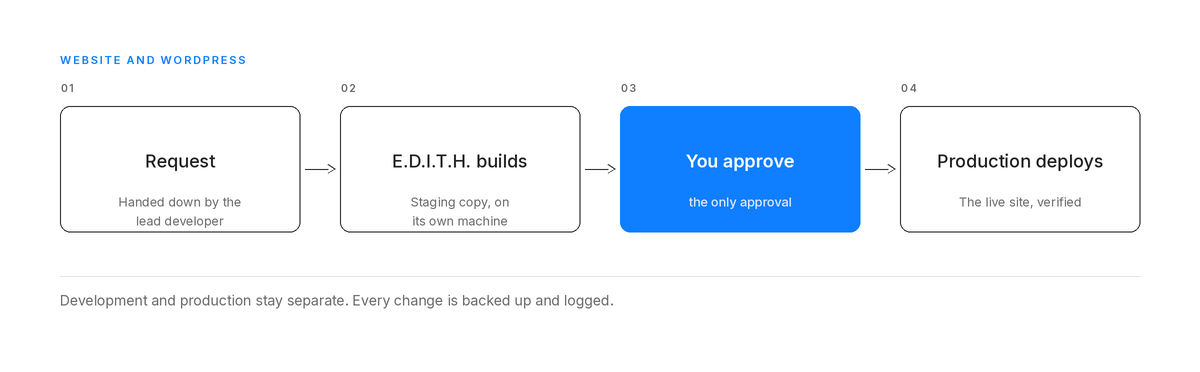
A request comes in, the lead developer hands it down, E.D.I.T.H. builds it on staging, and it waits for him. He approves, a production agent puts it live. The result is almost boring in the telling. "What would normally take weeks of development now takes 20 minutes."
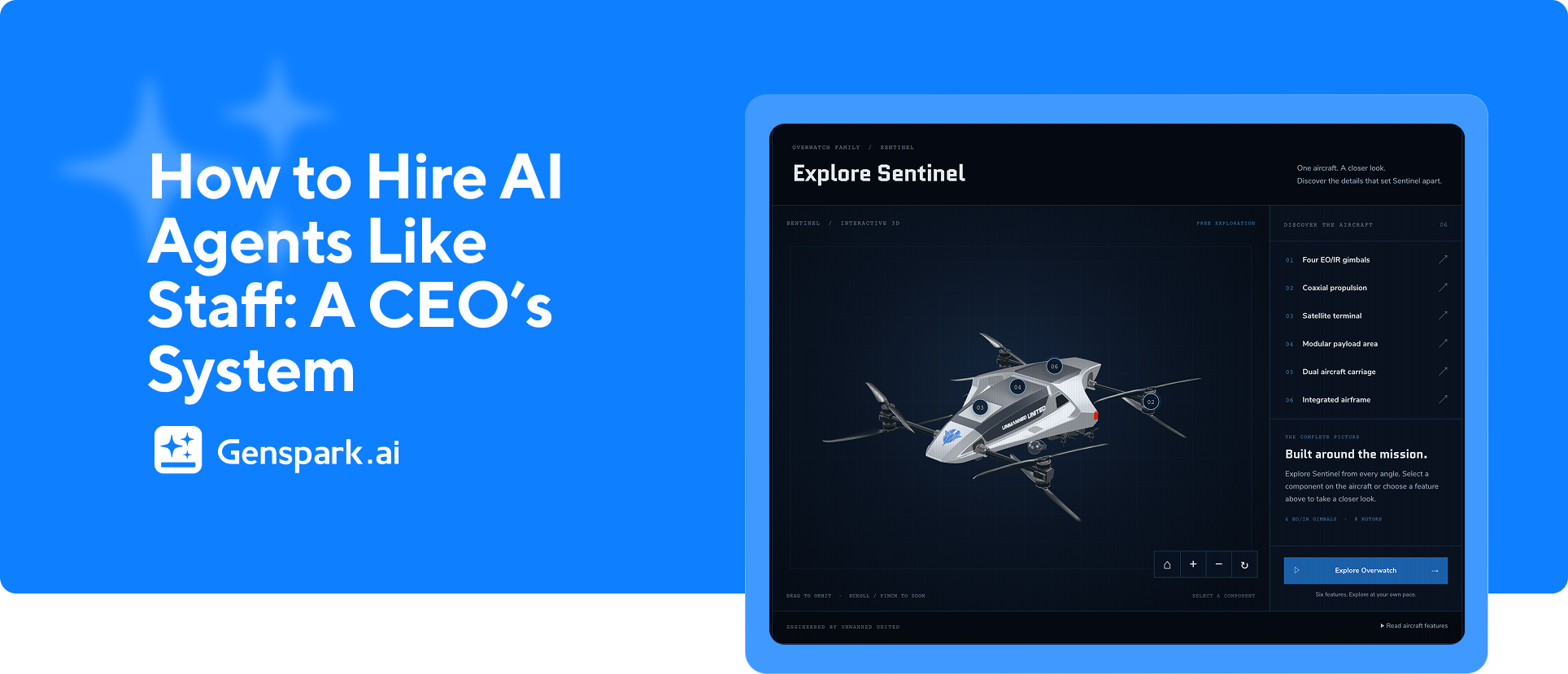
You can see what that buys on his product page, where a rotatable 3D model of the aircraft sits in the browser with clickable callouts that explain what each part does. "I could easily see the company spending $10,000 and a month of development just to create something like that, and maybe not even get it right."
The agents got it right on the first attempt, with no fixes. He pushed it live without ever watching it happen; Friday drove Blender in the background while he was doing something else.
Small changes stopped being events too. A news release, a video, a line of text: work that used to run through a content management system, with days or weeks between the request and the change. Now he tells the staging agent what changed, reads it, approves it.
What a drone company hands to its agents
The website is how you can check his story. The engineering is what makes it a story.
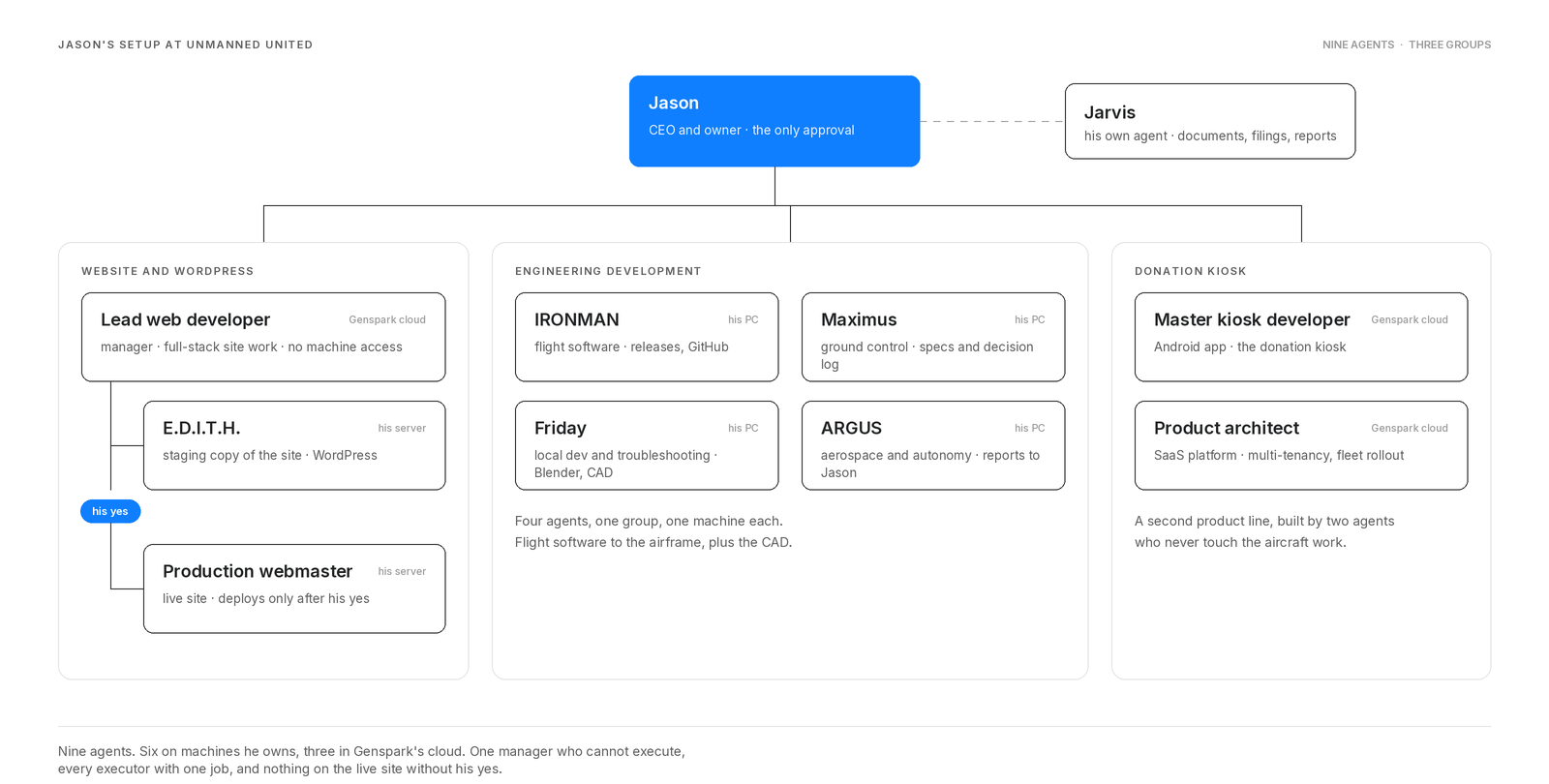
Jason Braverman's setup at Unmanned United: nine agents, three groups, and one person who approves. Six run on machines he owns; three run in Genspark's cloud.
After the web group held, Braverman built a second group, Unmanned United Engineering Development. Four agents: one on flight software, one on ground control, one on CAD and local troubleshooting, one on the airframe and its autonomy. They make useful changes daily.
"Most of my day now is with the engineering group," he says. "I will forget to eat because I'm in a nonstop communication with agents that don't consume food." They work around the clock, and the loop is fast enough that he stays in it all day: work he used to supervise now happens with him in the room.
Then there is IT, where the problems are the ugly ones: an onboard computer that will not take a configuration, a router that drops, a VPN that half works.
Before, somebody posted on Reddit or Stack Overflow and waited, and sometimes the company bought new hardware to route around a problem nobody could solve.
Now an agent gets SSH access to the machine and a defined problem. "Nine times out of ten, the agent solves the problem in the first ten minutes." Then it writes up how the problem happened, how to prevent it, and a standard operating procedure for next time.
The fix is the small part. The written SOP is the part that compounds.
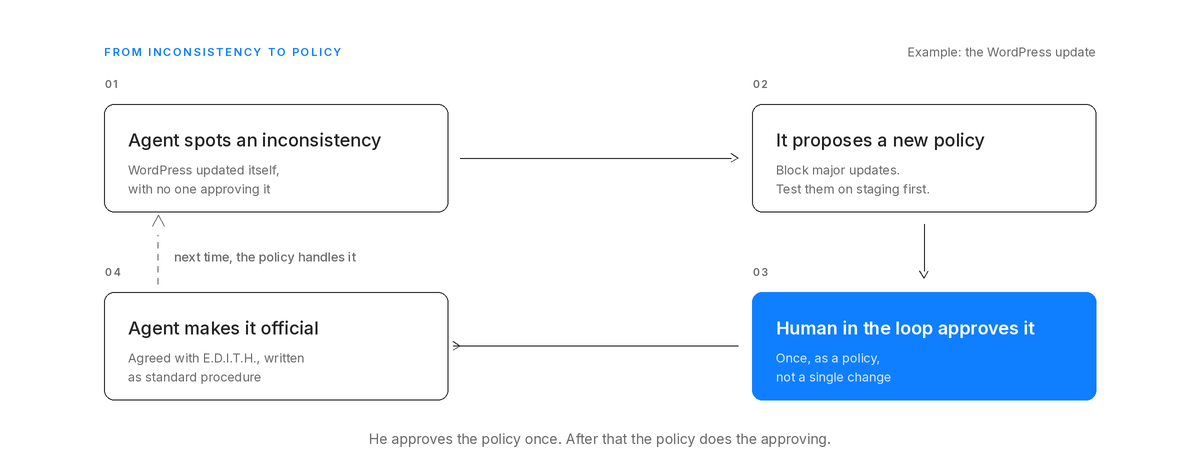
That is one habit at one company, and it keeps spreading. The latest: the production agent noticed that WordPress had updated itself on its own, and suggested blocking major releases and testing them on staging first. Braverman agreed and told it to settle the rule with E.D.I.T.H. They did. He approved it once, as a policy rather than a change, and the policy now runs without him.
There is one last group: the Donation Kiosk team, which runs his philanthropic project. It is charity work: the company donates its engineering. A local religious organization wanted to collect payments from a tablet. His team built them something custom instead, donated it, and maintains it for free.
Two agents keep it running from Genspark's cloud: the Android app on the kiosk, and the platform behind it that takes payments and rolls a new kiosk out across a fleet. Nine agents in all, spread across the website, the aircraft, and one piece of charity work.
The skill that makes it work: describing the work
The difference between an agent that saves you a week and one that wastes your afternoon is almost never the model. It is the brief.
In his own group, the agents once ran 334 checks on a single piece of work before he told them to stop. "Next time you don't have to go through so many checks. That's what I'm here for." Clear brief, clear reviewer: the agent stops trying to be perfect alone, because it knows you are the last step.
Three habits carry most of it.
Write more than feels natural. He asks every engineer with an idea to write it up, one page, and send it over. The page is the brief. Strong engineers who write thin pages get thin results.
Number the requirements. One, two, three, four, five. Say exactly how you want the result presented. A spec the agent can count is a spec it can meet.
Judge the answer. This is the skill, and the one nobody practices. Ask a model "what can you improve?" and it will find you 20 or 30 things to change, even when the work is already good, because it would rather have a view than say nothing.
Why context matters more than the model
At an AI conference in Dubai, someone asked him the question that follows this technology everywhere. His answer has not changed.
"AI is not there to take your job. It's there to enhance what you're already doing."
An agent can only be as careful as the world you let it live in. Jarvis knew Patrick because Braverman had given it years of documents, analyses, reports, and Slack threads, and let it work next to the people it was learning about. He has built about eight versions of Jarvis since. The first one is still the best.
He has given each one a personality and asked them to talk to him the way Jarvis talks to Tony Stark. "As a human, it makes me feel better to communicate with someone that's not just robotic and sterile." Which is why you can find him telling a group of agents that he has to go eat, because he is human. They give him a hard time. Then they keep working.
Build your own system in five moves
You do not need a drone company or 25 years in machine learning. You need one job you can describe and a process you are willing to enforce.
-
Write the brief. The three lines above: what the role owns, how it should think, what it is accountable for. This is the step people skip, and it decides whether the rest works.
-
Write the rules. Start with his five, then add the ones your business needs. The rules are what let you leave the agent alone.
-
Put a gate between the agent and anything you care about. Staging before production, a draft before a send, a preview before a publish. One person opens it, and it is you.
-
Hire the executors your manager cannot be. One agent per real job: the website, the IT queue, the analysis work. Give each a scope, then introduce them so work can pass between them.
-
Stay in the loop. Read what comes back every day. The reviewing is the job. Everything else is faster than it used to be.
Start with the job that annoys you most. His was a website he had been paying other people to build, and it took him about a week to get to something he was willing to publish.
FAQ
What does it mean to hire an AI agent?
Giving one agent a defined job, a set of rules, and a review step, the way you would a person. In GenTeam you describe the role, hire the agent into it, and set its limits. The job, not the conversation, is the unit of work.
How do you write a job description for an AI agent?
The one you would write for a human hire: what the role owns, how it should think, what it is accountable for. Braverman wrote the lead web developer he would have hired, and that became the agent's scope.
How do you stop an AI agent from shipping changes you did not approve?
Put a staging step between the agent and production, and keep the final approval. Every request runs on a staging copy, gets checked by a staging agent, then waits for a human yes. His version also requires change logs and a GitHub backup of everything the agents write.
What should I hand an agent first?
Something recurring, with a clear output and a review step. His first three: a website he was paying an agency for, an IT queue of small ugly problems, and engineering documentation. He could tell whether each result was right.
Can AI agents do real engineering work?
They can carry parts of it. His agents work daily on software and hardware problems for aircraft, including finite element and aerodynamic analysis, and clear most IT problems in ten minutes. He still owns the review and the judgment.